1. Introduction: The Ghost in the Machine
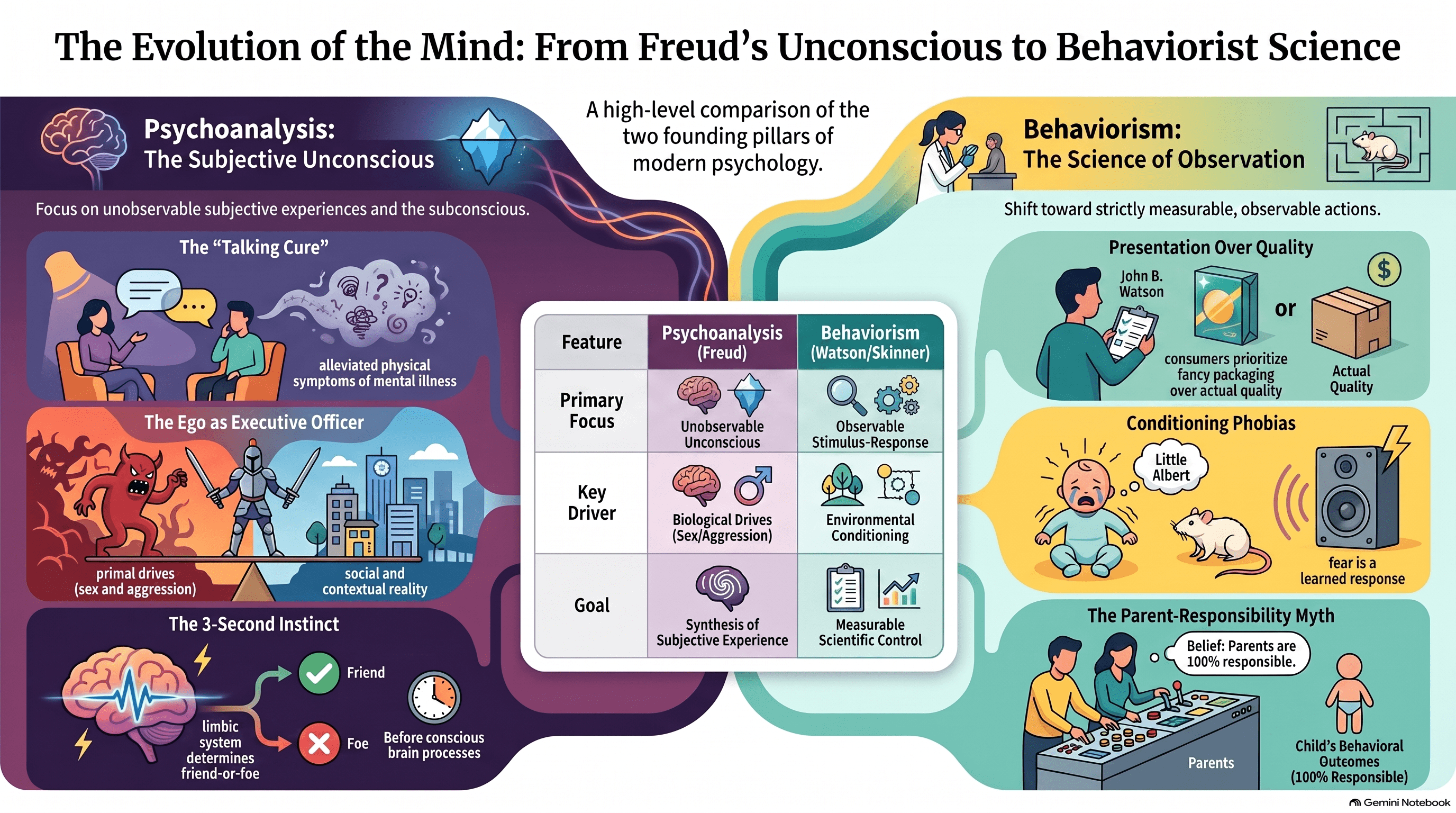
Are your thoughts truly your own, or are you merely a passenger in a vehicle driven by hidden historical biases and biological impulses? For centuries, humans have tried to understand the “ghost in the machine”—the subjective mind that governs our behavior. Historically, the study of the mind has swung like a pendulum between two extremes. We began with a “thesis” built on unobservable, often strange theories of the unconscious, before swinging toward a rigid “antithesis” known as behaviorism, which sought to eliminate subjective experience entirely in favor of measurable data.
As we transition from abstract philosophy to the modern “science” of psychology, we find that many of our daily behaviors are rooted in these older, counter-intuitive ideas. By exploring these origins, we can search for a synthesis: a way to understand ourselves that respects both our subjective reality and the biological triggers we often ignore.
2. The “Wandering Womb” and the Hidden History of Hysteria
Many of our common words carry heavy historical baggage that reflects deep-seated biases. Take the word “hysteria.” It shares the Greek etymological root hyster- with the word “hysterectomy,” referring to the female reproductive system. In the early days of medicine, it was believed that emotional outbursts and manic behavior in women were caused by a “wandering womb” physically moving around the body and creating chaos.
This diagnosis was a masterclass in gender bias. If a man had an emotional outburst, it was “rationalized” as a logical response to a situation. If a woman did the same, she was medicalized. This historical quirk is actually embedded in our modern vocabulary. Because of this etymological link, if you call someone “hilarious,” you are literally—in historical terms—suggesting they have a funny womb. Despite these ancient myths, objective studies from the mid-20th century proved that the symptoms once labeled as “hysteria” actually present themselves with equal frequency in both men and women.
Something to think about next time you see someone hilarious.
3. The “Talking Cure” was a Patient’s Discovery
It is a striking irony that the foundation of the multibillion-dollar modern therapy industry was not a medical discovery made by a doctor, but an observation made by a patient. While seeking treatment from Josef Breuer and Sigmund Freud, a female client effectively had to tell her doctors they were doing it wrong. She pointed out that she hadn’t been prescribed any effective medicine; rather, she realized that simply coming to the office and “talking” caused her symptoms to vanish for weeks at a time.
Breuer and Freud labeled this the “talking cure.” This patient-led breakthrough evolved into psychoanalysis, which serves as the direct ancestor of all modern Western counseling. The very idea that conversation can be medicine didn’t come from a clinical trial; it came from a patient identifying what actually worked while the “experts” were still looking for physical causes.
4. Why Your Diet Advice Might Be “Freudian,” Not Scientific
Sigmund Freud’s theory of “oral fixation” continues to exert a powerful, often invisible influence on how we judge health and weight. Freud theorized that if an infant fails to overcome the instinctual oral phase (such as breastfeeding), they become “orally fixated,” leading to a lifelong lack of self-control regarding consumption. Freud was so convinced of this that he even applied it to himself; he believed his own “oral fixation”—a lifelong, multi-cigar-a-day habit—was the reason he eventually died of agonizing jaw cancer.
This Freudian archetype is the primary driver of the modern medical advice that obesity is strictly a result of overconsumption and a lack of willpower. However, when you look at the actual data, this narrative falls apart. Statistically, overweight individuals do not necessarily consume more calories than underweight individuals. When we ignore this data to focus on “lack of control,” we aren’t being scientific; we are simply recycling 19th-century Freudian judgments.
When you think of someone being overweight because they consume too much, you’re being Freudian, not scientific.
5. The 3-Second Rule: Your Brain Decides Before “You” Do
The myth of conscious free will is challenged by the way your “reptilian brain”—the limbic system—processes the world. Information from every single one of your senses, with the notable exception of smell, reaches the limbic system first. This area prepares you for an emotional or physical response seconds before that same information ever reaches the conscious, thinking parts of your frontal cortex.
Imagine someone insults you. Your heart races and your fists clench instantly. This is your limbic system preparing for “fight or flight.” It is only a few seconds later that your frontal cortex provides an “inhibitory response,” allowing you to realize that hitting them would get you fired. This “unconscious-to-conscious loop” dominates our social lives. Research shows that your physiology decides whether you will “approach” or “withdraw” from a new person—effectively deciding if they are a friend or a foe—within the first 2 to 3 seconds of meeting them, long before you “get to know” them.
6. The iPhone Box Effect: How Psychology Invented Modern Marketing
John B. Watson, the father of behaviorism, famously claimed he could shape any human being if given enough control. He once boasted, “Give me your child and I will make them into whoever you want,” believing that we are all just a collection of responses to external stimuli. When he moved from the laboratory to the advertising world, he applied this extreme view to how we shop, realizing that consumers respond to the stimulus (the packaging) rather than the substance (the product).
Watson proved this with a coffee experiment: he placed the same mediocre coffee in a fancy, high-end container and a plain one. Participants swore the coffee in the fancy box was superior. This is why Apple spends millions on the “iPhone box” experience; the presentation creates a perceived value that has nothing to do with the silicon inside. It’s also why many people insist Kraft Macaroni & Cheese is better than the generic brand, even though both often come from the exact same factory. We aren’t buying the quality; we are responding to the box.
7. The Pigeon Bomb and the Paradox of Human Values
B.F. Skinner, another titan of behaviorism, once attempted to solve the problem of inaccurate “carpet bombing” during war by creating the first precision-guided weapon: the pigeon bomb. He trained pigeons to peck at aerial photographs, using their movements to guide a bomb toward a specific target.
The technology worked, but it was never deployed. Why? Because the public was horrified by the “sacrifice” of the pigeons. This created a staggering historical paradox: the ethical outcry over the lives of a few birds prevented the use of a technology that could have saved millions of innocent human lives by ending the era of imprecise carpet bombing. We are a species that will agonize over a bird while allowing millions to perish in the crossfire of inaccurate weaponry.
Human values will save a pigeon, but not millions of people.
8. Conclusion: Synthesis and the Path Forward
The story of psychology is the story of a pendulum. We have moved from Freud’s unobservable, subjective drives to Watson and Skinner’s rigid, “mindless” behaviorism. Today, we are tasked with finding a synthesis—recognizing that while we are shaped by our biology and our environment, our subjective experience still matters.
Ultimately, we must ask ourselves: are we truly the “executive officers” of our lives, or are we merely responding to a complex web of unconscious drives and external conditioning? Understanding these psychological roots doesn’t just explain our history; it provides the tools we need to recognize when our choices are being made for us before we even realize it. We may not be in total control, but by understanding the machine, we might finally stop being its ghost.
Leave a Reply