
By: Dr. Curtis Peterson
Human identity does not develop in isolation. Individuals construct their sense of self within networks of belonging that provide meaning, recognition, and social validation. While psychological theories have traditionally emphasized internal cognitive processes in identity formation, emerging perspectives increasingly recognize that identity is deeply embedded within social ecosystems. The Identity Ecology Model proposes that identity development occurs through the interaction of multiple belonging systems that operate at different levels of social organization.
Within this framework, individuals navigate three primary ecological layers: proximal identity systems such as family and close relationships, intermediate systems such as educational institutions and workplaces, and distal cultural systems that include media narratives, ideological movements, and national identity frameworks. These systems generate identity signals—normative expectations about roles, values, and social belonging.
When these signals align, identity development tends to produce coherence and stability. However, when signals conflict across systems, individuals may experience what this model conceptualizes as identity cross-pressure. Identity cross-pressure occurs when competing expectations from different belonging systems produce tension within the individual’s developing self-concept. This tension may lead to identity strain, migration toward alternative communities, or fragmentation of social belonging.
In contemporary societies undergoing rapid cultural, economic, and technological change, identity cross-pressure appears to be increasingly common. This article examines how cross-pressure emerges within modern belonging ecosystems and explores its implications for identity development, particularly among men navigating shifting social roles.
Belonging as the Foundation of Identity Development
Most psychological frameworks treat belonging as a secondary motivational need that supports other cognitive or affective processes. For example, several social motivation models conceptualize belonging primarily as a psychological desire for interpersonal connection. While these approaches capture important aspects of human social behavior, they may underestimate the structural role belonging plays in identity formation.
The Identity Ecology Model proposes that belonging is not simply a need individuals seek to satisfy but rather an environmental condition in which identity develops. Individuals do not construct identity independently and then seek belonging; instead, identity emerges through participation in communities that recognize and validate particular roles and identities.
Belonging systems therefore function as identity environments. These environments communicate expectations regarding behavior, responsibility, and social status. When individuals are embedded in stable belonging systems, these signals provide coherence and direction for identity development.
Identity Signaling Across Social Systems
Conversely, when belonging environments weaken or send conflicting signals, identity development becomes more uncertain. The resulting tensions form the basis of identity cross-pressure.
Within the Identity Ecology Model, social systems communicate identity expectations through a process referred to as identity signaling. Identity signals are implicit and explicit messages that inform individuals about who they are expected to be within a particular social context.
Different systems transmit these signals in different ways:
Proximal systems such as families and peer networks transmit identity signals through daily interaction, cultural norms, and emotional reinforcement. These signals often define foundational aspects of identity including gender roles, moral expectations, and relational responsibilities.
Intermediate systems such as schools, workplaces, and religious institutions transmit signals through institutional norms and role structures. These systems often define pathways to adulthood, professional identity, and social participation.
Distal systems such as media narratives, political discourse, and digital communities communicate broader cultural expectations regarding identity, success, and belonging.
Under stable social conditions, these signals often reinforce one another. However, in periods of rapid cultural transformation, signals across these systems may diverge significantly.
Identity Cross-Pressure
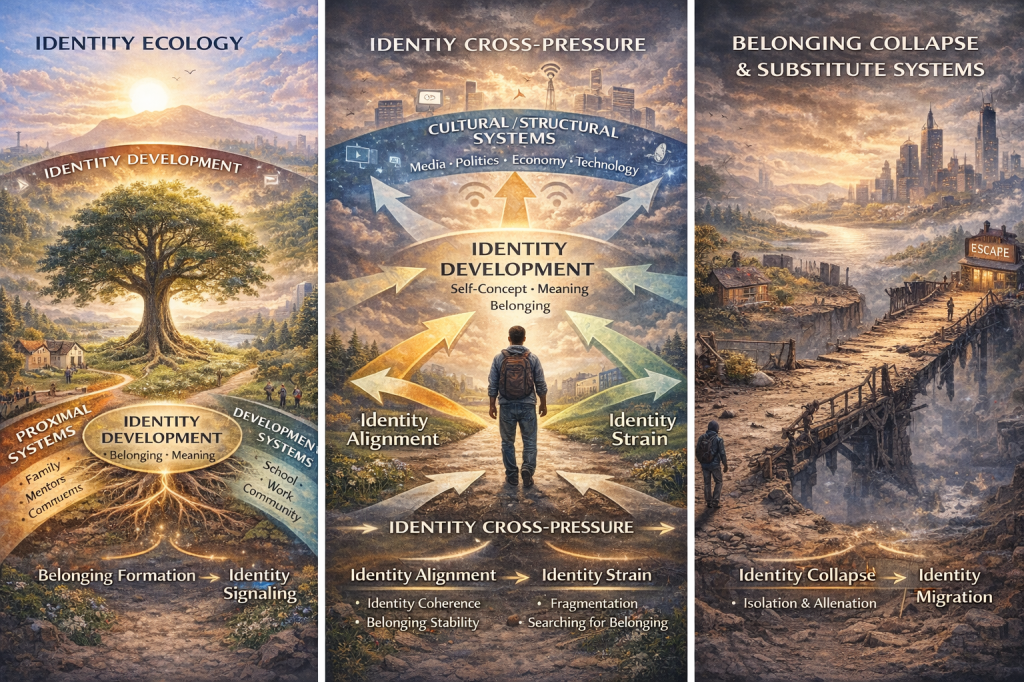
Identity cross-pressure emerges when individuals receive conflicting identity signals from multiple ecological systems simultaneously. Rather than providing coherent guidance for identity development, social systems begin to communicate competing expectations.
For example, a young adult may receive one set of expectations regarding masculinity from family and community traditions while encountering different expectations within educational institutions or media narratives. At the same time, economic conditions may reshape the practical roles available to them in work and family life.
These overlapping signals can produce a condition of identity tension in which individuals struggle to reconcile incompatible definitions of who they are expected to be.
The concept of identity cross-pressure expands upon earlier sociological theories that examined individuals positioned between competing social identities or ideological frameworks. However, the ecological perspective emphasizes that these pressures are not limited to political identity but may occur across multiple domains of life including gender roles, occupational identity, and community belonging.
Transitional Identity and Developmental Change
Identity cross-pressure is particularly common during periods of developmental transition. Throughout the lifespan, individuals move through a series of transitional identities such as student, professional, parent, and elder. Each transition involves entry into new belonging environments and the renegotiation of identity expectations.
Successful developmental transitions typically occur when new belonging systems provide clear signals that support emerging identity roles. However, when transitional systems are unstable or contradictory, individuals may experience prolonged uncertainty regarding their place within social structures.
In contemporary societies where traditional life pathways have become less predictable, transitional identities may persist for longer periods. Extended education, delayed family formation, and shifting labor markets all contribute to prolonged phases of identity negotiation.
These conditions increase the likelihood that individuals will experience identity cross-pressure as they attempt to integrate signals from multiple systems.
The Empty Porch and the Rise of Substitute Belonging Systems
One observable consequence of identity cross-pressure is the emergence of substitute belonging systems. When traditional belonging environments weaken or fail to provide recognition, individuals often seek alternative communities that offer identity validation.
One illustrative example is the transformation of informal neighborhood social life. In previous generations, community interaction often occurred through spontaneous face-to-face gatherings in local neighborhoods. The metaphor of the “empty porch” captures the gradual disappearance of these informal spaces of belonging.
As local community interaction declined, many individuals began to seek belonging in digital environments. Online gaming communities, social media groups, and virtual forums now function as substitute spaces where individuals can experience identity recognition and social validation.
These communities can provide meaningful connection, but they may also reinforce identity narratives that diverge significantly from those present in an individual’s immediate social environment. When substitute systems amplify certain identity signals while rejecting others, identity cross-pressure may intensify.
The Intergenerational Identity Sandwich
The experience of identity cross-pressure appears particularly pronounced among men navigating contemporary social change. Many men today occupy what might be described as an intergenerational identity sandwich.
On one side are traditional expectations inherited from earlier generations that emphasize roles such as provider, protector, and authority figure within the family structure. These expectations are often transmitted through proximal systems including family traditions and community norms.
On the other side are evolving cultural expectations surrounding relationships, emotional expression, and gender equality. These signals are often transmitted through institutions, media narratives, and broader cultural discourse.
Men positioned between these competing expectations may experience uncertainty regarding how to integrate traditional identity roles with contemporary social norms. When economic and institutional changes simultaneously reshape the pathways through which traditional roles were historically achieved, the resulting identity cross-pressure can become particularly intense.
Importantly, the ecological perspective emphasizes that these tensions should not be interpreted as simple opposition between men and women or between traditional and modern values. Rather, they reflect the broader transformation of belonging systems within contemporary societies.
Identity Migration and the Search for Belonging
When identity cross-pressure becomes severe, individuals may seek relief by migrating toward communities that provide clearer identity validation. This process, referred to as identity migration, involves shifting one’s primary sense of belonging from one ecological system to another.
Identity migration may occur in many directions. Some individuals move toward digital communities that provide recognition unavailable in their local environment. Others gravitate toward ideological movements that offer strong narratives of identity and belonging.
These movements can be politically diverse and ideologically varied. What they often share is the ability to provide a clear identity framework and a sense of community recognition that individuals may feel is missing from other belonging systems.
Understanding identity migration requires recognizing that individuals are often motivated less by ideology itself than by the search for stable belonging environments.
Integrating Identity Systems
The Identity Ecology Model suggests that identity stability depends on the alignment of signals across multiple belonging systems. When proximal relationships, institutional roles, and cultural narratives reinforce compatible expectations, individuals are more likely to experience identity coherence.
Conversely, when signals diverge across systems, identity cross-pressure increases and individuals may seek alternative belonging environments that offer clearer validation.
Addressing identity cross-pressure therefore requires more than individual psychological intervention. It involves strengthening the social environments that support belonging across different levels of society.
Conclusion
Identity development occurs within complex ecological systems of belonging that operate across multiple levels of social organization. The Identity Ecology Model provides a framework for understanding how identity signals transmitted through these systems shape individual self-concept and social participation.
In periods of social stability, identity signals across systems often align to produce coherent pathways for identity development. However, during periods of rapid cultural transformation, conflicting signals may generate identity cross-pressure that challenges individuals’ ability to integrate competing expectations.
Understanding identity cross-pressure provides insight into a wide range of contemporary social phenomena, including the rise of substitute communities, the transformation of gender roles, and the increasing fragmentation of social belonging.
In future articles we will explore how this model can used to develop identity coherence which can lead to a more stable and healthy life.
 Identity, Social Connection, and Loneliness
Leave a comment