
By: Dr. Curtis Peterson
In previous article titled “Rebuilding Belonging in an Age of Disconnection”, I argued that the crisis of loneliness we are witnessing—especially among men and young adults—is not merely emotional. It is existential. It reflects a weakening of identity coherence in a society that no longer reliably provides stable relational anchors. But that internal crisis did not emerge in isolation. It developed alongside a quieter, slower transformation: the erosion of community.
As I was writing this from my front porch in decades past, porches were social architecture. They were semi-public spaces where identity was rehearsed and reinforced through small, repeated interactions. You knew who lived next door. You recognized patterns of life—who left early for work, who watered their plants at dusk, who sat outside with coffee. These rhythms provided more than familiarity. They created belonging.
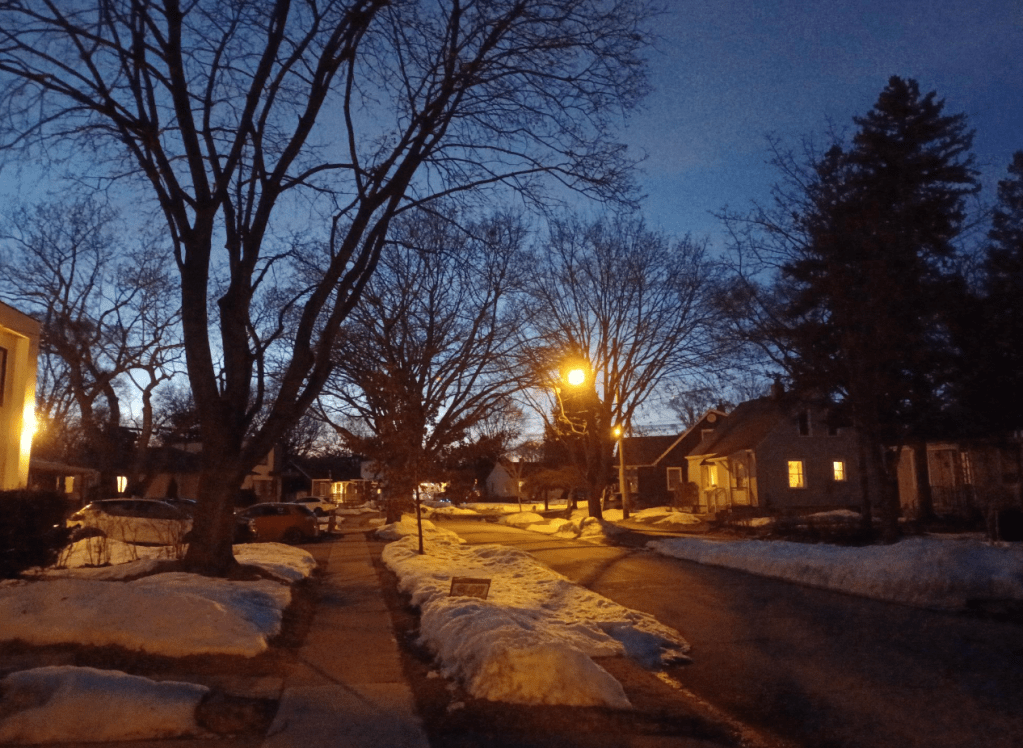
Now, most evenings, it feels as though we live in an abandoned neighborhood.
My wife Elsa and I spend many of our evenings outside. Across the street, one neighbor occasionally emerges. But in the four houses closest to us, the pattern is predictable: men go directly inside after work and disappear into video games until bedtime; women focus on cleaning and caring for children. This is not speculation; this is what they themselves describe as their nightly routine. There is no hostility. There is simply absence. Lights on. Doors closed. Silence.

This small scene mirrors a national pattern. Sociologist Robert Putnam documented decades ago in Bowling Alone that participation in civic groups, neighborhood organizations, and shared social activities had been steadily declining since the mid-20th century. Americans were still “bowling,” but they were doing so alone rather than in leagues. Social capital—our networks of trust, reciprocity, and mutual recognition—was thinning.
More recent national surveys reinforce this trajectory. The share of Americans who report having no close friends has increased significantly over the past several decades. Time spent socializing face-to-face has declined. Trust in neighbors and institutions has weakened. The U.S. Surgeon General has formally identified loneliness and social isolation as a public health crisis, linking chronic disconnection to increased risk of depression, cardiovascular disease, and early mortality.
But statistics only capture the surface. The deeper issue is structural: we have lost the “in-between” spaces of life. Sociologist Ray Oldenburg described these gathering points as “third places” locations beyond home and work where relationships form through repeated, low-pressure interaction. Coffee shops, front porches, community centers, barbershops, bowling leagues, neighborhood churches. These spaces once provided steady feedback loops through which identity stabilized. You were known. You were seen. You were remembered. Without those spaces, identity becomes more fragile.
In “Rebuilding Belonging in an Age of Disconnection”, I argued that loneliness is not simply the absence of company. It is the absence of relational mirrors. Identity is not formed internally and then expressed socially; it is co-constructed. We become who we are through repeated interactions in which others reflect back competence, belonging, and significance. When community infrastructure erodes, those mirrors disappear.
The consequences are visible in contemporary life. Consider the rise of what journalists have called the “friendship recession.” Many adults report shrinking social networks and fewer confidants. During and after the COVID-19 pandemic, remote work normalized physical withdrawal from shared environments. Men in particular report fewer close friendships than previous generations. Young adults spend more time online and less time in unstructured in-person interaction. Digital connectivity has expanded, but embodied presence has contracted.
We now live in neighborhoods filled with houses but empty of interaction. This erosion does not necessarily look dramatic. It looks ordinary. It looks like predictable routines: work, screen, sleep. It looks like evenings without spontaneous conversation. It looks like children playing in backyards but rarely roaming across shared spaces. It looks like men retreating into solitary digital environments that simulate competition and connection without requiring vulnerability. It looks like women carrying disproportionate domestic labor without broader communal support.
It looks like silence.
The identity consequences of this shift are profound. When individuals lack stable community reinforcement, identity must be constructed through more abstract or polarized means. Political tribes become stronger. Online subcultures become identity anchors. Ideological affiliation replaces local belonging. The “crisis of men” discussed in “Rebuilding Belonging in an Age of Disconnection” characterized by isolation, loss of purpose, and fragile masculinity—cannot be separated from this structural thinning of everyday community. Nor can the broader rise in anxiety, depression, and social distrust.
When people are not known locally, they seek recognition elsewhere.
And yet, sitting on this porch, the solution does not appear grand or institutional. It appears relational. It appears architectural. It appears simple and radical at the same time: proximity, repetition, and presence.
The loss of community is not merely nostalgic sentimentality for a bygone era. It is an identity issue. When neighborhoods go quiet, the self grows unstable. When the porch light stays on but no one steps outside, the social fabric frays—not with conflict, but with absence.
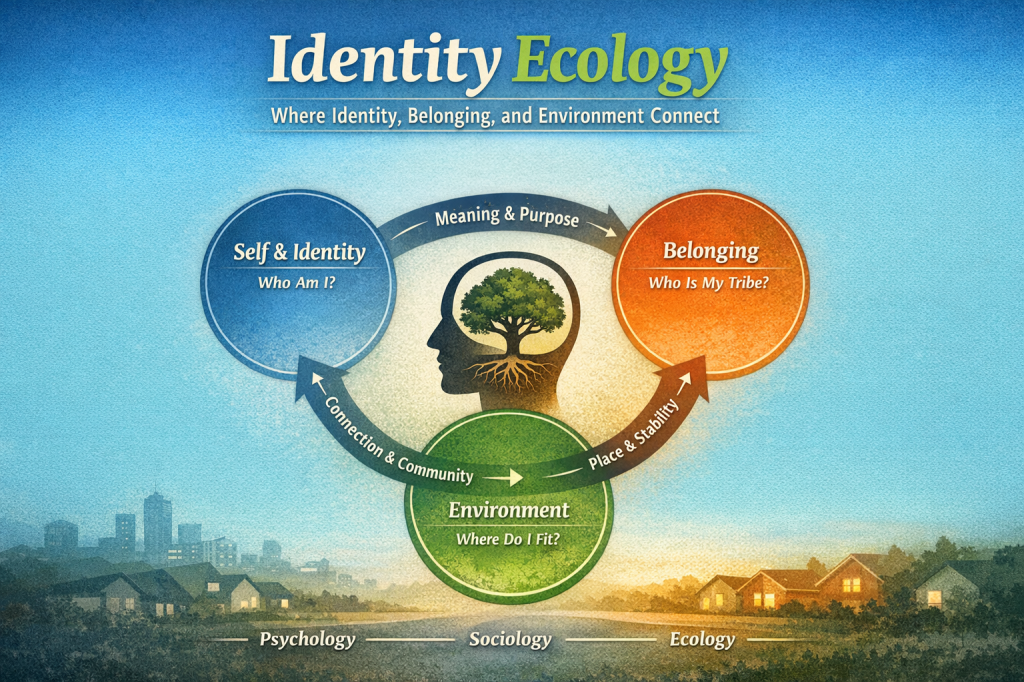
“Rebuilding Belonging in an Age of Disconnection” diagnosed the crisis of belonging as an identity fracture. This article argues that fracture is amplified by the collapse of everyday social infrastructure. Loneliness is not just psychological; it is ecological. Identity is not just internal; it is communal.
And perhaps the first act of repair begins with something as simple as staying on the porch a little longer.

What would repair actually look like?
We cannot rebuild mid-century civic culture by nostalgia alone. Nor can we expect digital networks to substitute for embodied presence. The work ahead is not about returning to an imagined past but about designing new relational ecologies that restore stable mirrors of identity.
Community does not regenerate accidentally. It is cultivated through structure, ritual, proximity, and intentional spaces of recognition. If loneliness is ecological, then belonging must be ecological as well. It must be embedded in neighborhoods, workplaces, campuses, congregations, and shared civic rhythms.
In the next article, I will move from diagnosis to design outlining practical, relational, and institutional strategies for rebuilding identity-supportive environments. The task is not simply to reduce loneliness. It is to restore conditions under which people can become known again.
Because identity does not stabilize in isolation.
It stabilizes in community.
 Identity, Social Connection, and Loneliness
Leave a comment