To fully comprehend the architectures of human behavior, we must trace their blueprints back to the deep evolutionary history of our species. While psychology spans a diverse array of clinical, cultural, and cognitive frameworks, it finds its foundational materialist anchor in Evolutionary Theory, pioneered by Charles Darwin. The core mechanics of human cognition were not forged in a vacuum; they were sculpted over millions of years by the unrelenting pressures of survival and reproduction. However, the true nature of human evolutionary success is frequently misunderstood, clouded by historical distortions that favor raw individualism and physical dominance.
When viewed through a strictly biological lens, the human animal is remarkably fragile. We possess no natural body armor, no predatory talons, and no remarkable physical velocity. Stripped of community, an isolated human on the Pleistocene savanna was an easy target for apex predators. Our primary biological survival adaptation is not physical might, but our oversized social brain. This chapter explores the social brain hypothesis, examining how the evolutionary forces of natural and sexual selection co-opted our neural architecture—not to turn us into solitary logicians solving abstract equations, but to engineer us as deeply cooperative, highly communicative, and profoundly interconnected tribal beings.
Learning Outcomes
- Explain the principles of natural selection and sexual selection by describing how evolutionary processes have influenced the development of human behavior, cognition, and social relationships.
- Analyze the evolution of the human social brain by explaining how language, cooperation, identity, empathy, and group membership contributed to human survival and adaptation.
- Differentiate between common misconceptions and scientific evidence regarding evolutionary theory, including the historical misuse of the phrase “survival of the fittest” and its distinction from Darwin’s theory of natural selection.
- Evaluate the evolutionary functions of human social behavior by examining how attachment, pair bonding, and cooperative parenting contributed to reproductive success and offspring survival.
- Apply principles of evolutionary psychology to interpret contemporary human behavior, including social relationships, cooperation, group identity, and interpersonal bonding, while recognizing the interaction between biological evolution and environmental influences.
Natural Selection and the Materialist Re-Frame
Charles Darwin’s landmark publication, On the Origin of Species (1859), fundamentally revolutionized the scientific community by introducing the theory of evolution by natural selection. Darwin proposed that all species of life have descended over time from common ancestors through a continuous, branching pattern of diversification. The core engine driving this change is natural selection, a process built upon three baseline facts of nature: phenotypic variation exists among individuals, these variations are at least partially heritable, and organisms produce more offspring than the environment can support, creating a perpetual struggle for existence. Within this struggle, individuals possessing traits better suited to their immediate environment are mathematically more likely to survive and successfully pass those traits on to the next generation.
The mechanism of natural selection acts as a passive filter over vast stretches of time, systematically shaping the anatomical, physiological, and behavioral profiles of organisms. Environmental pressures—such as resource scarcity, changing climates, predators, and disease—determine which specific variations provide a survival or reproductive advantage. Traits that enhance an organism’s relative fitness become increasingly prevalent in subsequent generations, while disadvantageous variations are gradually phased out of the gene pool. Through this continuous process of adaptation, species dynamically evolve complex biological structures, transforming what was once armchair speculation about the history of life into a rigorous, empirically verifiable natural science.
In the late nineteenth and early twentieth centuries, Darwin’s evolutionary framework profoundly altered the trajectory of psychological science by reshaping how researchers conceptualized human consciousness and somatic output. Early psychologists, most notably William James and the architects of the school of Functionalism, moved away from structuralist attempts to merely dissect and catalog the static pieces of the mind. Influenced heavily by Darwin, the functionalists argued that human consciousness, memory storage systems, and baseline emotional states did not emerge by historical accident. Instead, they investigated the explicit adaptive function of behavior, asserting that internal cognitive operations evolved precisely because they served a utilitarian purpose that helped the organism effectively adapt to, navigate, and survive environmental challenges.
Today, the legacy of natural selection continues to operate as a powerful unifying pillar within modern psychology, primarily through the contemporary sub-discipline of Evolutionary Psychology. This perspective applies the principles of evolutionary biology to map the functional architecture of the human mind, viewing covert cognitive operations, behavioral patterns, and implicit attitudes as evolved adaptations. Psychological mechanisms—such as ancestral fear responses, mate selection criteria, language acquisition modules, and kinship cooperation—are analyzed as downstream products designed by natural selection to solve specific survival and reproductive problems faced by our forebears. By tethering human behavior to these deep biological roots, the theory provides psychology with a cohesive baseline framework to scientifically interpret the complex theater of human nature.
To bridge the gap between these diverse global philosophies, modern psychology relies heavily on Evolutionary Theory, pioneered by Charles Darwin in his landmark text, On the Origin of Species.

Darwin systematically demonstrated the law of natural selection—the process by which organisms possessing physical or behavioral traits best suited to the demands of their local environment are more likely to survive, reproduce, and pass those adaptive traits down to their offspring.
Note: I want to clarify a massive historical misconception. Charles Darwin never coined the phrase “survival of the fittest”. That term was manufactured by later sociologists to justify ruthless social engineering, corporate monopolies, and the horrific Eugenics movement—a movement that led to the forced sterilization of thousands of marginalized, poor, and mentally ill individuals right here in America. Darwin would have vehemently disagreed with that cold philosophy.
When we apply natural selection to human psychology, we look for our primary evolutionary survival adaptations. Humans are physically fragile—we lack sharp claws, thick fur, or massive speed. Our supreme biological adaptations are our capacity for complex language and our oversized social brains.
For centuries, anatomists assumed that humans evolved an oversized frontal cortex purely to execute abstract logic, mathematics, and architectural engineering. However, decades of modern neuroimaging have revealed a completely different story.
If you were to flatten out your entire frontal cortex onto a standard sheet of paper, the area dedicated strictly to pure logic and mathematical computation would equal the size of a quarter. The remaining space on that paper is dedicated entirely to navigating the immense complexity of social living.
It is the architecture where your personal identity sits, where you track your loyalty to your tribe, where you process empathy, and where you calculate the emotional states of your partners and children. We did not evolve large brains to solve algebra; we evolved large brains to keep ourselves securely connected to our tribe, because for a human being, isolation equals death.
Sexual Selection and Bonding Mechanisms
In his later text, The Descent of Man, Darwin introduced sexual selection—the principle that certain traits evolve because they provide a distinct advantage in attracting a mate and securing reproduction. In human evolution, sexuality evolved to serve primarily as a powerful, neurological bonding mechanism first, and a reproductive tool second.
We see this in our biological traits: humans maintain a high intimacy frequency relative to birth outcomes, indicating that the neurochemicals released during intimacy are designed to weld a couple together to ensure long-term, cooperative care for a highly fragile human infant.
Conclusion: Wired for the Tribe
The evolutionary journey of Homo sapiens is fundamentally a story of communal reliance. As the structural data of the human cortex reveals, the vast majority of our advanced neural real estate is not assigned to cold, mathematical logic, but to the immensely complex, real-time calculations required for social survival. Our identities, empathy circuits, language networks, and tribal loyalties are the literal survival mechanisms that kept our ancestors alive. By reframing Darwinian mechanics away from the distorted, individualistic myths of corporate and social Darwinism, we come to recognize that human nature is fundamentally cooperative.
Furthermore, mechanisms of sexual selection underscore that our most intimate biological drives evolved to function as profound neurological bonding tools, ensuring the long-term, cooperative investment necessary to raise exceptionally vulnerable offspring. To be human is to be hardwired for connection; our nervous systems are designed to operate in tandem with the nervous systems of others. As we transition into investigating specific cognitive processes and behavioral models in the chapters ahead, we must carry this baseline truth with us: isolation is a biological emergency, and the social brain remains our greatest evolutionary asset.
EMOTION, MOTIVATION, AND SOCIAL IDENTITY
Why do we do the things we do, feel the things we feel, and crave the connections we seek?
Historically, science attempted to study biology, psychology, and sociology in isolated silos. But to truly understand human behavior, we have to look at how these layers interact. In Part IV, Chapter 1: Emotion, Motivation, and Social Identity, we will explore the profound, dynamic loop between our physiological architecture, our inner psychological drives, and our social environments.
To navigate this complex landscape, we will use the Tree of Emotion analogy. We will examine how our deepest biological and genetic baselines serve as the “roots” of our nervous system, sprouting into fundamental survival drives—like the split brainstem pathways of mating and bonding—before branching into bodily emotions and leafing out as conscious, cognitive feelings.
Through this lens, we will dismantle the illusion that our minds operate independently of our bodies. We will study the strict boundary between subconscious physiological reactions (emotions) and conscious interpretations (feelings), showing how childhood trauma can distort relational schemas to equate love with pain. Finally, we will look at the survival mechanics of our social design, mapping how the brain processes social isolation not just as an abstract mood, but as a literal, physical emergency that alters our immune systems, accelerates aging, and triggers the brain’s physical pain pathways.
Learning Outcomes
Upon successful completion of this chapter, students will be able to:
- Differentiate the biological and psychological relationships among basic drives, motivation, emotions, and feelings by applying the Tree of Emotion model to explain how physiological processes influence conscious emotional experiences.
- Distinguish between emotions and feelings, and evaluate how cognitive schemas formed through early attachment experiences influence adult relationships, emotional regulation, and clinical interventions for relational trauma.
- Compare the biological, psychological, and neurological mechanisms underlying loneliness, social rejection, and social identity, including the distinctions between social loneliness and emotional loneliness and the role of the brain’s physical pain system in experiences of rejection.
- Explain how personal identity and social identity differentially influence belonging, stress regulation, and psychological well-being, and evaluate the physiological and health consequences associated with chronic loneliness and social isolation.
- Analyze contemporary psychological research examining social connection, bicultural identity conflict, executive functioning, and resilience, and apply these findings to understand the importance of belonging, community, and social relationships in promoting mental and physical health.
To understand how our biological systems, internal motivations, and social environments interact, we can use the Tree of Emotion analogy:

Figure 1: Tree of emotions
- The Roots (Biology, Genetics, Environment): The biological foundation. Environmental toxins, genetic baselines, and our collective, transgenerational historical trauma shape our nervous system’s resting baseline.
- The Lower Trunk (Basic Drives): The primary evolutionary job of our brain is not to give us consciousness, but to keep us biologically viable. Our most basic survival drives—hunger, thirst, sleep, sex, and the drive to bond—are housed deep within our ancient brainstem.
- Neuroscientific Distinction: Brain imaging shows that the drive to bond (romantic love) is controlled by a separate pathway on the left side of the brainstem, while the mating drive (sex) is controlled by a pathway on the right. Because they are biologically distinct systems, an individual can be asexual (desiring romantic bonding without sexual desire) or aromantic (desiring sexual relationships without romantic bonding).
- The Trunk Splits (Motivation): These basic drives give rise to motivation, which is the internal state that gets us moving to resolve those biological drives.
- The Branches (Emotions): Motivation branches into emotions, which are highly situationally bound, physiological signaling devices in our bodies.
- The Leaves (Feelings): The conscious, cognitive interpretations of our bodily emotions.
Emotions vs. Feelings
While used interchangeably in casual conversation, psychology makes a strict distinction:
Emotions play out in the theater of the body. They are immediate, automatic, and subconscious physiological reactions to a stimulus (e.g., adrenaline release, muscle tension, pupil dilation, heart rate changes).
Feelings play out in the theater of the mind. They are your conscious, cognitive interpretations of those physical sensations, heavily filtered and shaped by your past experiences, memory, and cognitive schemas.
The Attachment Schema: Love = Pain
This distinction is vital for understanding relational trauma. Consider a child who grows up in a chaotic, abusive home. In their developing mind, the biological archetype of “love” (associated with their primary caregiver) is consistently paired with physical or emotional pain. Consequently, their brain develops a deeply ingrained cognitive schema: Love = Pain.
As an adult, when this individual encounters a healthy, peaceful, and emotionally stable partner, they will often feel highly uncomfortable, anxious, or bored. Because this safe relationship does not cause them pain, it fails to match their internal schema of what “love” feels like. As a result, they may subconsciously self-sabotage, reject healthy partners, and find themselves repeatedly drawn back to chaotic, abusive relationships that match their schema.
Clinical Intervention
In clinical practice, we treat this by advising survivors to intentionally date partners who make them feel slightly “uncomfortable” (defining “uncomfortability” here not as danger, but as the unfamiliar sensations of peace, safety, and emotional consistency). Over time, through repeated safe exposure, their cognitive feelings align with healthy emotional experiences, allowing them to rewrite their relational schema and build stable, long-term partnerships.
The Special Case of Loneliness and Rejection
Loneliness: An Emotional-Motivational State
Loneliness is a complex biological warning system designed to protect us from the dangers of isolation. It has two components:
- The Emotional Part: Triggered by the amygdala and serotonin systems as a fear response to being isolated. This fear response puts lonely individuals into a state of hypervigilance, making them highly defensive, self-protective, and paradoxically wary of others.
- The Motivational Part: Driven by dopamine, which pushes us outward to actively seek out social connection.
We must also distinguish between the two primary forms of loneliness:
Table 1: Types of loneliness
| Type of Loneliness | Definition | Characterized By |
| Social Loneliness (Social Isolation) | The subjective feeling that you lack a sufficient number or quantity of social connections. | Highly subjective. One person may feel perfectly connected with only two close friends, while another feels profoundly isolated despite having thousands of online followers. |
| Emotional Loneliness | The painful experience of losing a single, deeply connected, intimate relationship. | The loss of a spouse, parent, child, or best friend that cannot be replaced by a wider social circle. |
The Neuroscience of Social Rejection
We must differentiate loneliness from social rejection. In a landmark study, researchers placed participants in an fMRI scanner and had them play an online game of virtual catch called Cyberball. The participant is told they are playing with two other real people. Eventually, the other two players (who are actually computer algorithms) stop throwing the ball to the participant, completely excluding them from the game.
Fascinatingly, when this social rejection occurs, the areas of the brain that light up are not the emotional or motivational centers—it is the physical pain matrix (the anterior cingulate cortex).
Social rejection activates the exact same opioid pathways in the brain that light up when you physically break an arm or burn your hand. Social pain is not metaphorically painful; it is literally physical pain.
The Acetaminophen Clinical Trials
Because social pain utilizes the same physical pain pathways, clinical trials have shown that if you give socially rejected individuals standard acetaminophen (Tylenol, 325 mg) daily for four days, their subjective feelings of rejection disappear. While Tylenol cannot cure long-term, systemic loneliness, it directly numbs the immediate, raw biological pain of being rejected.
3. Social Identity and the Loneliness Cascade
Our self-concept is divided into two parts:
- Personal Identity: The traits, talents, and characteristics that make us unique.
- Social Identity: How we connect to groups, cultures, communities, and social roles (e.g., “I am a father,” “I am a student,” “I am a member of this community”).
When researchers ask individuals to write down five positive things about their social identity before measuring their loneliness, their loneliness scores drop far below the baseline. However, when asked to write down five positive things about their personal identity (“I am unique,” “I am smart”), their loneliness scores spike to nearly double the baseline.
This occurs because we are biologically hardwired to belong. When we view ourselves as isolated, independent, self-reliant units, our biological stress systems instantly activate, initiating a highly destructive physiological cascade:

Figure 2: Loneliness cascade
- Mortality: Chronic loneliness increases the risk of early death by 26%—making it as lethal as smoking 15 cigarettes a day or being clinically obese.
- Morbidity: It significantly accelerates rates of cardiovascular disease, Type II diabetes, and cellular cancers.
- Immune Dysfunction: Chronic isolation alters the genetic expression of white blood cells, permanently degrading the immune system’s ability to fight off viral infections while increasing systemic, chronic inflammation.
- Suicidality: While depression is a major mental health concern, research shows that depression only leads to active suicide attempts when it is paired with high levels of subjective, emotional loneliness.
4. Key Contemporary Research Findings
Bicultural Conflict and Cognitive Fatigue (Yu et al., 2024): In indigenous and minority populations, navigating conflicting social identities (e.g., traditional Native American identity versus the dominant colonized culture) causes severe cognitive fatigue. This fatigue impairs the brain’s executive functioning, causing individuals to become “time-bound”—stuck in the immediate present, losing the cognitive resources required to plan for the future.
The Power of Connection (Jordan, 2023): Social connection is the single most effective self-care strategy. Engaging with a friend, family member, or community member has a greater healing, regulatory effect on our nervous system than meditation, exercise, or traditional solo therapy alone.
Part IV, Chapter 1 has taken us from the evolutionary depths of the brainstem to the complex networks of contemporary social identities. Throughout this chapter, the recurring theme is clear: our social needs are not optional psychological luxuries; they are hardwired biological imperatives.
The boundary between emotion and feeling is where our history meets our biology. When we look at how relational trauma quiet compiles a “Love = Pain” schema, or how bicultural conflict induces cognitive fatigue that compromises our executive functioning, we see just how deeply our social environments shape our physical brains.
Perhaps the most haunting revelation of this chapter lies in the neurobiology of social rejection. As fMRI imaging of the Cyberball clinical trials has proven, when we are excluded or isolated, our brain does not activate general emotional centers. Instead, it lights up the anterior cingulate cortex—the very same pathway responsible for processing physical pain.
The Biological Reality of Social Pain: Social rejection is not metaphorically painful; it is literally physical pain. It shares the same neural circuitry and opioid pathways as a broken bone, which is why simple anti-inflammatory over-the-counter medication can temporarily dull the immediate sting of being left out.
When we experience chronic loneliness, our body treats isolation as a physical threat, initiating a destructive physiological cascade that is statistically as lethal as smoking 15 cigarettes a day. As you close this chapter, carry this vital takeaway with you: our personal identity makes us unique, but our social identity keeps us alive. Engaging with our communities and nurturing deep human relationships is the most powerful regulatory self-care strategy we possess—a biological necessity designed to soothe our nervous systems and ensure our survival in a vast, interconnected world.
THE POWER OF THE SOCIAL SITUATION
We often pride ourselves on our individuality, believing that our personal morals, values, and choices are entirely self-directed. We like to think that if we were put to the test, we would always do the right thing, resist peer pressure, and stand up to unfair authority. In this chapter, we are going to challenge those comforting assumptions.
Social psychology is the scientific study of how our thoughts, feelings, and behaviors are influenced by the actual, imagined, or implied presence of other people. To understand this discipline, we must adopt the lens of situationalism—the understanding that our behavior is largely a function of our immediate social context, rather than fixed, internal personality traits. Like an actor on a theatrical stage, our actions cannot be understood in isolation; we must zoom out to analyze the setting, our co-actors, the cultural script, and the audience watching us.
In this chapter, we will chart the spectrum of social influence and systemic compliance through some of the most famous, and historically controversial, studies in psychology:
- Sherif’s Autokinetic Studies, which reveal how we look to others to define reality in ambiguous situations (informational social influence).
- Asch’s Line Judgment Studies, which prove how easily we will deny our own senses to fit in with a group (normative social influence).
- Milgram’s Obedience Studies, which show how ordinary citizens can be systematically guided to commit horrific acts simply because an authority figure commands it.
We will unpack the nine situational elements that generate systematic compliance and explore real-world parallels—from airline cockpit communication failures and hospital safety slip-ups to the group dynamics of the schoolyard bullying cycle. Ultimately, we will discover that our default, biological shortcuts under stress often pull us toward conformity and prejudice, and that choosing to stand up, think critically, and actively resist is an effortful, conscious choice that demands our cognitive energy.
Learning Outcomes
By the end of this chapter, students should be able to:
- Describe the major principles of social psychology, including actual, imagined, and implied social presence, and explain how social situations influence thoughts, emotions, and behavior.
- Differentiate between informational social influence, normative social influence, obedience, compliance, and situationalism by comparing the foundational research of Sherif, Asch, Milgram, Zimbardo, and related investigators.
- Analyze how authority, group norms, social roles, diffusion of responsibility, conformity, and compliance techniques shape behavior in educational, organizational, healthcare, legal, and everyday social settings.
- Apply principles of social influence to evaluate contemporary issues such as bullying, discrimination, leadership, ethical decision-making, prejudice, media influence, and systemic obedience while identifying evidence-based strategies for promoting prosocial behavior and reducing harmful group processes.
- Evaluate the interaction between individual choice and situational forces by critically examining how social environments can either strengthen moral courage, promote independent thinking, or facilitate conformity, obedience, and collective harm.
Essential Question
How much of our behavior reflects who we are, and how much is shaped by the social situations in which we find ourselves?
Social psychology is the scientific study of how our individual thoughts, feelings, and behaviors are influenced by the actual, imagined, or implied presence of other people.
To map out how this influence operates, we must first analyze how we conceptualize the “presence” of others in our social environment:

Figure 1: Presence of others
- Actual Presence: An active, physical person—such as an authority figure, peer, or group—is physically present in the room with you, directly shaping your immediate behavioral choices.
- Imagined Presence: Our behavior is regulated by our cognitive representation of another person watching us. This is illustrated by fascinating developmental studies conducted on children during Halloween:
The Experiment: A researcher leaves a bowl of candy on a table and tells a child, “I have to step out to take a phone call. Please only take two pieces.”
The Manipulation: If the researcher places a mirror behind the bowl, or hangs a simple, highly ambiguous drawing of a smiley face on the wall, the children strictly regulate their behavior and take only the two requested pieces. However, if the wall has a neutral picture of a mountain or a flower, the children take far more candy than permitted. The simple cue of a face triggers the imagined presence of an observer, which activates self-monitoring.
Implied Presence: The internalization of social expectations and cultural norms. If you are driving down an entirely empty country road at midnight and come to a red traffic light, you stop and wait for it to turn green. Even though you are completely alone and know there is not a car or a police officer for miles, the implied presence of society and its legal codes governs your actions.
1. Core Themes of Social Psychology
Social psychology is built upon three foundational, highly interconnected themes:
Theme 1: Group Influence and Social Power
The groups to which we belong are incredibly powerful drivers of our individual choices. In structured group environments, our personal morals can quickly dissolve, a phenomenon visible in riot behavior and famously documented in the Stanford Prison Study. In that study, emotionally healthy college students quickly adopted highly abusive, sadistic “guard” behaviors or severely submissive, passive “prisoner” behaviors simply because they were assigned to those structured institutional roles.

Figure 2: Theme 1 – group influence
Theme 2: The Primacy of the Subjective Experience
Even when we place people in the exact same physical environment and they display the exact same behaviors on the outside, every individual processes that situation through a unique internal lens. If we ask nine students in the same lecture hall to write down what they learned from a presentation, we will receive nine completely different responses. Clinicians and researchers must always prioritize the subjective, internal processing of the client’s social world.

Figure 3: Theme 2 – Subjective experience
Theme 3: Small Manipulations Have Large Influences
The smallest, seemingly trivial adjustments to a social situation can trigger massive, unpredictable shifts in human behavior.

Figure 4: Theme 3 – Small manipulations
The Paper-Drop Study: A researcher walked through a busy college campus and “accidently” dropped her notebooks, scattering papers everywhere. The only variable she manipulated across different trials was the color of her shirt (red, black, white, blue, or grey). When she wore the red shirt, the number of strangers who stopped to help her pick up her papers quadrupled.
Real-World Parallels: This exact phenomenon is documented across other industries—female bartenders receive double the tips when wearing red, and individuals wearing red on dates receive significantly more physical and romantic attention.
2. Situationalism: The Theatrical Stage
To analyze these social dynamics, we use Situationalism—the idea that our behavior is largely a function of our immediate social context, rather than fixed, internal personality traits.

Figure 5: Situationalism
The social psychologist Philip Zimbardo compared this to a theatrical stage:
If you watch a lone actor screaming at the top of their lungs on a stage without looking at the set, the script, the other actors, or the audience, their behavior seems completely insane. However, the moment you zoom out and analyze the entire stage, the behavior becomes perfectly logical.
To truly understand why human beings do what they do, we must analyze the entire “stage”—the setting, the social actors, the implicit cultural script, and the active audience.
This perspective is vital for clinical psychologists. When evaluating a client, we cannot simply look at their internal pathology in isolation. We must look at their housing security, their community dynamics, who is watching them, who is judging them, and the social stories they have lived up to that point.
3. The Spectrum of Social Influence

Figure 6: Spectrum of social influence
A. Sherif’s Autokinetic Studies (Informational Social Influence)
In the 1930s, Muzafer Sherif conducted a series of studies utilizing the autokinetic effect—a natural visual illusion where a single, stationary pinpoint of light in a pitch-black room appears to move because the cells in our eyes fatigue and micro-shift their focus. The distance the light appears to move varies wildly from person to person (some see it move 6 inches, others only half an inch).
- The Findings: When tested alone, participants established their own consistent personal baselines. However, when placed in a group, if one participant confidently stated that the light moved 2 inches, the other participants’ estimates quickly converged toward that number.
- The Concept: When we find ourselves in an ambiguous situation where the truth is unclear, we look to the behavior of others to inform our reality. This is informational social influence.
- Real-World Example: If you have ever arrived at an event and realized you were drastically underdressed or overdressed, that immediate, deeply uncomfortable panic you felt was informational social influence telling you that you misread the social script.
B. Asch’s Line Judgment Studies (Normative Social Influence)
Solomon Asch wanted to see what happens when the situation is not ambiguous—when the objective truth is completely clear. He brought a participant into a room with six “confederates” (actors working for the experimenter) and asked them to look at a card with a standard line, and then identify which of three comparison lines matched its length:
The correct answer (Line C, or Line 2 in standard tests) was completely obvious. However, on key trials, the six actors sitting ahead of the participant would all confidently give the exact same wrong answer.
- The Results: Asch found that 75% of participants conformed and gave the obviously incorrect answer at least once, simply to avoid standing out. Overall, about one-third of the participants conformed consistently across all trials.
- Cognitive Rationalization: When the experimenter pressed them, this one-third would actively argue and manufacture complex rationalizations to defend the group’s incorrect answer rather than admit they were conforming. This explains the psychological roots of social extremism—whether in politics, religion, or social groups. Roughly one-third of any given group will adopt, defend, and internalize the extreme consensus of their peer group, even when it directly contradicts objective reality.
Situational Factors that Break Conformity
Asch discovered that minor alterations to the situation completely shattered this conformity:
- Anonymity: If the participant was allowed to write their answer down privately on a piece of paper instead of speaking aloud, conformity plummeted to 0%.
- An Ally: If even one actor in the group disagreed with the majority and gave the correct answer, conformity rates dropped by 80%.
- Status: If the participant was of lower social status than the group (e.g., testing college freshmen alongside seniors), conformity rates spiked.
SYSTEMIC OBEDIENCE & COMPLIANCE
1. Milgram’s Obedience Studies
Stanley Milgram, a Jewish psychologist, designed his famous 1960s obedience studies to answer a haunting historical question: How could millions of ordinary, civilized citizens in Germany participate in the systematic atrocities of the Holocaust?
Milgram set up a study disguised as an investigation into how punishment affects human learning. A participant (the “teacher”) was instructed by an experimenter in a gray lab coat to administer increasingly powerful electric shocks to a “learner” (an actor in another room) whenever they made a mistake on a word-association task.
The shock generator started at a harmless 15 volts and increased in 15-volt increments up to 450 volts, which was marked with a red warning label: “Danger: Severe Shock [XXX].” As the shocks increased, the actor in the other room would scream, pound on the wall, complain of a heart condition, and eventually fall completely silent.
The Predictions: Before the study, Milgram asked prominent psychiatrists how many people would go all the way to the maximum 450-volt shock. They predicted only 1% to 2%—essentially only clinical sadists.
The Actual Result: 65% of ordinary, everyday citizens went all the way to the maximum, lethal 450-volt shocksimply because an authority figure in a lab coat calmly told them, “The experiment requires that you continue.”

Figure 7: Milgram’s obedience studies
2. The Nine Elements of Systematic Evil
Milgram proved that obedience is not a function of a sadistic personality; it is a direct product of the social situation. His compliance rate could be manipulated from 10% to 90% depending on the environment:
- Peer Defiance: If the teacher saw another peer refuse to obey, only 10% went all the way.
- Peer Conformity: If the teacher saw a peer confidently go to 450 volts, 90% complied fully.
From this research, we can extract nine situational elements that compile to generate systematic compliance and evil:
- Contractual Obligations: Agreeing to do the study and being paid upfront created an implicit sense of duty and honor.
- A Meaningful Role: Framing the task as “scientific research on learning” gave the participant the prestigious, helper role of “teacher.”
- Arbitrary, Yet Logical Rules: The rules of the shocking system made mathematical sense (15-volt increments), even if they were ultimately arbitrary.
- Euphemistic Language: Using clinical terms like “instruction,” “learning,” and “feedback” instead of “hurting,” “torturing,” and “shocking.”
- Diffusion of Responsibility: When participants hesitated, the experimenter explicitly stated, “I will take full legal and moral responsibility. Please continue.”
- Small Incremental Acts: The shocks did not start at 450 volts; they started at a harmless 15 volts, sliding down a slippery slope.
- Gradual Progression: The learner would get answers right at first, slowly drawing the teacher deeper into the shocking pattern before answering incorrectly.
- High Exit Costs: The intense psychological friction of challenging a prestigious authority figure in a closed room.
- An Overarching Ideology: The belief that the behavior is serving a grand, noble cause (such as “scientific progress” or “national security”).

Figure 8: Nine elements of comppliance and evil
3. Real-World Applications of Obedience
A. The Live Puppy Experiment (Sheridan & King, 1972)
To address the criticism that Milgram’s participants knew the shocks were fake, researchers replicated the study using a live, fluffy puppy dog as the learner. The puppy was placed in a glass box, and college students were instructed to train it. If the puppy failed to learn a specific sequence, the students had to administer real, painful shocks that caused the puppy to yelp and run in terror.
- The Results: When the authority figure was a known university professor with whom the students had a professional relationship, obedience rates spiked to 75%.
- Gender Differences: While 54% of the male students went all the way to the maximum shock, 100% of the female students went all the way.
- Refusal Strategies: The male students who refused did not openly challenge the professor. Instead, they used deceptive strategies to escape the situation—such as lying that the machine had broken down or claiming the dog had successfully completed the task. They manipulated their way out of the conflict, whereas the female students complied fully despite experiencing intense psychological distress.
B. The Foot-Shape Personality Theory
I once wanted to prove to my psychology students how easily we can be manipulated by authority figures. I delivered a completely fabricated, highly detailed lecture claiming that a person’s foot size and shape perfectly predicted their personality. I asserted that if your big toe was shorter than your second toe, you were highly extroverted, and if you wore a shoe size above 12, you were highly open to experience.
Three weeks later, I slipped a survey question into a quiz asking if they believed in this “scientific theory.” 85% of my students asserted that foot-shape personality theory was completely valid.
A Warning to sttudents: Do not blindly trust authority figures—including your professors! Always question, analyze, and look for independent evidence.
C. Medical Obedience (Hofling et al., 1966)
Researchers placed a call to 22 nursing stations in real hospitals. An actor posing as a physician who was not on the hospital’s approved registry ordered the nurses over the phone to administer 20 mg of a fictional drug called “Astroten” to a patient. This order violated four major hospital safety regulations:
- The order was given verbally over the phone (verbal orders were strictly prohibited).
- The doctor was completely unknown to the nursing staff.
- The dose ordered (20 mg) was double the maximum daily dose clearly printed on the bottle’s warning label.
- The medicine was unauthorized and not on the ward’s stock list.
Despite these critical red flags, 21 out of 22 professional nurses attempted to administer the lethal dose to the patientbefore they were stopped by researchers. In post-study surveys, 47% of nurses admitted they had previously administered incorrect medication dosages simply because they felt they could not challenge a doctor’s authority.
D. Cockpit Resource Management
In an analysis of 27 commercial airplane crashes, aviation researchers discovered that 81% of the crashes were caused by the first officer failing to challenge the captain. Even when the first officer knew the captain was making a fatal piloting error, the steep, top-down hierarchy of aviation culture kept them from speaking up, leading to preventable disasters. Today, airlines utilize Cockpit Resource Management to actively train co-pilots to aggressively challenge captains.
E. The Strip Search Scam
Between 1992 and 2004, a caller posing as a police officer (“Sir”) made over 68 calls to fast-food restaurants across 32 states. He would contact the young assistant manager and claim that a female employee (e.g., “Jill”) had stolen money from a customer. He instructed the manager to bring Jill into the back room, put the phone on speakerphone, and conduct a systematic search.
Using small, incremental steps (checking shoes, then socks, then shirts), the caller compelled the assistant managers to completely strip-search the victims. In 50% of these cases, the situation escalated to physical and sexual assault directed by the caller over the phone. When the caller was finally caught, he was never charged with sexual assault because he was never physically present; the assistant managers were arrested and prosecuted. None of these managers had prior histories of deviance or cruelty; they were simply caught in an ambiguous, high-stress situation governed by a confident, systematic authority figure.
F. The Third Wave Experiment (Ron Jones, 1967)
A high school history teacher in California wanted to show his students how easily the German public was drawn into the Nazi movement. He started a classroom movement called “The Third Wave.” He introduced simple, structured rules—demanding military-grade posture, strict salutes, and systematic chanting. He told the blue-eyed students they were intellectually superior to the brown-eyed students, assigning them to act as “enforcers.”
The Outcome: Within days, the blue-eyed students began actively bullying and denouncing their brown-eyed classmates. To test their psychology, the teacher reversed his statement, claiming that the brown-eyed students were actually the superior ones. Instead of choosing equality after experiencing victimization, the brown-eyed students immediately turned on the blue-eyed students, initiating the exact same cycle of abuse and exclusion.
The Shutdown: The movement grew so rapidly and became so aggressive that the teacher had to shut it down within five days, presenting the students with a film of Adolf Hitler to show them how easily they had conformed to fascism.
G. Reserve Police Battalion 101
In 1942, a battalion of middle-aged, working-class men from Hamburg, Germany was deployed to occupied Poland. These men were too old for the regular army, had grown up in a highly integrated, non-antisemitic community, and had lived alongside Jewish neighbors for decades. Upon arrival, their commander tasked them with rounding up and executing thousands of Jewish men, women, and children. Crucially, the commander offered them an out: anyone who felt they could not perform the task was free to step forward and accept a different assignment with zero penalty.
Despite this explicit choice, 90% of the men participated in the mass executions. Only 10% stepped out. The pressure to conform to their peers and honor their national identity overrode their lifelong moral values.
H. The Psychology of Suicide Bombers (Marc Sageman)
In a landmark analysis of 400 Al-Qaeda members, researchers sought to determine if suicide bombers were uneducated, impoverished, mindless fanatics. The data revealed the opposite:
- 75% were from stable, middle-to-upper-class backgrounds.
- 90% came from intact, caring families.
- 66% had attended college, mostly specializing in sciences and engineering.
- The majority were married with children.
These individuals were highly rational, “mindful martyrs” driven by two primary social desires:
- Conformity and Social Power: A deep, biological need to belong and connect with a highly structured, prestigious peer group.
- The Need for Efficacy: The desire to make their lives meaningful and impactful on a global stage.
- Any individual can be mobilized to commit extreme acts if these two needs are leveraged within a closed, high-pressure group environment.
SPECIAL APPLICATION OF SOCIAL INFLUENCE: THE SEVEN DISCRETE ROLES OF THE BULLYING CYCLE
The Social Ecology of Group Abuse
To extend our analysis of situational mechanics and power asymmetry within social psychology, we must map The Bullying Cycle. Western individualistic sociology historically reduced bullying to a simple, isolated binary dynamic containing only a “bully” and a “victim.”
Contemporary social psychology rejects this reductionism, proving that bullying is a highly structured, self-sustaining group ecosystem engineered by the passive or active compliance of the surrounding peers. We break this cycle down into seven discrete social roles, demonstrating how a structural group configuration dynamically enforces interpersonal abuse:
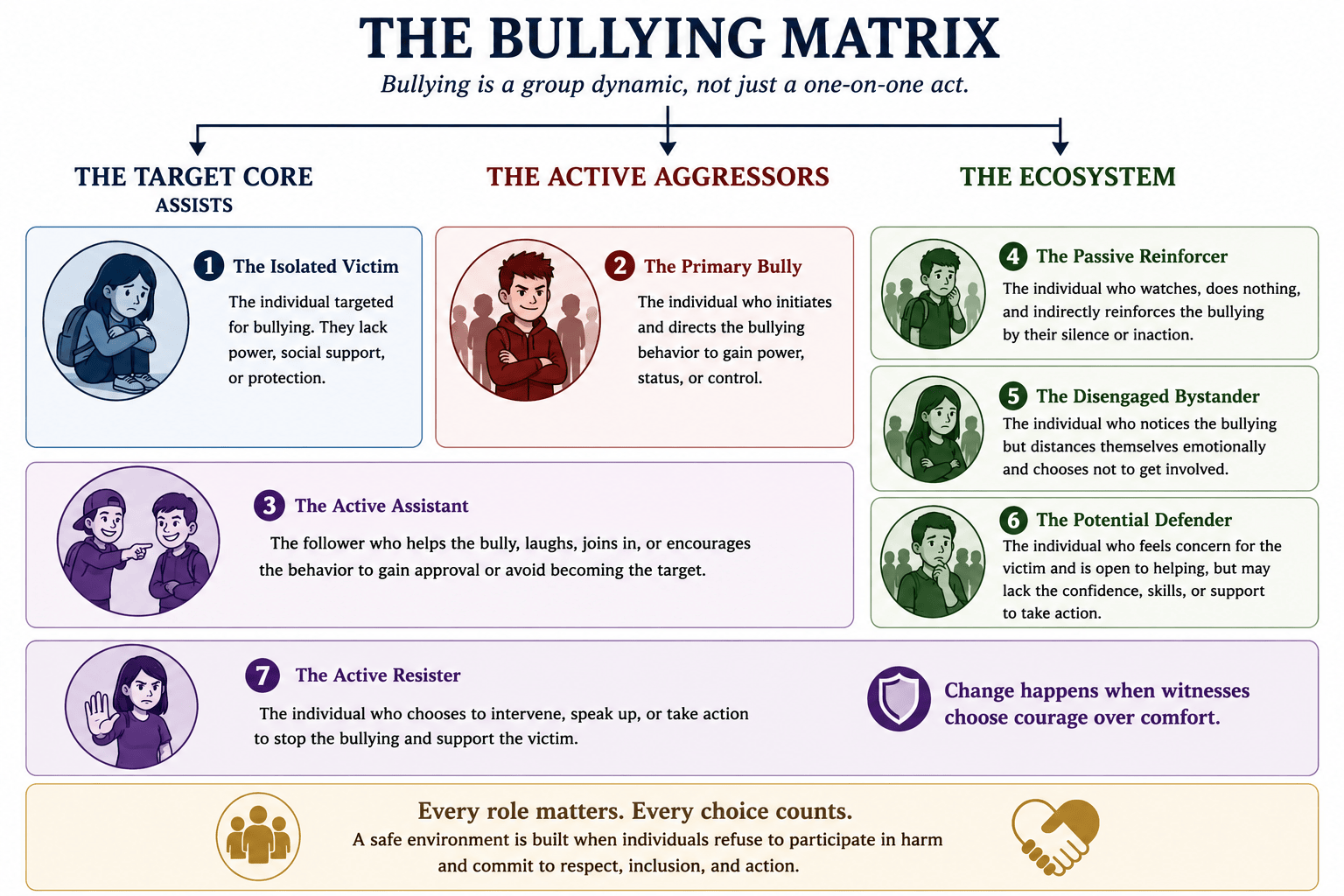
Figure 9: The bullying matrix
1. The Victim (The Target)
The structural anchor of the cycle. This individual is systematically selected by the dominant actors because they present distinct markers of social isolation, low peer support, or compromised self-efficacy. They absorb the collective aggression of the network.
2. The Primary Bully (The Ringleader)
The active generator of the aggression. Driven by a powerful psychological requirement for dominance, status acquisition, and social leverage, this actor initiates the boundary-testing “15-volt” insults and organizes the social exclusion of the target.
3. The Assistant (The Lieutenant)
This actor does not initiate the abuse independently, but directly joins the primary bully once the attack is launched. They execute the secondary mechanics of the assault, looking to capture secondary status and secure their own safety by aligning with the dominant power structure.
4. The Passive Reinforcer
A vital structural component of the ecosystem. This peer does not physically or verbally attack the victim directly, but stands by laughing, whispering, or recording the interaction on a smartphone. Their active attention delivers immediate positive reinforcement to the primary bully, validating their status and signaling that the abuse carries high social reward.
5. The Disengaged Bystander
This individual completely withdraws from the scene, looking away and pretending they don’t see the transaction occurring. Trapped inside the diffusion of responsibility, their internal software claims: “This is none of my business; someone else will surely step in to stop this.” Their total silence delivers massive passive compliance to the aggressors, signaling that the network will tolerate the abuse.
6. The Potential Defender
This peer experiences an acute internal state of moral discomfort while witnessing the assault. They recognize the behavior is fundamentally wrong and want to step in to protect the target, but they are completely paralyzed by the fear of social disapproval or the threat of becoming the next victim. They remain frozen in place.
7. The Active Resister (The Defender)
The explicit disruptor of the cycle. This individual possesses the high self-efficacy required to actively shatter the social script. They physically step into the space, look the primary bully in the eye, and explicitly break the diffusion of responsibility by mobilizing the surrounding potential defenders to protect the victim.
Advanced violence-prevention modules demonstrate that the most effective way to eliminate bullying within a school or community is not to target the primary bully, but to systematically train the disengaged bystanders and potential defenders to act as a unified wall of active resisters. The moment the group network drops its passive compliance, the primary bully’s social reward system is completely extinguished
When we attempt to get someone to agree to a request without relying on authority, we use compliance techniques:
Table 1: Compliance techniques
| Technique | Strategy | Real-World Example |
| Foot-in-the-Door | Start with a small, easy request, then follow up with a large request. | Ask a neighbor to place a small safety sticker in their window. Two weeks later, ask to place a massive billboard on their lawn. (Compliance rate: 75%) |
| Door-in-the-Face | Start with an extreme, unreasonable request (which is rejected), then offer a smaller, reasonable request. | Ask your partner to take you out for a $200 steak and lobster dinner. When they say no, say, “How about we just order a $20 pizza?” (They will gladly agree!) |
| Low-Ball | Get agreement on an attractive, low-cost offer, then reveal the hidden costs or change the terms. | Agree to buy a car for an attractive price, only for the dealer to add fees, insurance, and warranty costs at the final signing. |
| That’s-Not-All | Make a request, but immediately sweeten the deal with additional bonuses before they can answer. | Infomercials: “Buy this car wax for $19.99, but wait! If you call in the next ten minutes, we will throw in a second bottle absolutely free!” |
5. Group Polarization and Prejudice
When we are exposed to opinions that directly challenge our deeply held beliefs, we do not react logically. Instead, we experience group polarization:

Figure 10: Group polarization
If you present conservative arguments to a liberal group, they do not find common ground; they double down and become more extreme in their liberalism. If you present liberal arguments to a conservative group, they become more extreme in their conservatism. This is why arguing on social media platforms is completely futile; it biologically pushes both sides further into their respective corners.
The Sheri Studies on Prejudice
We conducted an experiment analyzing helping behaviors versus discrimination:
- Under normal conditions: Highly prejudiced individuals acted prejudiced, and non-prejudiced individuals acted helpful.
- Under cognitive load: We placed participants under intense mental strain by having them walk down a hallway while counting backward from 100 in complex mathematical increments (sevens and fours). Under this cognitive load, both groups acted in highly prejudiced, discriminatory ways.
This reveals a profound truth about human nature: prejudice is our default, automatic biological response to out-groups under stress. To be open, accepting, and helpful is an active, conscious, and effortful choice. We must intentionally expend cognitive energy to override our primitive social biases, especially when our minds are tired.
PART VI, CHAPTER 1 has delivered a stark, essential lesson in human vulnerability and social power. By looking closely at the theatrical stage of our social environments, we have dismantled the myth of the completely independent, unshakeable individual.
Whether it is a group of well-adjusted students quickly descending into abusive roles in a simulated prison, professional nurses prepared to administer lethal medication on a telephone doctor’s orders, or ordinary citizens proceeding to deliver 450-volt shocks to a screaming stranger, the historical data is consistent. Under the right situational pressures, our individual moral baselines can dissolve with terrifying speed.
The Power of the Minority: While the situational pull toward conformity and obedience is immense, Stanley Milgram and Solomon Asch both uncovered a powerful antidote. If even one peer stands up, challenges the script, and refuses to comply, conformity rates plummet by up to 80% and obedience rates drop to just 10%.
This is the ultimate clinical and social takeaway of our study of influence, vividly reflected in our analysis of the bullying cycle. Aggression and systematic evil do not sustain themselves on their own; they are actively fueled by the passive compliance, disengagement, and silence of the surrounding network. The moment a single bystander finds the self-efficacy to act as an active resister, the social rewards of the aggressor vanish.
As you step away from this chapter, remember that your environment is constantly broadcasting silent cues—actual, imagined, and implied—to shape your behavior. Being open, empathetic, and independent is not a passive default state; it is an active, effortful, and continuous choice. Question authority, monitor your cognitive load, and never underestimate the massive, ripple-effect influence of a single, courageous voice.
SEX, GENDER, AND RELATIONSHIP DYNAMICS
Few topics in modern discourse evoke as much passion, debate, and confusion as the concepts of sex and gender. In popular culture, these terms are frequently lumped together as if they mean the exact same thing. In this chapter, we will establish clear, empirical definitions to ground our exploration. We will separate sex—the biological and physiological characteristics defined by our chromosomes, hormone levels, and internal reproductive anatomy—from gender—the complex social, psychological, and cultural roles and identities we build around those physical foundations.
To understand the full spectrum of these dynamics, we will move beyond simple, rigid binaries. We will examine the biological bimodal curves that produce intersex variations and look at the default female gestational pathway of the human embryo. From there, we will chart the diverse ways gender identity and expression are organized across human history and cultures—including the honored roles held by Two-Spirit (Nádleehí) individuals in Indigenous nations before colonization. Finally, we will dive into the science of sexual orientation and physical arousal, showing just how fluid and dynamic human attraction can be, before analyzing a startling modern shift: the educational, economic, and relational trends reshaping how young men and women navigate today’s dating landscape.
Learning Outcomes
By the end of this chapter, students should be able to:
- Differentiate between biological sex, gender identity, gender expression, and sexual orientation while explaining how biological, psychological, and sociocultural factors contribute to human diversity.
- Describe the biological foundations of sex development, including chromosomal variation, prenatal hormonal influences, and the concept of bimodal biological distributions, recognizing the natural variation that exists across human populations.
- Compare contemporary concepts of gender identity, gender expression, and sexual orientation by examining empirical research on identity, attraction, behavioral flexibility, and cultural diversity across the lifespan.
- Analyze how biological processes, social expectations, cultural traditions, and environmental influences interact to shape romantic relationships, attraction, mate selection, and relationship development.
- Evaluate current demographic, educational, and societal trends affecting gender roles, relationship dynamics, and family formation while critically examining how psychological research informs discussions of sex, gender, and human relationships.
Essential Question
How do biological processes, psychological identity, and social environments interact to shape human sexuality, gender, and relationship dynamics?
Important Reminder: Psychology is not about proving ideological positions, it is about following the best available empirical evidence while recognizing that scientific understanding continues to evolve as new research emerges.
To begin, we must establish clear scientific definitions, as “sex” and “gender” are often confused in popular culture:
Sex refers to the biological and physiological characteristics of an individual, defined by chromosomes, hormone levels, and internal/external reproductive anatomy.
Gender refers to the psychological, social, and cultural meanings assigned to being a man or a woman. It is a social construction that defines roles, expectations, and identity.
1. The Biological Spectrum of Sex
While we often view sex as a strict binary, biology operates on a bimodal distribution:

Figure 11: Bimodal distribution of sex
When we analyze an individual’s complete biological panel—including chromosomes (XX vs. XY), hormone levels (estrogen vs. testosterone), and gonadal development—we find that no one is 100% biologically male or female. We fall along two overlapping curves, with some individuals born with a mixture of male and female anatomical characteristics, known as intersex.
The Default Female Pathway
All human fetuses are conceived as female. For the first six weeks of gestation, every embryo develops internal female reproductive structures. Around the six-week mark, if the fetus possesses the Y chromosome, the SRY gene triggers a massive surge of androgens (testosterone) that washes over the tissue, converting those internal structures into external male genitalia. If that hormone surge does not occur, or if a female fetus is exposed to high levels of maternal testosterone during gestation, they will continue on the default female pathway but may present with more masculine traits.
2. Gender Identity and Expression
Our internal gender identity (how we feel inside) and external gender expression (how we present to the world) exist on a continuous spectrum, some examples include:
- Cisgender: An individual whose internal gender identity aligns with their biological sex at birth.
- Transgender: An individual whose internal gender identity does not align with their biological sex at birth, often experiencing the distressing feeling of being “trapped in the wrong body.”
- Two-Spirit (Nádleehí): A traditional Indigenous identity that predates Western colonization. Many Native American nations recognized and celebrated individuals who possessed “two spirits”—the essence of both a man and a woman. Far from being outcasts, Two-Spirit individuals were highly respected leaders, mediators, and healers, as they were believed to have a uniquely balanced perspective on human problems.
- Genderqueer: An individual who expresses their gender identity in an extreme, non-binary, or highly stylized way, challenging traditional social boundaries (RuPaul is a classic example).

Figure 12: Sex, gender identity, & expression
3. Sexual Orientation and Fluidity
Sexual orientation defines who we are attracted to emotionally, romantically, and sexually, some example include:
- Bisexual: Attraction to both men and women.
- Pansexual: Attraction is not limited by gender identity or biological sex. Pansexuals are often described as being attracted to a person’s “personality” or “soul,” rather than their physical gender markers.
- Asexual: Little to no sexual attraction to others.
- Aromantic: Little to no romantic attraction to others.

Figure 13: Sexual orientation
The Fluidity of Attraction and Behavior
We must separate our identity from our actual sexual behaviors, which are highly fluid and shaped by availability:
The Female Arousal Study: In physiological studies, when women who strongly identified as heterosexual were hooked up to plethysmograph sensors, 76% of them showed physical sexual arousal when shown images of attractive women. For women, physical sexual response is highly fluid and less rigidly category-specific than for men.
The Craigslist Study: A researcher analyzed “men seeking men” hookup ads on Craigslist. He interviewed the respondents confidentially, assuming they were gay men. The results were surprising: only 13% identified as gay. The vast majority (76%) were married to women and identified as heterosexual, yet they actively sought out same-sex physical encounters.
The Prison Effect: When human beings are isolated from their preferred gender (such as in single-sex prisons), they will adapt and engage in same-sex behaviors. We see this exact behavior across our closest evolutionary relatives, bonobos and chimpanzees, who routinely use same-sex sexual contact to resolve social conflicts and build alliances.
Attraction is not a fixed, rigid concrete box; it is a fluid, dynamic biological system that shifts across the lifespan (typically peaking or shifting for men in their early 30s and 50s, and for women in their early 20s and late 50s).
A fascinating modern sociological trend noted by Philip Zimbardo is the shifting educational and economic balance between genders:

Figure 14: Demise of guys
Women graduate from high school at a 25% higher rate than men.
Women earn the majority of Associate, Bachelor, Master, and Doctoral degrees. Young men are increasingly withdrawing from the physical world, struggling to launch careers, and are over-represented in rates of gaming addiction, substance abuse, and suicide.
This educational and economic shift has completely altered the dating landscape. In a massive survey of young, sexually active men conducted before the pandemic, researchers asked a simple question: “Would you rather spend a romantic, sexual weekend with your partner, or a weekend playing video games and hanging out with the boys?” Nearly 80% of the men chose the video games and the boys over their romantic partner.
As women become increasingly independent, educated, and financially secure, their standards for a partner are rising, making modern mate selection highly competitive for young men.
PART VI, CHAPTER 2 has challenged us to look beneath the surface of cultural assumptions, revealing that sex, gender, and attraction are not fixed, immutable boxes, but fluid, dynamic biological and social systems.
By separating physical sexual response from conscious labels, we have seen how deeply our social scripts interact with our physical wiring. Physiological studies on female arousal and real-world behavioral studies remind us that human sexuality is highly adaptive and responsive to environmental changes, rather than a rigid, permanent baseline. This lesson is echoed throughout our evolutionary history, where we observe how close biological relatives like bonobos leverage social and physical contact to manage group tension.
The Modern Sociological Shift: The dramatic educational and economic transformations of the 21st century have completely redrawn the landscape of human relationships. With women earning the vast majority of academic degrees—reflected clearly in our local student demographics—young men are increasingly retreating into digital spaces, altering the dynamics of mate selection and forcing a critical re-evaluation of what it means to launch successfully into modern adulthood.
As we conclude this chapter, reflect on the vast bimodal nature of our biology and the diverse cultural legacies, such as the Two-Spirit tradition, that have historically honored psychological complexity. Real-world alignment, emotional health, and relational success require us to move past simplistic binaries. Understanding the biological, psychological, and social forces shaping gender and relationship dynamics gives us the crucial tools needed to build empathy, foster healthy connections, and adapt to an ever-evolving social landscape.
THE SPECTER OF DESPAIR: BIOLOGY OF RELATIONSHIPS
We often like to believe that falling in love is an abstract, purely spiritual, or emotional event—a mysterious selection guided by fate, poetry, and destiny. In this chapter, we are going to dismantle that romantic folklore. While pop culture paints love as a whimsical hobby or an elevated state of mind, contemporary cognitive neuroscience reveals a much more grounding truth: romantic attachment is a primal biological drive.
When we look at the brain under functional neuroimaging (fMRI), we find that viewing a long-term romantic partner does not light up our complex, logical cortical networks. Instead, the metabolic activity locks deep within the caudate nucleus and the ancient brainstem—the same primitive core responsible for managing our heartbeat, breathing, and physical thirst. Your biology does not process love as an optional emotional luxury; it treats attachment as a vital, non-negotiable requirement for physical survival.
In this chapter, we will map the profound neurochemical metamorphosis that occurs as a relationship transition across the lifespan. We will explore the intense, obsessive “amphetamine storm” of limerence that dominates the first year of a partnership, and analyze how the brain systematically down-regulates this volatile dopamine state to transition the couple into the calm, secure, and enduring “internal opiate” bond of companion attachment. Ultimately, we will uncover how a misunderstanding of this natural biological transition drives widespread relationship dissolution, and how recognizing these physiological phases can help us cultivate resilient, lifelong connections.
Learning Outcomes
By the end of this chapter, students should be able to:
- Describe the biological and neurological foundations of romantic attraction by explaining how brain structures, neurotransmitters, and evolutionary processes contribute to attachment and pair bonding.
- Differentiate between the major neurochemical phases of romantic relationships, including early-stage infatuation (limerence) and long-term companion bonding, while explaining how these biological transitions influence emotional experiences across the lifespan.
- Analyze how biological drives, cognitive interpretations, and social expectations interact to influence mate selection, relationship satisfaction, and long-term relationship stability.
- Apply principles from neuroscience and psychological research to explain common relationship experiences, including attraction, attachment, commitment, relationship transitions, and relationship dissolution.
- Evaluate popular cultural beliefs about romantic love by comparing them with contemporary psychological and neuroscientific evidence regarding human attachment, bonding, and healthy long-term relationships.
Essential Question
How do biology, cognition, and social experience interact to create, maintain, and transform human romantic relationships over time?
The Myth of the Romantic Emotion
We conclude our comparative analysis of affective systems by mapping the structural evolution of Romantic Attraction and Mate Selection. While Western pop-culture folklore frames falling in love as an abstract, purely emotional or spiritual selection, contemporary neuroscience proves that romantic attachment is a primal biological drive.
When researchers place an individual inside an fMRI scanner and flash a photograph of their long-term partner, the brain’s emotional, cortical, and logical networks do not respond.
Instead, the metabolic activity locks entirely within the caudate nucleus and the ancient brainstem—the raw, primitive core that manages our automated survival, breathing, heart rates, and physical thirst. Your biology does not view love as a fun hobby; it processes attachment as an absolute, non-negotiable requirement for physical survival.
The Chemical Metamorphosis of Love
As a relationship marches across the human lifespan, the underlying neurological chemistry undergoes a precise metamorphosis to transition the couple from initial infatuation to long-term structural companion bonding:
Phase 1: The Amphetamine Spurge (Limerence)
During the first six to eighteen months of an attachment, the brain is flooded with a high-intensity mixture of specialized phenylethylamines. This chemical cocktail shares an identical structural profile with synthetic methamphetamines, keeping the nervous system inside a state of intense, hyper-focused arousal, elevated energy, and obsessive cognitive fixation.
This high dopamine surge completely uncouples the prefrontal networks from factual logic, causing the individual to view their partner through a lens of absolute perfection.
Phase 2: The Endorphin and Opiate Transition (Companion Bonding)
A human nervous system cannot survive inside an amphetamine storm indefinitely; prolonged exposure would completely burn out your neurological receptors. Therefore, as the relationship stabilizes past the two-year threshold, the brain stem systematically triggers a chemical shift, downregulating the volatile dopamine loops and deploying a continuous release of natural endorphins and enkephalins.
These are your body’s natural, internal opiates. They induce a deep, profoundly calming state of emotional security, physical relaxation, and systemic peace.
The primary cause of relationship dissolution during middle age tracks directly to this chemical transition: when the high-octane amphetamine surge naturally fades to make way for the calming opiate bond, many chemically uneducated individuals mistake the quiet safety for a “loss of love,” abandoning a perfectly healthy companion to go back out into the market to chase a fresh dopamine spike. True, long-term love is not the continuation of the storm; it is the absolute
Biology creates the capacity for attachment, but biology does not determine the quality or longevity of a relationship. Healthy relationships emerge through the continuous interaction of neurobiology, individual cognition, communication, shared experiences, cultural expectations, and intentional behaviors. While our brains provide the architecture for love, the strength of a relationship is ultimately shaped through thousands of everyday choices that build trust, commitment, and mutual support. Modern psychology therefore views romantic relationships through a biopsychosocial lens, recognizing that biology, psychology, and social experience continually influence one another throughout the lifespan.
PART VI, CHAPTER 3 has demystified our most cherished romantic myths, exposing the raw evolutionary and chemical scaffolding that supports human connection.
As we have traced, the progression of long-term intimacy is governed by a precise neurochemical handoff. The dizzying, obsessive rush of Phase 1 (Limerence) is a highly temporary amphetamine surge designed by evolution to override our logic, blind us to our partner’s flaws, and compel us to mate. But our neural receptors cannot tolerate this high-octane state indefinitely.
To prevent receptor burnout, our brain stems must execute a vital transition into Phase 2 (Companion Bonding), replacing volatile dopamine loops with a soothing, continuous release of natural endorphins and enkephalins.
The Chemistry of Lifespan Love: The primary tragedy of modern relationships is a simple lack of chemical education. When the volatile amphetamine storm naturally fades to make way for the deep, stabilizing opiate bond, many mistake this quiet safety for a “loss of love.” They abandon a perfectly healthy companion to chase a fresh dopamine spike, unaware that true, enduring love is not the continuation of the storm—it is the peace that follows it.
As we close this chapter, reflect on the profound way your primitive brainstem processes those you love. By understanding that attachment is anchored to the very same deep survival networks that control your breathing and thirst, we can appreciate why social loss and relationship breakdown can feel so physically devastating. Viewing our relational transitions through this empirical lens allows us to respect our biology rather than fight it—permitting us to treasure the quiet, enduring safety of companion bonding as the ultimate, natural masterpiece of human connection.
ATTRACTION AND MATE SELECTION
We often like to believe that falling in love is an abstract, purely spiritual, or emotional event—a mysterious selection guided by fate, poetry, and destiny. In this chapter, we are going to dismantle that romantic folklore. While pop culture paints love as a whimsical hobby or an elevated state of mind, contemporary cognitive neuroscience reveals a much more grounding truth: romantic attachment is a primal biological drive.
When we look at the brain under functional neuroimaging (fMRI), we find that viewing a long-term romantic partner does not light up our complex, logical cortical networks. Instead, the metabolic activity locks deep within the caudate nucleus and the ancient brainstem—the same primitive core responsible for managing our heartbeat, breathing, and physical thirst. Your biology does not process love as an optional emotional luxury; it treats attachment as a vital, non-negotiable requirement for physical survival.
In this chapter, we will map the profound neurochemical metamorphosis that occurs as a relationship transitions across the lifespan. We will explore the intense, obsessive “amphetamine storm” of limerence that dominates the first year of a partnership, and analyze how the brain systematically down-regulates this volatile dopamine state to transition the couple into the calm, secure, and enduring “internal opiate” bond of companion attachment. Ultimately, we will uncover how a misunderstanding of this natural biological transition drives widespread relationship dissolution, and how recognizing these physiological phases can help us cultivate resilient, lifelong connections.
Learning Outcomes
By the end of this chapter, students should be able to:
- Differentiate between attraction and mate selection while explaining how biological, psychological, and social factors influence the formation and maintenance of intimate relationships.
- Describe the major principles of attraction, including familiarity, similarity, reciprocation, evolutionary preferences, and neurobiological mechanisms that contribute to romantic interest and partner selection.
- Analyze how evolutionary theory, neuroscience, cultural influences, and contemporary social changes interact to shape mate preferences, relationship formation, and long-term relationship outcomes.
- Apply psychological theories of attraction, attachment, and relationship development to evaluate real-world relationship behaviors, dating practices, and interpersonal decision-making across diverse social contexts.
- Evaluate how psychological science informs our understanding of human relationships while recognizing the importance of empathy, scientific inquiry, and evidence-based thinking when interpreting individual differences in attraction, relationships, and behavior.
Essential Question
How do biology, psychology, and social experience work together to influence whom we are attracted to, whom we choose as long-term partners, and how relationships develop over time?
While casual dating advice treats these as the same thing, in psychology we must separate them:
- Attraction is the broad, initial net we cast. It is the voluntary desire to explore a relationship with someone because you enjoy their presence.
- Mate Selection is the systematic narrowing of that net. It is the process of choosing a specific individual with whom you want to build a long-term, intimate, and reproductive partnership.
1. The Three Laws of Attraction

Figure 15: Three laws of attraction
Principle 1: Familiarity (The Mere Exposure Effect)
Simply being exposed to a person over time increases your liking of them, regardless of your initial reaction. If you meet someone at the beginning of the semester and find them slightly annoying, the continuous, passive exposure of sitting in the same classroom for 16 weeks will statistically shift your rating of them from a “dislike” to a “like.” Proximity and continuous contact naturally lower our biological defenses.
Principle 2: Similarity
While popular culture claims that “opposites attract,” empirical research consistently supports the opposite: birds of a feather flock together. As similarity in values, intelligence, height, religion, and personality increases, the stability and longevity of the relationship increase.
Why? Because we know ourselves. If you are with someone similar to you, you can easily predict and understand their reactions. This shared cognitive blueprint drastically reduces relational chaos, miscommunication, and conflict.
Principle 3: Reciprocation
We are naturally attracted to people who like us and treat us well. However, this principle has a major caveat: authentic congruency.
If you wake up in a terrible, grumpy mood and look exhausted, and your partner smiles and says, “You are the most beautiful, perfect angel in the world,” their praise is incongruent with reality. Instead of feeling happy, your brain immediately initiates motive seeking: “Why are they lying to me? What do they want from me? Are they hiding something?” For reciprocation to build attraction, it must feel grounded and authentic to the situation.
2. Universal Physical Markers of Attractiveness
Across cultures, there are highly consistent, biologically driven markers of physical attractiveness:
- Symmetry: Symmetrical features signal robust genetic health, lower rates of genetic mutations, and high reproductive viability. When researchers use computers to make a person’s face perfectly symmetrical, both men and women rate the symmetrical face as significantly more attractive.
- The Female Waist-to-Hip Ratio (WHR): Irrespective of overall body size (whether a woman is very thin or highly curvaceous), the most consistent predictor of physical attractiveness across every culture is a waist-to-hip ratio of approximately 0.7.
- Women with a 0.7 WHR have optimal estrogen levels, are highly fertile, and statistically experience significantly fewer complications during childbirth.
- Universal Female Features (Youth/Fertility): Men are drawn to large, wide-set eyes, a small nose, a delicate chin, and clear skin.
- Universal Male Features (Testosterone/Dominance): Women are drawn to a strong, jutting jawline, a deep voice, craggy eyebrows, and a broad, angular face.

Figure 16: Physical markers of attraction
Dating Tip for Men: If you are nervous about an upcoming date, call her first and speak in your deepest, lowest register. A deep voice is a direct biological indicator of testosterone and dominance, which immediately jumpstarts the female attraction pathway.
3. Evolutionary Priorities in Mate Selection

Figure 17: Priorities in mate selection
While both men and women rate kindness, loyalty, and emotional stability as their top three traits in a long-term mate, their secondary evolutionary priorities diverge. Men consistently prioritize youth and physical beauty (markers of fertility), while women consistently prioritize social status, ambition, and resource acquisition (earning potential).
Historically, feminist theorists hypothesized that as women gained economic independence, their need for a wealthy, powerful man would decrease. However, empirical tracking shows the exact opposite: as a woman’s individual power and income increase, her desire for an even more powerful, higher-earning partner increases exponentially. Rather than settling for equal or lower-earning mates, high-achieving women demand partners who outperform them.
The Hawaii Study (Clark & Hatfield, 1989)
To analyze male and female mating intent, attractive research assistants approached random college students of the opposite sex on campus and asked one of two questions:
“Would you go on a date with me tonight?”
“Would you go to bed with me tonight?”
The results were stark:
- When asked to go on a date, 50% of the women and 50% of the men said yes.
- When proposed to go directly to bed, 0% of the women said yes (many reacting with disgust or outrage), while 70% of the men said yes. (The 30% of men who declined politely apologized, citing that they were currently in a relationship or married!)
4. The Modern Mating Landscape
Historically, most people married someone who lived within a six-block radius of their home, meeting them through school, church, or their local neighborhood. Today, online dating and globalization have given us an infinite, global catalog of potential mates. While this offers endless choice, it has had major sociological consequences:
Delayed Marriage: The average age of marriage and first birth has shifted from 18–21 in the pre-internet era to 27–30 today, with overall marriage rates dropping to historic lows.
Cheating Dynamics: Infinite choice has made relationships more fragile. Interestingly, there is a distinct socio-economic pattern to infidelity:
- Men who cheat tend to select partners who are two socio-economic classes below their current spouse.
- Women who cheat tend to select partners who are two socio-economic classes above their current spouse (seeking higher status/resources).
Intimate Partner Homicide: While overall global murder rates have plummeted since the 1980s, intimate partner homicides have steadily risen. This is almost always triggered by one partner stepping outside the relationship to access the infinite global dating market.
5. The Neurobiology of Falling in Love
Falling in love is not a conscious, logical choice—it is a primary biological drive.

Figure 18: Neurology of love
When we place individuals who are deeply in love into an fMRI scanner and show them pictures of their partner, the cognitive prefrontal cortex does not light up. Instead, the activity occurs entirely within the caudate nucleus and the primitive brainstem—the reptilian core of our survival brain. Falling in love is processed by the exact same pathways that regulate your heart rate, breathing, hunger, and thirst. Your body views connection as an absolute biological necessity for survival.
The Chemical Cocktail of Limerence
Limerence is the acute, high-octane infatuation phase of romantic love. During this phase, the partner becomes the absolute center of your universe; they occupy the foreground of your mind, and everything in the background completely fades away. This state is driven by a precise chemical sequence:
Oxytocin is the primary bonding chemical in our brain, while Dopamine is the brain’s motivational and reward chemical. When you trigger an oxytocin release followed closely by a dopamine release, you become chemically attached to that person.
This explains why many people are drawn into high-risk relationships with “bad boys” or “bad girls”—the erratic, unpredictable situations spike their dopamine levels, making them biologically addicted to that person.
Practical Dating Advice
If you want to build attraction, do not take your date on a quiet, romantic stargazing picnic. Doing that raises their serotonin levels (the emotional, calming chemical). When we lift serotonin, we actually reduce dopamine levels, which are responsible for motivation, excitement, and drive.
Instead, give your date a dopamine lift. Take them to a roller coaster, an escape room, or an exciting activity that triggers the high-arousal, thrilling chemicals in their body. When they experience that adrenaline and dopamine spike alongside an oxytocin bond, their brainstem will associate that chemical rush with you, jumpstarting the biological attraction pathway.
What We Know…and What We’re Still Learning
The psychology and biology of sex, gender, attraction, and relationships represent one of the fastest-evolving areas of modern behavioral science. Over the past several decades, advances in genetics, endocrinology, neuroscience, developmental psychology, and cross-cultural research have greatly expanded our understanding of how biological processes, personal identity, and social environments interact throughout the lifespan. At the same time, many important questions remain unanswered. Researchers continue to investigate the developmental influences of prenatal hormones, the neurobiology of gender identity, the fluidity of attraction, the impact of culture on identity development, and the long-term effects of rapidly changing social norms on relationships and well-being. As with all scientific disciplines, psychology does not seek to defend political or ideological positions. Instead, it follows empirical evidence, revises theories when new data emerge, and remains open to changing conclusions as our understanding improves. The hallmark of scientific thinking is not certainty—it is a willingness to question, test, and refine our knowledge in light of new evidence.
The Final Philosophy: The Privilege of Compassion
Every single piece of data we have cross-examined points back to an absolute, unshakeable law of human nature: who we are is built entirely of our lived experiences continuously interacting with our organic biology.
Never slip into the catastrophic intellectual failure of assuming that because your specific nervous system successfully survived a crisis or climbed out of a toxic family ecosystem, another human being should be able to execute that exact same recovery effortlessly through raw willpower alone.
You have never lived inside their experience. You have never inherited the compressed genetic markers of their ancestral historical trauma, you have never had your emotional labels warped by their early childhood, and you have never processed the sensory environment through their un-filtered thalamic networks. To demand that they perform like you is a severe failure of intellect and empathy.
The ultimate purpose of securing a rigorous education in psychological science is not to look down on those who are failing to survive; the purpose of science is to deliver the absolute cognitive clarity required to set your own biases aside.
Your education should make you radically compassionate. It should give you the heart, the mind, and the voice to look at an individual trapped inside a behavioral or psychiatric storm and declare: “I do not understand the specific hell you have walked through, but I recognize your unique human value, and I will use my knowledge to help you find your footing.”

Figure 19: Rapture of compassion
PART VI, CHAPTER 3 has demystified our most cherished romantic myths, exposing the raw evolutionary and chemical scaffolding that supports human connection.
As we have traced, the progression of long-term intimacy is governed by a precise neurochemical handoff. The dizzying, obsessive rush of Phase 1 (Limerence) is a highly temporary amphetamine surge designed by evolution to override our logic, blind us to our partner’s flaws, and compel us to mate. But our neural receptors cannot tolerate this high-octane state indefinitely.
To prevent receptor burnout, our brain stems must execute a vital transition into Phase 2 (Companion Bonding), replacing volatile dopamine loops with a soothing, continuous release of natural endorphins and enkephalins.
The Chemistry of Lifespan Love: The primary tragedy of modern relationships is a simple lack of chemical education. When the volatile amphetamine storm naturally fades to make way for the deep, stabilizing opiate bond, many mistake this quiet safety for a “loss of love.” They abandon a perfectly healthy companion to chase a fresh dopamine spike, unaware that true, enduring love is not the continuation of the storm—it is the peace that follows it.
As we close this chapter, reflect on the profound way your primitive brainstem processes those you love. By understanding that attachment is anchored to the very same deep survival networks that control your breathing and thirst, we can appreciate why social loss and relationship breakdown can feel so physically devastating. Viewing our relational transitions through this empirical lens allows us to respect our biology rather than fight it—permitting us to treasure the quiet, enduring safety of companion bonding as the ultimate, natural masterpiece of human connection.