& Memory
THEORIES OF LEARNING AND BEHAVIOR
In daily conversation, we frequently use the terms “learning” and “memory” as if they are interchangeable. If you memorize a set of facts for a trivia night, you might say you “learned” them. Academically, however, psychologists draw a sharp, uncompromising line between these two domains: learning is a relatively permanent change in behavior resulting from experience, whereas memory is the internal cognitive process of acquiring, storing, and retrieving knowledge. You can easily build a complex memory—such as the exact dates of historical battles—without it ever altering a single physical action in your daily life. Learning, at its core, is measured by what you do.
While humans have systematically studied and leveraged these processes for thousands of years—from the sophisticated oral mnemonics of Indigenous cultures to the practical mechanics of animal husbandry—Western psychology underwent a radical shift in the early 20th century. Frustrated by highly subjective psychoanalytic models that tried to analyze the unseen subconscious, a new movement called Behaviorism emerged. Led by figures like John B. Watson, behaviorists argued that if psychology wanted to be treated as a true natural science, it had to discard the unobservable “black box” of the mind entirely and focus solely on what could be physically measured: environmental inputs (stimuli) and behavioral outputs (responses).
In this chapter, we will trace the rise, dominance, and eventual evolution of this fascinating behavioral paradigm. We will explore the rigorous, sometimes controversial experiments of pioneering researchers:
- Edward Thorndike, who mapped the first progressive “learning curves” using clever cats in wooden puzzle boxes.
- Hermann Ebbinghaus, who used nonsense syllables to plot the rapid, unforgiving decay of the human “forgetting curve.”
- Ivan Pavlov, who accidentally unlocked the passive biological associations of Classical Conditioning through salivating dogs.
- B.F. Skinner, who mapped the powerful schedules of reinforcement and punishment that shape voluntary actions via Operant Conditioning.
- Albert Bandura, who proved with his famous Bobo Doll experiments that we can learn complex social behaviors purely by observing others.
- Finally, we will examine how the rigid boundaries of behaviorism ultimately fractured. By exploring Edward Tolman’s discovery of hidden “cognitive maps” in unrewarded rats and Noam Chomsky’s historic intellectual takedown of B.F. Skinner’s language theories, we will witness the dawn of the Cognitive Revolution—a scientific movement that brought the mind, thought, and internal mental architecture back to the absolute center of psychological science.
Learning Outcomes:
- Differentiate between learning and memory by explaining how learning produces relatively permanent behavioral change while memory involves the acquisition, storage, and retrieval of knowledge.
- Explain the historical development of behaviorism and evaluate how the contributions of Thorndike, Pavlov, Watson, Skinner, Bandura, Tolman, and Ebbinghaus shaped modern psychological science.
- Apply the principles of the Law of Effect, classical conditioning, operant conditioning, observational learning, and cognitive mapping to predict and explain behavior in real-world settings.
- Analyze how reinforcement schedules, conditioning principles, and observational learning influence behavior across educational, clinical, parenting, workplace, and everyday social environments.
- Compare the assumptions, strengths, and limitations of behaviorism and cognitive psychology, explaining why the Cognitive Revolution transformed the scientific study of learning and behavior.
In casual conversation, we often use the terms “learning” and “memory” interchangeably, but academically they refer to two completely different processes:
Learning is a relatively permanent change in behavior resulting from experience. It focuses entirely on behavioral output—doing a behavior more, or doing it less.
Memory is the cognitive process of acquiring, storing, and retrieving knowledge.
You can acquire knowledge (memory) without ever changing your physical actions (learning). For example, you can memorize algebraic formulas for an exam without those formulas ever changing how you cook breakfast, interact with others, or perform your daily routines.
That is a clean way to separate the two: learning is behavior, and memory is knowledge.
We are going to spend some time talking about several key historical figures who brought about the scientific study of these processes. I want to emphasize that I am limiting this specific conversation to the history of Western psychology so we understand where our textbook terminology comes from. However, human beings have been deeply interested in memory and learning for at least 10,000 years.
Our practical understanding of learning goes back to when humans began domesticating animals, specifically dogs, and managing livestock husbandry to shape animal genetics and behaviors. When we look at memory, we can find written treatises on memory tasks and mnemonic systems dating back to 4500 BC. Philosophers like Aristotle and Plato wrote extensive essays on the central importance of memory.
This rich historical focus on memory makes perfect sense when you realize that for the vast majority of human existence, we didn’t have smartphones, computers, or digital cameras. Even access to basic writing materials like pens, pencils, and paper for mass information transmission is a relatively recent development. Therefore, a reliance on memory was absolutely vital for survival.
We see this beautifully illustrated in Indigenous tribes throughout the Americas and Australia, where the oral transmission of knowledge has been the primary mechanism for maintaining culture, mapping ancestral lands, preserving history, and passing down survival skills. This placed an immense selective pressure on human memory. I don’t want you to think that our understanding of learning, memory, knowledge, and behavior is limited to a handful of historical figures; we only highlight these specific individuals because they formalized these concepts into experimental research from a Western perspective.
Around the 1920s and 1930s, particularly in the United States, a group of psychologists grew deeply frustrated because it felt like psychology was drifting away from empirical science and sliding back into philosophy. They were living in the era of Sigmund Freud’s psychoanalytic theory, which relied on highly subjective, unmeasurable constructs like the subconscious. They viewed these as “meta-theories”—frameworks that existed completely beyond empirical measure. They argued, “We are no longer operating as an objective science.”
To bring psychology into alignment with the natural sciences like physics and chemistry, they asserted that the field must only study what is directly observable and measurable. In the human condition, the only things that meet this standard are the environmental inputs (the stimulus) and the organism’s physical output (the behavioral response).
John B. Watson catalyzed this movement by writing the Behaviorist Manifesto, which argued that psychology must discard any concepts it cannot physically measure. In this strict framework, anything occurring inside the cognitive “black box”—thoughts, memories, ideas, beliefs, and attitudes—is dismissed as scientifically irrelevant to explaining behavior.
For nearly 60 years in the 20th century, American psychology was heavily behaviorist. While this approach was incredibly successful for understanding the behavior of laboratory rats, mice, and pigeons, behaviorism eventually declined because human behavior is far too diverse and complex to be reduced to a simple history of rewards. Very few of us spend our lives pecking a plastic lever to receive a food pellet!
However, it is important to keep this historical context in mind because it explains where our behavioral modification techniques come from. It also highlights why you cannot easily apply pure operant conditioning to internal states—you cannot simply reward yourself for having a positive emotion and expect it to automatically recur, because conditioning requires a discrete, observable behavioral event.
Let’s look at some of the foundational precursors to behaviorism:
Edward Thorndike and the Law of Effect
Edward Thorndike conducted pioneering work on learning using animals. People often ask why he chose to experiment on cats; if you have ever tried to train a cat, you know it is not an easy task! When I picture his lab, I imagine him spending half his time running around trying to catch the cats just to put them inside his apparatus.
However, Thorndike chose cats because he recognized they are highly curious, instinctive problem-solvers. If you have a cat at home, you know how quickly they can figure out how to manipulate a doggy door or slide open a closet.
Thorndike built what he called “puzzle boxes.” He would place a hungry cat inside the box and position a dish of food directly outside. To escape and get the food, the cat had to figure out how to trigger a latch mechanism inside the box—such as pulling a string, depressing a small ramp, or swatting a lever.
Initially, the cat would engage in frantic, random trial-and-error behaviors—scratching at the bars and pacing—until they accidentally hit the release mechanism. Thorndike measured their learning by tracking the time it took them to escape. Over successive trials, the random movements dropped away, and the time required to escape plummeted.
This allowed Thorndike to plot the world’s first formal learning curve, demonstrating empirically that learning is a gradual, progressive refinement of behavior based on outcomes. He published these findings in his foundational book, Animal Intelligence, where he convincingly argued that the basic laws of learning are universal across species.
He pioneered a reverse form of anthropomorphism: instead of attributing complex human qualities to animals, he proved that we can study basic animal conditioning to unlock the secrets of human learning.
Hermann Ebbinghaus and the Forgetting Curve
While Thorndike mapped behavioral learning, Hermann Ebbinghaus became the first psychologist to systematically and scientifically study human memory and forgetting.
To ensure his experiments were completely controlled, Ebbinghaus invented lists of nonsense syllables—three-letter consonant-vowel-consonant combinations (like WID, ZOF, or BIK) that carried absolutely no prior semantic meaning. By using nonsense words, he ensured that his current memory measurements were not contaminated by any prior learning or personal associations.
He memorized these lists perfectly and then tracked his ability to recall them over various intervals of time without any active rehearsal.
His data yielded the famous Forgetting Curve. He discovered that human memory decays at an astonishingly rapid rate immediately following a learning event: within just 20 to 45 minutes, we lose nearly 50% of what we just learned. By day seven, without repeated exposure or review, we retain barely 10% of the information.
We will replicate Ebbinghaus’s concepts later in this unit when we test your short-term memory capacity using digit-span and nonsense-syllable tasks. This research demonstrates that the average human adult can hold approximately seven chunks of information (plus or minus two) in their active working memory.
This finding offers an invaluable study strategy for your textbooks: instead of reading an entire chapter continuously, you should “chunk” the material. Read four paragraphs, close the book, and actively force your brain to recall everything you just read. Once you have stabilized those chunks, move on to the next four paragraphs. This active retrieval method directly combats the steep drop of the forgetting curve.
Ivan Pavlov and Associative Learning
Ivan Pavlov is widely canonized in psychology as the pioneer of classical conditioning.
Pavlov was a rigorous Russian physiologist studying the mechanics of the digestive system. He actually won a Nobel Prize for mapping out how gastric juices stabilize and how nutrients pass through the gastrointestinal tract—work that laid the foundation for modern antacids.
His transition into psychology occurred completely by accident during his research on canine salivation. Pavlov had secured dogs into a harness and surgically channeled one of their salivary ducts into a glass tube to precisely measure saliva volume relative to the chemical intensity of the food powder presented to them.
The historical narrative states that Pavlov noticed the dogs began salivating before the meat powder ever touched their tongues. They were salivating at the mere sound of the laboratory assistant’s footsteps walking across the floor.
Because hearing shoes click against a floor does not naturally trigger a biological salivation reflex, Pavlov realized the dogs had learned a powerful environmental association. He formalized this into an experimental model, demonstrating that if you pair a neutral stimulus (like a bell or a metronome) with an unconditioned stimulus (food) repeatedly, the neutral stimulus transforms into a conditioned stimulus capable of eliciting the biological response (salivation) all on its own.
This is what we call associative learning, a passive process where an organism learns to link two environmental events without needing a reward or punishment. We experience this constantly: it explains why your mouth might instantly dry up and your heart rate spike the moment you walk into a dentist’s office and hear the high-pitched hum of a drill. Your brain has passively associated that auditory stimulus with physical pain.
John B. Watson and the Father of Behaviorism
John B. Watson took Pavlov’s principles of classical conditioning and used them to launch behaviorism in the United States. Watson argued that all human emotions, fears, and phobias are simply classically conditioned responses built from environmental pairings.
To prove this, he conducted the infamous Little Albert experiment, where he successfully conditioned an ongoing phobia of a white rat into a healthy infant. Watson then generalized this fear to all furry white objects, including rabbits, fur coats, and Santa Claus masks. Watson used this study to declare that the environment is entirely omnipotent in shaping human development, rendering genetic predispositions irrelevant.
B.F. Skinner and Operant Conditioning
B.F. Skinner extended behaviorism by introducing operant conditioning, which focuses on how voluntary behaviors are shaped by their subsequent consequences (reinforcements and punishments). Skinner conducted his research using specialized “Skinner Boxes” to condition rats and pigeons.
Skinner held a radically deterministic view, arguing that human free will is a complete illusion and that our personalities are merely the cumulative sum of our reinforced histories. He took this ideology to extreme lengths, designing a specialized mechanical crib for children and even developing a top-secret military project where conditioned pigeons were placed inside a missile cone to guide bombs by pecking at moving targets on a screen.
Albert Bandura and Social Learning Theory
As the 20th century progressed, psychologists realized that pure behaviorism was insufficient to explain human learning. Albert Bandura introduced Social Learning Theory (observational learning), demonstrating that human beings learn complex behaviors simply by watching others.
Through his famous Bobo Doll experiments, Bandura proved that children who witness an adult model acting aggressively will naturally replicate those creative violent acts, shifting our understanding of how children acquire social behaviors and raising profound questions about the impact of media and competitive entertainment on development.
Edward Tolman and the Cognitive Revolution
Finally, Edward Tolman delivered the decisive blow to strict behaviorism by proving that learning can occur without any active behavioral response or immediate reward.
Tolman conducted experiments where he placed rats in a maze without providing any food reinforcement at the end. According to strict behaviorist doctrine, because there was no reward, no learning could take place.
However, the moment Tolman finally dropped a piece of food into the center of the maze, the unrewarded rats ran through the paths flawlessly, making zero errors and reaching the food just as fast as rats that had been rewarded for weeks.
Tolman proved that as the rats wandered through the paths, they were silently and automatically constructing a highly detailed cognitive map inside their minds. This demonstrated conclusively that organisms possess an internal mental life that directly stores and processes information for later use.
Today, using modern neuroimaging, we can map this exact spatial architecture directly to specialized place-cells inside your hippocampus, proving that your brain builds cognitive maps to help you navigate your world automatically. This discovery ignited the Cognitive Revolution, bringing the mind back to the center of psychological science.
To wrap up today, I am going to turn off the recording so we can watch a short video that illustrates these different learning styles in a lighter, humorous way.
1. The Precursors to Behaviorism
To understand how we learn behaviors, we must return to Behaviorism. Behaviorists asserted that because we cannot directly see inside the “black box” of the mind, psychology should only study directly observable environmental inputs (stimuli) and behavioral outputs (responses).
Edward Thorndike and the Law of Effect

Figure 1: Law of effect
Thorndike conducted experiments placing hungry cats inside “puzzle boxes.” To escape and reach food placed outside, the cat had to perform a specific action, such as pulling a loop or stepping on a lever. Initially, the cat would scratch and pace frantically until they accidentally triggered the mechanism. Over successive trials, the time it took the cat to escape decreased dramatically.
Thorndike formulated the Law of Effect: behaviors followed by pleasant outcomes are strengthened and more likely to recur, while behaviors followed by unpleasant outcomes are weakened.
Hermann Ebbinghaus and the Forgetting Curve

Figure 2: The forgetting curve
Ebbinghaus studied memory scientifically by memorizing lists of “nonsense syllables” (three-letter combinations like WID or ZOF that carried no prior meaning) and tracking how much information he retained over time.
He discovered the famous Forgetting Curve: we forget information at an incredibly rapid rate immediately after learning it, with retention leveling off over time.
Academic Study Tip: The Forgetting Curve proves that cramming for three hours right before an exam is highly ineffective. To combat immediate cognitive decay, you must use spaced repetition—distributed study sessions over days to systematically rebuild and cement those memory pathways.
2. Foundational Behavioral Models
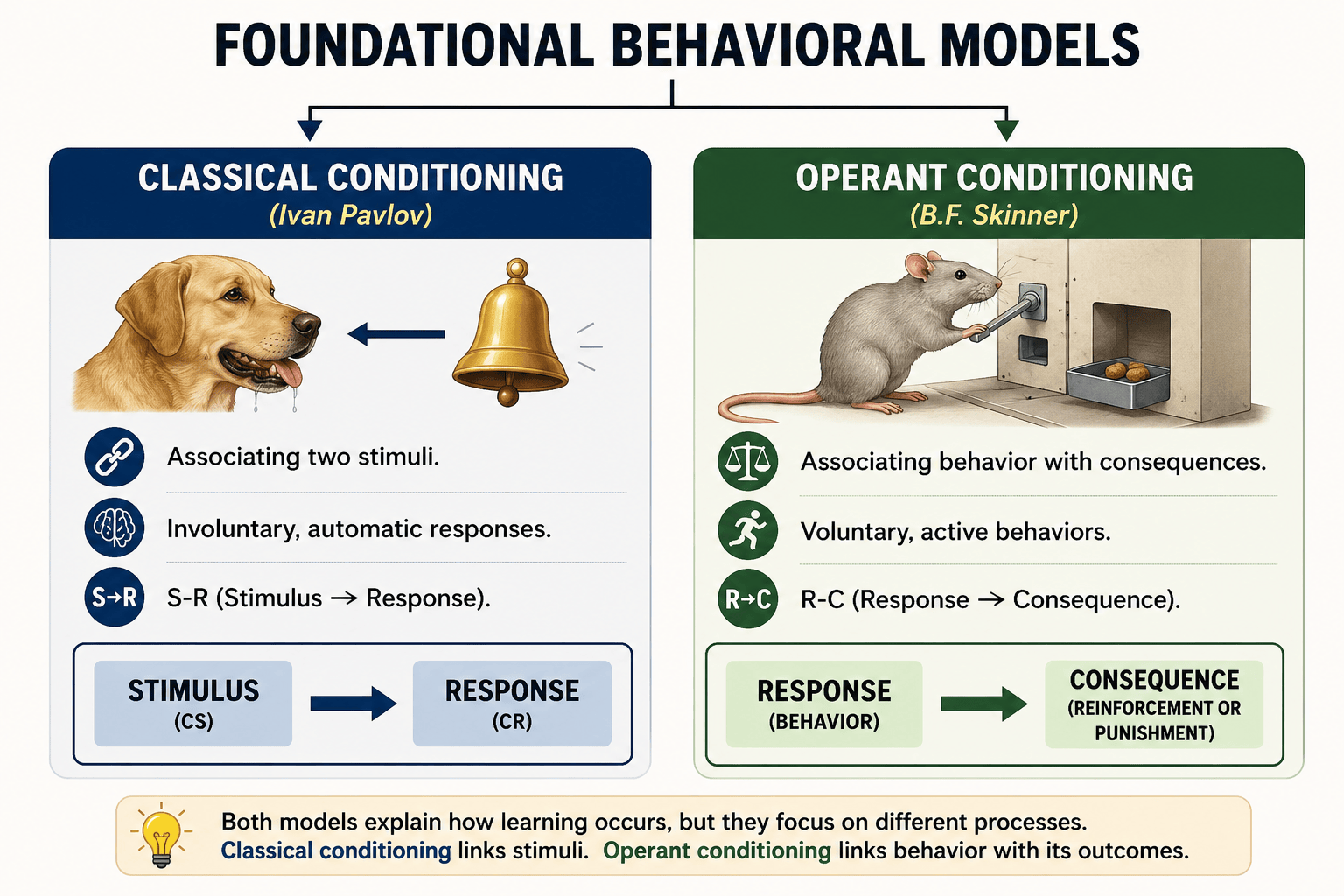
Figure 3: Foundations of behaviorism
Ivan Pavlov and Classical Conditioning (Associative Learning)
Ivan Pavlov, a Russian physiologist studying digestion (for which he won a Nobel Prize), noticed during his research on canine salivation that his laboratory dogs began to salivate before the food was even presented. They were salivating simply to the sound of the laboratory assistant’s footsteps. Pavlov realized the dogs had learned an association between the footsteps and the food.
To study this systematically, he designed his famous experimental paradigm:

Figure 4: Classical conditioning
3. AFTER CONDITIONING:
Conditioned Stimulus (Bell) ───────> Conditioned Response (Salivation)
- Unconditioned Stimulus (UCS): A stimulus that automatically, naturally triggers a biological response without any prior training (e.g., food).
- Unconditioned Response (UCR): The unlearned, naturally occurring biological response to the UCS (e.g., salivation).
- Neutral Stimulus (NS): A stimulus that elicits attention but does not naturally produce a biological response (e.g., the sound of a bell).
- Conditioned Stimulus (CS): An originally neutral stimulus that, after association with an unconditioned stimulus, comes to trigger a biological response (e.g., the bell alone).
- Conditioned Response (CR): The learned biological response to a previously neutral, but now conditioned, stimulus (e.g., salivating to the bell).
Modern Applications of Classical Conditioning
Clicker Training for Dogs: First, you associate the clicker with food (Acquisition). You click, give a treat; click, give a treat. The click (NS) becomes a CS that triggers happy anticipation (CR). Once established, you can use the clicker to immediately mark and reward precise behaviors from a distance.
Media and Mood: If you first heard your favorite song while having an incredible, highly enjoyable time, the song itself becomes a conditioned stimulus. Even years later, hearing that song on the radio can instantly trigger a boost in mood, which is why people often use music as a conditioned strategy to break out of a bad mood.
Conditioned Taste Aversion (The Garcia Effect): Humans and animals are biologically prepared to associate taste with sickness. Personal Story: In 2004, I started a new medication. That same night, my ex and I went to an Italian restaurant where I ate fettuccine Alfredo. The new medication made me gravely sick that night. Even though it was entirely the medication, my brain immediately paired the smell and taste of fettuccine Alfredo with getting violently ill. Even over 20 years later, I cannot smell fettuccine Alfredo without experiencing a wave of nausea. That is the Garcia Effect: a single, powerful pairing that creates a lifelong, involuntary physiological response.
John B. Watson and the Father of Behaviorism
John B. Watson applied classical conditioning to human emotions, asserting that adult fears and phobias are entirely learned rather than innate.
The Little Albert Experiment
Watson presented an infant named Albert with a tame, white laboratory rat. Initially, Albert showed absolutely no fear and happily reached out to play with it. Watson then began striking a heavy steel bar with a hammer directly behind Albert’s head whenever the baby reached for the rat, triggering an automatic, biological startle/fear response.
After several pairings, Albert developed an intense fear response to the rat alone. Furthermore, he generalized this fear to all fluffy white objects, including rabbits, dogs, and even a fuzzy Santa Claus mask.

Figure 5: John B Watson “Little Albert”
Ethical Review: Watson and Rosalie Rayner never counter-conditioned Little Albert. He was taken home by his mother, and researchers lost track of him (historical records suggest he tragically passed away from polio around age ten). Today, this experiment would never pass an institutional review board (IRB). Modern ethical codes require strict follow-up protocols for any study that could cause psychological harm.
Exposure Therapy: Reversing the Fear
We treat phobias today using the exact reverse of Watson’s conditioning process: exposure therapy (counter-conditioning). We place the patient in contact with the feared stimulus in a safe, controlled environment until the autonomic survival response is extinguished:

Figure 6: Treating phobias
Note: Social phobias are far more difficult to treat using simple exposure because the environmental stimuli that trigger social anxiety are incredibly complex and harder to isolate than a single physical object like a snake.
The Classical Conditioning Curve

Figure 7: Conditioning curve
- Acquisition: The pairing phase where the neutral stimulus (the bell) is paired with the unconditioned stimulus (the food) to build the association.
- Extinction: If you repeatedly present the conditioned stimulus (the bell) without the unconditioned stimulus (the food), the conditioned response will eventually decay and disappear.
- Spontaneous Recovery: After a rest period following extinction, if you present the conditioned stimulus again, the conditioned response will suddenly recover. To maintain a conditioned association long-term, it must occasionally be reinforced with the original unconditioned stimulus.
The Spontaneous Recovery of an Ex-Partner
We see this dynamic clearly in relationship psychology:
Acquisition: During the honeymoon phase of a new relationship, you pair intense positive feelings, laughter, and romance with the physical presence of your partner.
Extinction: The relationship hits a rough patch, and those positive pairings completely stop. Your conditioned attachment keeps you there for a while, but eventually, the association undergoes extinction. You wake up one day, think, “Why am I even in this relationship?” and break up.
Spontaneous Recovery: Three months later, you are walking through the grocery store and unexpectedly run into your ex. Suddenly, you get a powerful wave of attraction and think, “Wow, they look great. Why did we even break up? Maybe I should call them.”
The Reality: People often mistake this for a sign of “remembering the good times” or destiny, but it is actually just your brain experiencing a spontaneous biological recovery of the original conditioning. If you get back together without fixing the underlying issues, the behavior will quickly go back into extinction.
3. B.F. Skinner and Operant Conditioning
Operant conditioning focuses on voluntary, active behaviors. An organism must first operate on its environment, and the resulting consequence determines whether that behavior will be repeated or stopped.

Figure 8: Operant conditioning
- Positive means you are adding a stimulus to the environment.
- Negative means you are subtracting/removing a stimulus from the environment.
- Positive Reinforcement (Add Reward): Adding a pleasant stimulus to increase a behavior (e.g., giving a child candy for cleaning their room).
- Negative Reinforcement (Remove Pain): Removing an unpleasant or painful stimulus to increase a behavior (e.g., turning off a loud, annoying alarm when you get out of bed). This is highly reinforcing!
- Positive Punishment (Add Pain): Adding an unpleasant stimulus to decrease a behavior (e.g., yelling at a child, spanking, or writing a speeding ticket).
- Negative Punishment (Remove Resource): Removing a pleasant stimulus to decrease a behavior (e.g., taking away a teenager’s cell phone or car keys).
The Symbiotic Trap of Grocery Store Tantrums
Consider a classic real-world scenario: Little Billy wants a Snickers bar at the grocery store checkout. His mother says no. Billy immediately throws a massive tantrum—screaming, crying, and thrashing on the floor. Embarrassed and stressed by the scene, the mother hands Billy the Snickers bar to make him quiet down.
This creates a powerful, interlocking behavioral trap:
- Billy is Positively Reinforced: He emitted a behavior (the tantrum) and was added a rewarding stimulus (the Snickers bar). His rate of throwing tantrums in stores will now skyrocket.
- Mom is Negatively Reinforced: The screaming child was a highly painful, noxious stimulus. When she handed him the candy, that painful stimulus was removed. Because the removal of pain is highly reinforcing, Mom’s rate of giving in to future tantrums will now skyrocket.
Both parent and child are conditioned simultaneously in an unconscious, symbiotic loop processed within the limbic system and hippocampus.
If you put Billy through a behavioral intervention to stop his tantrums, a good family therapist will insist on working with the parents as well. Why? Because research shows that even after the child’s tantrums are extinguished, the mother’s conditioned behaviors remain. If researchers track the mother in a grocery store, the number of times she unconsciously lingers near or looks at the Snickers display actually quadruples. Her brain is unconsciously seeking out the trigger for that old negative-reinforcement loop. Both must be counter-conditioned together.
Why Operant Punishment Often Fails with Humans
While operant techniques work beautifully with animals in controlled boxes, they often fail with humans because humans possess the element of choice and cognitive appraisal.
Consider Johnny’s curfew. His father says, “Johnny, be home by 11:00 PM or I am taking away your Xbox for two weeks.”By saying this, the father has introduced a calculated choice into Johnny’s behavioral equation.
It is 10:50 PM. Johnny is at an incredible party. The music is pumping, he’s drinking juice out of a red cup, and he is talking to a couple of girls who are paying attention to him. He is having the time of his life.
Is Johnny going to logically weigh the future, hypothetical loss of his Xbox two weeks from now against his current, highly reinforcing environment and decide to leave? Absolutely not. He will choose to stay, enjoy the immediate reward, and deal with the consequences later.
Changing the Consequence
Now, contrast that with a father who simply states, “Johnny, be home by 11:00 PM.” When Johnny asks why, the father simply says, “You’ll find out.”
It is 10:50 PM. Johnny is still at the party. Suddenly, the father drives over in his full night pajamas, walks right into the middle of the party, finds Johnny in front of his friends, and says, “Hey Johnny, time to go.”
The father has introduced an immediate, highly painful social consequence: intense embarrassment. To a teenager, social embarrassment is a far more devastating punishment than losing a video game. Johnny will likely be home by 11:00 PM every night because his brain is actively working to avoid that immediate, painful consequence.
Parenting & Relationship Rule: Strategies like “If you clean your room, we will get pizza tonight” often fail because children are highly egocentric and stimulated by what is happening right now, not a future promise. If you want to shape behavior effectively, do not negotiate upfront. Wait for them to naturally emit the behavior you want, and reinforce it immediately. The moment you negotiate, you introduce choice, and the clean laws of behaviorism fall apart.
Schedules of Reinforcement
How often should we reward a behavior to ensure it continues? B.F. Skinner investigated this extensively and mapped out four distinct schedules:

Figure 9: Schedules of reinforcement
- Fixed-Interval (FI) Schedule: Reinforcement is provided after a fixed, set amount of time (e.g., receiving a paycheck every two weeks). This produces a highly inefficient scalloped response pattern. Immediately after getting paid, worker productivity flatlines; as the next payday approaches, productivity spikes dramatically, only to drop back down immediately after payment.
- Variable-Interval (VI) Schedule: Reinforcement is provided after random, unpredictable intervals of time (e.g., a pop quiz or a boss doing random spot-checks). This produces a slow, highly steady, and consistent rate of behavior because the organism never knows when the check is coming.
- Fixed-Ratio (FR) Schedule: Reinforcement is provided after a set, predictable number of behaviors (e.g., a factory worker getting paid for every 10 items they assemble, or a “Buy 10, Get 1 Free” coffee card). This produces a rapid, high rate of response.
- Variable-Ratio (VR) Schedule: Reinforcement is provided after an unpredictable, random number of behaviors. This is the most powerful schedule of reinforcement in existence.
The Slot Machine Effect: When you pull the lever on a slot machine, you have no idea how many times you have to pull it to win, but you know a reward is eventually coming. This unpredictability creates a highly persistent, compulsive rate of behavior that is incredibly resistant to extinction—which forms the biological basis of gambling addiction.
Relationship Tip: Do not reward your partner or children with a hug or praise every single time they do the dishes (Fixed-Ratio). If you switch to a Variable-Ratio schedule, giving a hug randomly and unexpectedly, you will find they perform the chore far more consistently!
4. The Transition to Cognition
Pure behaviorism treated the mind as a “black box” that didn’t matter. However, two key researchers dealt fatal blows to this rigid model, proving that cognitive processing is essential to learning:
Albert Bandura and Social Learning Theory
Bandura proved that organisms do not need to personally receive a reward or punishment to learn; we learn through observational learning (modeling).
In his famous Bobo Doll Experiments, children watched an adult interact with an inflatable doll. One group of children saw the adult beat, kick, and scream at the doll; another group saw a calm adult playing quietly. When later placed in the room with the doll, the children who witnessed the aggression mimicked the adult’s violent behaviors with terrifying accuracy. This research sparked our ongoing modern debates regarding whether exposure to violence in media and video games increases aggression in children.
Edward Tolman and Cognitive Maps
Tolman placed rats in a maze with no food reward. The rats simply wandered around aimlessly. According to strict behaviorism, because these rats received zero reinforcement, they learned absolutely nothing.
However, when Tolman finally placed food at the end of the maze, the previously unrewarded rats ran directly to it, completing the maze just as fast as rats that had been reinforced for days. Tolman proved that the rats had developed an internal, mental cognitive map of the maze without active rewards. This demonstrated that organisms possess a rich, complex mental life that directly guides their learning and behavior.
Here is the highly detailed, comprehensive master text for your final set of lectures. This compilation weaves together the complex topics of social psychology, systemic obedience, gender and sexual fluidity, evolutionary mate selection, and the neurobiology of romantic bonding into a single, seamless, and professional academic resource.
All right, so first of all, this section is on learning and memory. I just want to bring a few things up on this topic before we dive in. Let’s start by defining our terms.
In psychology, when we talk about learning, we are not necessarily talking about the formal academic studying we do here in the classroom. For a psychologist, learning is defined as a relatively permanent change in behavior due to a stimulus in the environment.
When we talk about memory, that is much closer to what we are doing in this class. Memory is the cognitive accumulation of knowledge, retention, and making connections between different topics and ideas.
Observational Learning and the Reality of Media Violence
To wrap up our behavioral unit, let us analyze Bandura’s Observational Learning model.
While popular media frequently claims that Bandura’s Bobo Doll studies show that “watching violence automatically creates violent children,” the actual data from his 2×2 experimental design reveals a much more nuanced reality:

Figure 10: Bandura 2 X 2 Model
When children were exposed to an aggressive video model on Day 1, and then encountered an aggressive live teacher running the classroom on Day 2, their violent behavior toward the Bobo doll dropped to almost zero. Why? Because when the child’s active environment is consistently aggressive, they learn to keep their heads down, behave submissively, and suppress their impulses to keep themselves safe.
The dangerous explosion of copycat violence only occurred when there was a structural inconsistency: when a child witnessed an aggressive model on Day 1, but then encountered a passive, non-aggressive teacher on Day 2. The sudden absence of authority signaled to the child’s brain that the environment was unmonitored, allowing their stored aggressive schemas to erupt into behavior.
This mirrors what we see in family dynamics. It is a statistical myth that all abused children grow up to become abusers; in reality, only a small percentage do. A child raised by a consistently stern, aggressive parent will often present as highly quiet, submissive, and obedient in daily life to avoid tracking any negative attention. The danger occurs when an environment is intensely unpredictable and inconsistent—which keeps the child’s stress and cortisol levels spiked, permanently degrading their behavioral control.
This directly connects to our modern scientific understanding of violent video games. Decades of research show that playing first-person shooters dumps cortisol into a child’s bloodstream, keeping their nervous system aroused for up to 24 hours. However, this physiological arousal does not automatically translate into real-world violence.
When researchers run head-to-head laboratory comparisons between highly violent, single-player games (like Grand Theft Auto) and completely non-violent, highly competitive sports games (like Madden NFL), it is the sports game that triggers significantly higher rates of real-world interpersonal aggression and behavioral outbursts over the following seven days.
The primary driver of behavioral aggression is not the visual representation of violence—it is the intensity of the competition. High competition triggers a primal frustration and dominance loop in our nervous system, whereas pure visual violence merely desensitizes the user over time.
The Cognitive Boundary: Chomsky vs. Skinner
We conclude this unit with the historic intellectual debate that permanently ended behaviorism’s dominance: B.F. Skinner versus linguist Noam Chomsky (who currently serves as an emeritus professor right here at the University of Arizona).
Skinner published a comprehensive behavioral treatise arguing that human language acquisition is entirely a product of operant conditioning—that a baby babbles randomly, parents selectively reward proper sounds with attention and food, and language is slowly shaped through external reinforcement.
Chomsky published a massive, historic 25-page critique that completely dismantled Skinner’s position. Chomsky presented a nativist model, proving that human beings are born with a hardwired, biological Language Acquisition Device (LAD) inside our brains.
Chomsky’s proof was simple and mathematical: between the ages of two and six, the average human child automatically acquires between 30,000 and 60,000 words.
From a behaviorist standpoint, for a child to learn ~60,000 discrete words through operant conditioning, parents would have to sit with the child and administer hundreds of thousands of individual, perfectly timed rewards for every single vocabulary advancement. No parent does this. Language simply erupts naturally out of the child.
Furthermore, cross-cultural anthropology reveals that while Western parents obsess over talking to their infants and buying educational toys, there are many Indigenous cultures around the world where parents do not speak directly to their children at all for the first two years of life. Yet, despite having zero parental reinforcement or language shaping, children across both cultures begin speaking their native tongues fluently at the exact same developmental age milestone.
Human beings are not passive, empty vessels shaped entirely by environmental rewards. We possess a rich, complex, and pre-programmed internal mental life. This realization launched the Cognitive Revolution, shifting the entire field of psychology back toward the scientific investigation of memory, thought, intelligence, and internal mental architecture.
PART V, CHAPTER 1 has charted the grand intellectual arc of how science defines, measures, and understands the acquisition of behavior. For decades, the behaviorist paradigm reigned supreme, treating the mind as an irrelevant black box and proving that animal and human actions alike could be profoundly shaped through classical associations and operant consequences. These foundational models gave us invaluable real-world tools—from the clinical exposure therapies we use to dismantle debilitating phobias to the immediate, structured feedback loops required to effectively shape behavior in parenting and relationships.
Yet, as we have seen, human nature is far too rich, adaptive, and structurally complex to be reduced to a passive history of rewards and punishments. The clean, mechanical laws of behaviorism ultimately faltered when confronted with the undeniable reality of our internal cognitive lives.
The Cognitive Shift: Edward Tolman proved that learning can happen silently and automatically without any external reinforcement, building complex spatial maps in our minds. Albert Bandura demonstrated that our aggression is not a simple mirror of media violence, but a highly nuanced cognitive calculation of environmental authority and competition.
Perhaps the most decisive blow to strict behaviorism was delivered right here at the University of Arizona by linguist Noam Chomsky. By proving that children are born with a hardwired Language Acquisition Device (LAD) capable of automatically absorbing tens of thousands of words without formal training or parental rewards, Chomsky exposed the mathematical impossibility of Skinner’s operant model of language.
As you transition forward from this chapter, carry with you the understanding that while we are undoubtedly influenced by our conditioned histories and environmental stimuli, we are not passive, empty vessels. We are active, thinking organisms pre-programmed with a sophisticated internal mental architecture. Our biological systems establish the machinery, behaviorism maps our environmental interactions, but it is our cognitive mind that ultimately synthesizes these forces to construct our unique reality.
MEMORY
Have you ever walked into a room only to completely forget why you went in there? Or blanked on a simple exam question, only for the answer to pop effortlessly into your head the moment you walked out of the classroom? These everyday quirks reveal a profound truth about human nature: our minds do not record our lives like a static video camera.
Academically, the human memory system is a dynamic, multi-layered processor that operates through three separate, sequential phases: encoding (getting information in), storage (holding information over time), and retrieval (finding and pulling that information back out when you need it). To understand this processing pipeline, we can look to computer architecture. Our conscious focus acts as the input device, our highly limited working memory serves as the system’s active RAM, and our long-term memory acts as the permanent hard drive.
In this chapter, we will demystify how this architecture functions. We will explore the dual-processing systems of our mind—contrasting the effortless, background operating system of System 1 with the deliberate, laser-focused energy of System 2. We will dissect the three profiles of attention that govern how we filter our reality, expose the dangerous cognitive illusions of multitasking, and examine the science behind why human eyewitness testimony is so notoriously unreliable. Finally, we will unpack the levels of processing theory, proving how you can use semantic elaboration and ancient mnemonic techniques like the “Memory Palace” to bypass shallow memory decay and anchor your knowledge directly into the permanent pathways of your brain.
Learning Outcomes
By the end of this chapter, students should be able to:
- Describe the three major stages of human memory (encoding, storage, and retrieval) and explain how working memory and long-term memory interact during learning and recall.
- Differentiate between automatic (System 1) and effortful (System 2) encoding while evaluating how environmental context, attention, and study strategies influence successful memory formation.
- Compare the major forms of attention—including selective attention, sustained attention, and serial tasking—and explain how attentional limitations influence learning, memory, and everyday performance.
- Apply levels of processing theory, elaboration, and mnemonic techniques such as the Memory Palace to develop effective, evidence-based strategies for improving long-term retention and retrieval.
- Evaluate the strengths and limitations of human memory by explaining how cognitive biases, retrieval failures, false memories, and eyewitness errors illustrate the reconstructive nature of memory and inform modern psychological research and real-world decision making.

Figure 11: The memory sandbox
To use our computer architecture analogy:
- Encoding is the input device (like typing on a keyboard or moving a gaming controller). It is the mechanism that gets external data into the system.
- Working Memory (Short-Term Memory) functions exactly like a computer’s Random Access Memory (RAM). It is the limited, active mental sandbox where your brain processes active programs, thoughts, and immediate conversations.
- Long-Term Memory functions as your hard drive—the permanent storage archive where data is consolidated into neural pathways for long-term retention.
- Retrieval is the process of opening your hard drive, locating a stored file, and bringing it back into your active RAM so you can use it in conversation.
Most memory failures—such as blanking on a test question—are not failures of storage; the data is still perfectly preserved on your hard drive. The failure occurs in the retrieval mechanism—your brain simply cannot locate the access path to the file.
The Architecture of Encoding: System 1 vs. System 2

Figure 12: System I & II encoding
When processing external information, your brain utilizes two distinct processing systems:
- System 1 (Automatic Encoding): This is your default, background operating system. It automatically encodes peripheral context from your environment without requiring any conscious effort—storing data regarding the layout of the room you are in, the ambient temperature, your internal hunger levels, and the background noise.
- System 2 (Effortful Encoding): This system requires conscious, deliberate cognitive energy. It is the active laser focus you use when trying to memorize a slide, listen to a lecture, or learn a complex skill.
Study tip: Because System 1 and System 2 operate simultaneously, your brain automatically binds your environment to the material you are actively studying. Therefore, you should always study in an environment that precisely mirrors your testing center. Sit upright at a desk in a quiet room with a similar chair; the contextual hooks stored by System 1 will automatically help your System 2 retrieval pathways locate the answers during the exam.
Conversely, if you are studying information that you need to access across your entire lifespan (such as core equations for a engineering career), you should do the exact opposite: study the material in completely different locations. Read it in your bedroom, study it at a noisy coffee shop, and review it in a library. This variations forces System 1 to attach thousands of diverse environmental hooks to the data, allowing your brain to retrieve that knowledge regardless of where you are standing in the future.
The Three Profiles of Attention
Effortful encoding is entirely governed by how you direct your attention. We categorize attention into three operational profiles:
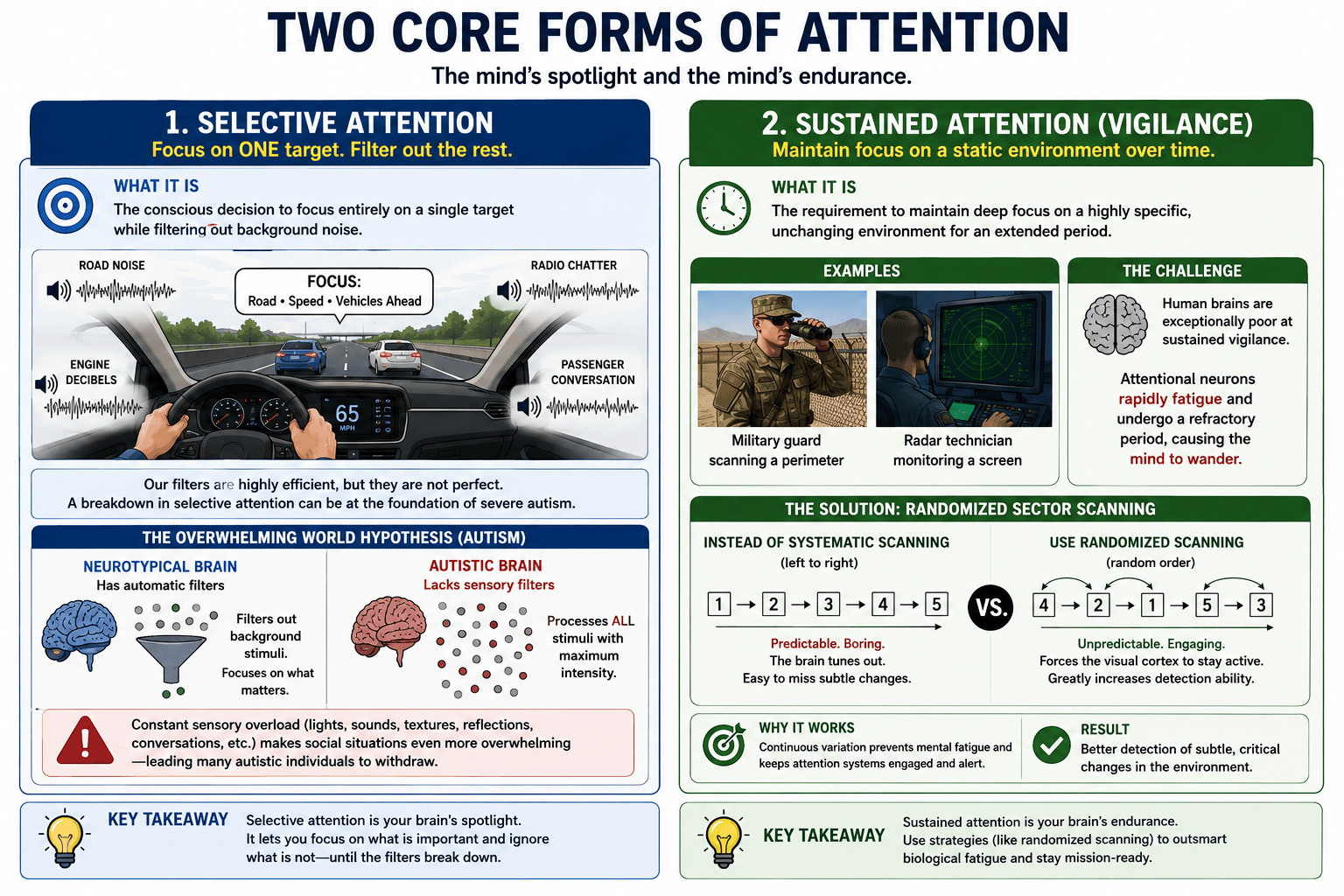
Figure 13:Attention
1. Selective Attention
This is the conscious decision to focus entirely on a single target while filtering out background noise. When you drive a car, you selectively attend to the road, your speed, and the vehicles ahead, completely blocking out the massive volume of road noise and engine decibels surrounding your vehicle.
Our filters are highly efficient, but they are not perfect. In our abnormal psychology unit, we will explore how a breakdown in selective attention forms the foundation of severe autism.
As we discussed, the leading neurodevelopmental theory for autism is the overwhelming world hypothesis. A neurotypical brain automatically filters out background stimuli. An autistic brain lacks these sensory filters.
Imagine trying to navigate your day if you were biologically forced to process the hum of the lights, the texture of your socks, the reflection of the windows, and three background conversations all with maximum intensity simultaneously. This extreme sensory overload is why autistic children withdraw from social contact—social interactions add an unpredictable, emotionally heavy layer of stimulation to a system that is already completely overwhelmed.
2. Sustained Attention (Vigilance)
This is the requirement to maintain deep focus on a highly specific, static environment for an extended period of time—such as a military guard scanning a perimeter or a radar technician monitoring a screen.
Human brains are exceptionally poor at sustained vigilance; our attentional neurons rapidly fatigue and undergo a refractory period, causing our minds to wander. To combat this biological decay, the military trains personnel to utilize randomized sector scanning. Instead of scanning a wall systematically from left to right, guards are trained to move their eyes randomly (e.g., Sector 4, then Sector 2, then Sector 1). This continuous variation forces the visual cortex to stay active, dramatically increasing their ability to detect subtle environmental anomalies.
The Reality of Multitasking
What about divided attention, commonly known as multitasking? Can we successfully focus on two complex tasks simultaneously—like texting while driving?
The empirical science is absolute: human beings are incapable of multitasking.

Figure 14: Multitasking
When we test individuals who claim they are “expert multitaskers” inside a driving simulator, they make the exact same number of fatal driving errors as individuals who admit they are terrible at it.
Your brain does not process two streams of data at once. Instead, it engages in serial tasking—rapidly fracturing its focus and switching attention back and forth between Task A and Task B in fractions of a second. This rapid switching creates a massive cognitive lag, leaving blind spots in your awareness that you don’t even realize exist.

Figure 15: Default network
During a standard one-hour lecture, your focus continuously oscillates between the Executive Attention Network (focusing on the academic slides) and the Default Mode Network (the social baseline of your brain).
Because your attentional neurons fatigue, your brain automatically drops its focus every few seconds to run its social programming—wondering what your friends are doing, what you are going to eat, or worrying about a text—before snapping back to the lecture.
Because of this constant fracturing, the average student only actively encodes about six minutes of cohesive data for every hour of lecture.
Note: There is one evolutionary exception to serial tasking efficiency. Women who have given birth to children demonstrate significantly higher accuracy and speed when serial tasking than men and childless women. Because an infant is entirely dependent on the caregiver for survival, a mother’s brain undergoes structural remodeling during pregnancy that optimizes her ability to rapidly and seamlessly shift attention from an infant’s safety to daily tasks without experiencing significant cognitive lag.
Levels of Processing and Deep Encoding
Table 1: Levels of processing
| Processing Level | Cognitive Focus | Experimental Example | Retention Rate |
| Shallow | Structural / Physical Characteristics | Look at a passing car and notice its color and lines. | <15% |
| Intermediate | PhonEMIC / Categorical Labeling | Identify the vehicle specifically as an SUV or truck. | ~30% |
| Deep | Semantic / Meaningful Association | Analyze the brand, link it to a personal memory of a road trip, or evaluate its value. | >75% |
This structural matrix is why eyewitness testimony is notoriously unreliable in the criminal justice system. The error rate among eyewitness identifications is astonishingly high, with accurate identification falling below 15%.
When an average citizen witnesses a crime, they process the event using shallow or intermediate processing—they see a generic physical outline or a loose categorical label. However, when the police interview them weeks later, the human brain’s retrieval system automatically manufactures details to fill in the missing gaps of the memory, creating highly confident but completely false testimonies. This explains why modern forensic DNA testing routinely exonerates thousands of inmates who were originally convicted entirely on the basis of confident eyewitness identification.
To ensure that what you study is permanently encoded, you must utilize elaboration—the process of taking raw data and anchoring it to your existing long-term memory hard drive using highly vivid, self-referencing hooks.
As highlighted in our video, you can construct a Memory Palace. Take a familiar physical environment—like your living room—and identify five fixed landmarks (the TV, the couch, a lamp, an end table, a plant). To memorize a list of items, use your imagination to anchor absurd, high-emotion images to those landmarks. If you need to buy milk, imagine your living room lamp spraying milk from every opening while a pack of wild cats licks it up off the floor.
The weirder and more self-referential the image, the more securely it anchors into your deep semantic processing pathways, allowing you to easily retrieve the data later.
We will pause here for today. On Thursday, we will map out the boundaries of sensory, short-term, and long-term memory storage systems and run a live biometric diagnostic on your short-term memory capacity. Have a great afternoon!
PART V, CHAPTER 2 has pulled back the curtain on the complex cognitive machinery of human memory, demonstrating that what we ultimately remember is dictated entirely by how we pay attention and encode our experiences.
By analyzing the boundaries of our attention, we have dismantled the modern myth of multitasking. Our brains do not process parallel channels of complex information; instead, they engage in rapid, exhausting serial tasking that fractures our focus and leaves massive, unrecognized blind spots in our awareness. We also saw how a breakdown in these vital attentional filters can lead to sensory overload, providing a powerful neurological framework for understanding the “overwhelming world” experienced by autistic individuals.
Perhaps the most critical academic takeaway from our study of memory is the power of deep, semantic processing.
The Retrieval Reality: Most memory failures are not failures of storage. The data is not missing from your hard drive; your brain has simply lost the retrieval path. By moving past shallow structural features and actively using elaboration to build vivid, self-referential hooks, you can systematically construct durable access routes to your stored knowledge.
As we transition into our next lectures, where we will run live biometric diagnostics on your short-term memory capacity, keep this fundamental truth in mind: your memory is not a passive filing cabinet, but an active, plastic muscle. The environmental context captured by System 1 and the deliberate focus of System 2 are constantly negotiating what gets saved and what gets discarded. By understanding the rules of this cognitive sandbox, you can actively take control of your learning, protect your mind from cognitive decay, and dramatically improve how you store and retrieve your life’s experiences.