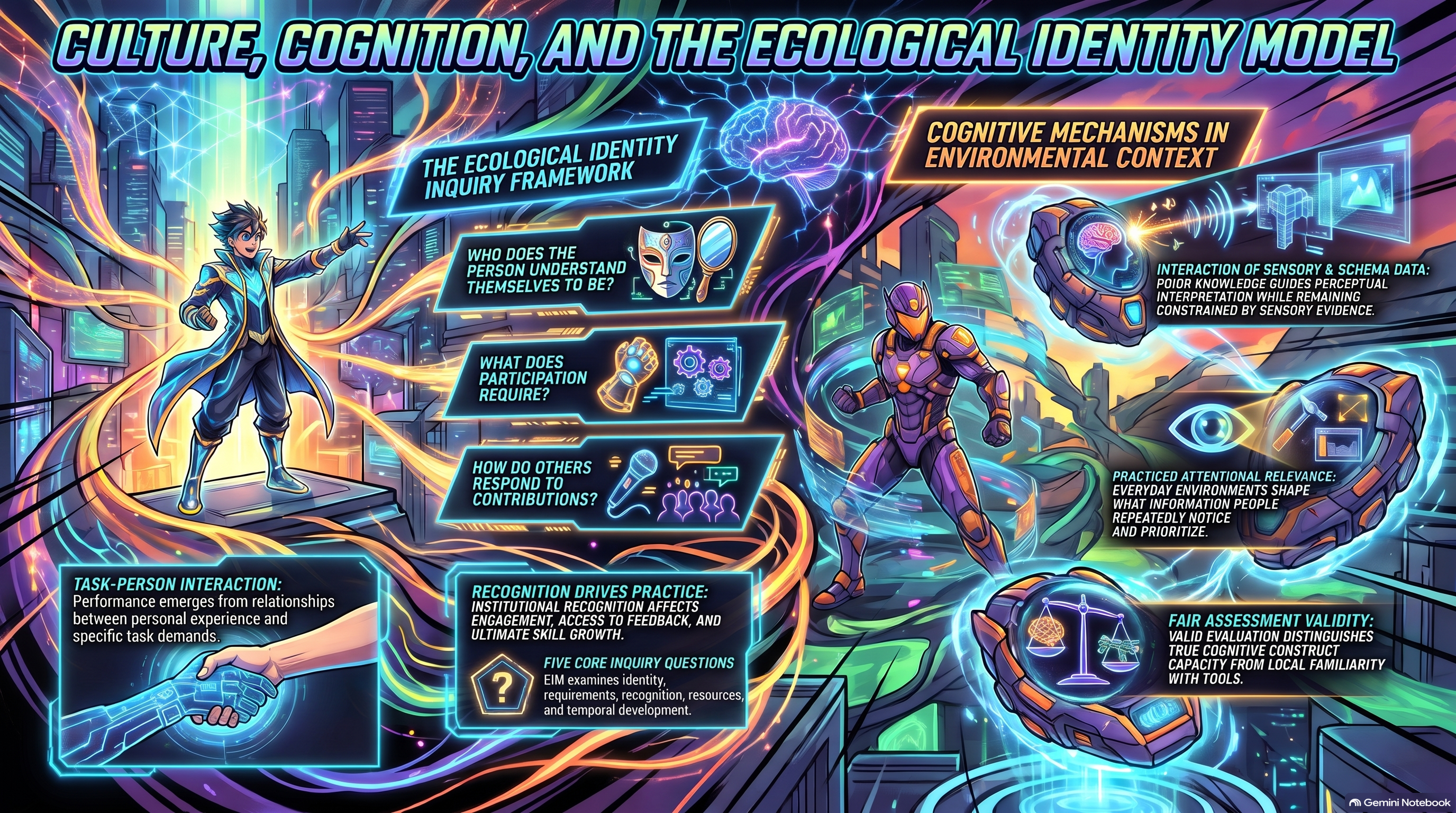
Research updated through November 16 2026
Cognition develops through the interaction of biological capacities, learned knowledge, cultural tools, and the conditions of participation. This chapter examines sensation, perception, attention, language, memory, reasoning, time, and intelligence through an Ecological Identity Model framework.
Readers learn to distinguish cognitive mechanisms, evaluate cultural comparisons, and interpret assessment evidence carefully. Six supplied research articles are integrated alongside selected additional studies, with worked applications in education, workplaces, digital environments, and cultural learning design.
Includes learning activities, review questions with suggested answers, a glossary, and research references.
1 Cognition in a world of meanings
Two trainees watch the same demonstration of a complex machine. One remembers the sequence of controls. The other remembers where coworkers stood, who checked the safety guard, and when the operator asked for help. When the supervisor asks what happened, their accounts differ. Neither difference establishes that one trainee is more intelligent or that they belong to two fundamentally different kinds of mind. They may have attended to different information, used different prior knowledge, interpreted the assignment differently, or anticipated different responsibilities.
Cognition includes the processes through which people acquire, organize, use, and revise information. Sensation, perception, attention, memory, categorization, language, reasoning, and problem solving contribute to these activities. They operate through biological systems while developing within environments that provide tools, instruction, relationships, and recurring demands. Culture matters because these environments make some distinctions useful, some knowledge familiar, and some performances socially consequential. Explaining a difference requires identifying the process rather than treating culture as a final answer.
This chapter uses the Ecological Identity Model, or EIM, to connect cognitive activity with identity, belonging, and participation. Peterson’s public description presents EIM as an evolving framework concerning people and their social environments (Peterson, n.d.). The instructional application here asks how people become recognized as knowledgeable, which cognitive activities a setting supports, and what resources make competent participation possible. These questions extend the framework for teaching; they are not a standardized EIM cognitive assessment or evidence that EIM has explained every process discussed.
The trainees’ experience illustrates why identity belongs in a chapter about cognition. A person trying to demonstrate technical independence may focus on operating the controls. A person assigned responsibility for coordination may monitor coworkers. A newcomer worried about looking incompetent may devote attention to the supervisor’s reactions. These are plausible explanations to test, not predetermined effects of identity. A person’s stated goals, observable behavior, and the task’s demands would help determine which account is appropriate.
Readers will learn to distinguish sensation from perception; compare bottom-up and top-down processing; explain attention and memory; evaluate cultural accounts of reasoning and intelligence; and analyze the fairness of cognitive assessments. The chapter integrates the supplied research papers with selected additional work through November 16, 2026. It separates empirical findings, theoretical proposals, and teaching applications. Fictional cases and original classroom exercises illustrate mechanisms without presenting any person as representative of an entire cultural population.
2 An ecological identity approach to cognitive activity
| Analytical focus | Question for investigation |
| Valued identity | Who does the person understand themselves to be? |
| Expectations | What does participation require? |
| Recognition | How do others respond to the person and their contributions? |
| Resources and constraints | What makes participation possible or costly? |
| Time and change | How does the relationship develop? |
Table 1 A teaching guide developed for this chapter
Cognitive performance occurs in a relationship between a person and a task. The person brings abilities, experience, goals, language, bodily conditions, and expectations. The task has instructions, materials, response requirements, timing, and social consequences. An institution decides which performances count and how results will be used. An ecological approach investigates these connections. It avoids interpreting a score as if the surrounding conditions were irrelevant, while also avoiding the assumption that all differences can be reduced to situational factors.
For this chapter, five questions organize an EIM inquiry. What identity or role matters to the person? What does the activity require? How is competence recognized? What resources and barriers shape participation? How do these relationships develop over time? These are author-created teaching questions based on EIM’s broad concerns. They help formulate hypotheses about cognition without declaring that the hypotheses are established components of the model. A framework becomes useful when it directs attention toward evidence that could change an explanation.
Consider a skilled cook who struggles with a written assessment of ingredient ratios. The difficulty could involve mathematics, reading, unfamiliar units, test anxiety, or the translation of practiced knowledge into a formal representation. The cook might perform well when scaling an actual recipe and poorly when interpreting an abstract worksheet. This difference does not show that the worksheet is meaningless or that practical expertise proves every relevant mathematical skill. It shows why the relationship between tasks needs investigation.
Recognition adds another level. If the examiner treats the cook’s explanation as irrelevant before understanding it, a useful source of evidence disappears. If the examiner accepts every response merely to be encouraging, the assessment also loses value. A fair inquiry clarifies the skill of interest and creates an appropriate opportunity to demonstrate it. It may then identify a genuine learning need, an access problem, or both. Respect for the person and accuracy about performance support one another.
The EIM connection is strongest when specific mechanisms are proposed. A change in recognition might alter willingness to ask questions, which might change access to explanation and later performance. Alternatively, improved performance might elicit recognition. Existing expertise might explain both. These pathways require different evidence. Throughout the chapter, the framework will generate questions about identity and participation while cognitive theories specify processes such as attention allocation, retrieval, and reasoning. Their relationship is complementary rather than interchangeable.
3 Sensation perception and the constraints of reality
Sensation begins when sensory systems respond to physical conditions, such as light, sound pressure, or chemical stimulation. Transduction converts relevant energy into neural signals. Perception involves organizing and interpreting sensory information. The distinction is useful, but the processes are interconnected: attention, learning, and current goals can influence what information is selected and how it is used. A complete account must also respect physical constraints. Cultural influence does not mean that people can perceive anything they wish regardless of the incoming information.
A visitor entering an unfamiliar kitchen may smell something strong without identifying the ingredient. An experienced cook may recognize the aroma and anticipate the next preparation step. Both people have sensory systems responding to the environment, but their knowledge supports different interpretations and actions. The example concerns expertise, which can be culturally organized through training and participation. It does not establish a national difference in sensory thresholds or prove that experience has changed a particular brain region.
Psychophysical methods investigate relationships between physical stimulation and reported or behavioral responses. Researchers may vary intensity, compare discrimination, or examine detection under uncertainty. Interpretation requires attention to response criteria as well as sensitivity. A participant might hesitate to report a faint signal because they do not want to make a mistake, whereas another may respond whenever uncertain. Different response rates can therefore reflect several processes. A culturally meaningful account should specify which aspect of performance it seeks to explain.
The supplied podcast presents cognition as if the brain simply replaces bottom-up processing with cultural expectations. That formulation is too strong. Sensory evidence and prior knowledge interact. Expectations can help resolve ambiguity, but unexpected information can also change an interpretation. A driver who expects an empty crossing can still detect a pedestrian and brake. The scientific issue is how conditions influence processing, not whether people inhabit entirely private realities with no shared evidential constraints.
An EIM-informed observation asks when perceptual expertise is noticed and valued. A trainee may detect a subtle machine sound that an outsider misses because repeated participation has made it informative. If the workplace recognizes only verbal test scores, that competence may remain invisible. Conversely, familiarity with a sound does not establish competence in diagnosis without further evidence. A careful account relates sensory information, learned interpretation, and the task’s practical purpose before making claims about ability.
4 Bottom up and top down processing
Bottom-up processing emphasizes information supplied by the stimulus. Top-down processing emphasizes contributions from knowledge, expectations, goals, and context. These are analytical distinctions, not two independent pipelines or mutually exclusive modes. Reading a sentence requires detecting visual features and connecting them with learned symbols and meanings. When a word is unclear, the surrounding sentence may help. When the visible letters contradict an expected word, additional inspection can reveal the error and revise the interpretation.
A familiar classroom demonstration asks readers to inspect a sentence containing a repeated word. Some readers overlook the repetition on a quick pass. The useful lesson is that fluent processing can favor expected structure under some conditions. The demonstration does not establish that everyone misses the word, that culture determines visual cortex function, or that an error reveals intelligence. Reading speed, instruction, fatigue, display format, and familiarity all provide possible influences on the result.
Schemas are organized knowledge structures that support interpretation. A restaurant schema may include entering, being seated, ordering, eating, and paying. Actual establishments differ, and a visitor may not know when to wait or what to do next. The visitor’s difficulty is not a lack of all social understanding. It may be a mismatch between an available schema and local procedures. Explicit signs, observation, and explanation can support learning without requiring the visitor to infer every expectation through embarrassment.
Assimilation and accommodation describe two aspects of adapting knowledge. Assimilation interprets new experience through existing structures. Accommodation revises those structures when they do not adequately organize the experience. Assimilation is not necessarily distortion; it is part of ordinary understanding. Accommodation is not automatically complete or easy. A learner may retain several interpretations and use them in different settings. Evidence of change requires looking beyond whether the learner can repeat the expected terminology.
Identity can affect what a schema means to a person. A worker accustomed to being an expert may find unfamiliar procedures more threatening than a beginner who expects to ask questions. That possibility should not become a general rule that experts resist learning. EIM encourages investigation of what uncertainty implies for membership and status. A setting can make revision easier by treating questions as part of competent practice, then assessing whether the changed interaction actually improves understanding.
5 What it means for culture to shape cognition
Saying that culture shapes thought can identify an important question while leaving the mechanism unspecified. A difference between groups might reflect different information, preferred strategies, practiced skills, available representations, incentives, or testing conditions. These explanations are not equivalent. If researchers attribute every difference to a deep cognitive transformation, they risk overstating what the design shows. If they assume that culture affects only superficial content, they may overlook how learning creates new forms of skilled activity.
Amir and Pitt’s 2026 review distinguishes several possible pathways: culture may privilege a process while alternatives remain available, prune unused alternatives, produce new processes, or have no effect on the process under study (Amir & Pitt, 2026). This is a conceptual framework for sharpening claims. It does not mean that every observed group difference demonstrates pruning or that the four possibilities can be distinguished with one cross-sectional task. The mechanism must be investigated through predictions appropriate to each proposal.
Suppose one group more often uses a visual strategy and another a verbal strategy. If both can switch after instruction, the difference may concern preference or practice rather than lost capacity. If learning a symbolic system enables a previously unavailable computation, the claim concerns acquisition of a new representational tool. If groups perform similarly when language and task comprehension are controlled, the original difference may not reflect the proposed cognitive process. Each outcome supports a different interpretation.
This distinction is particularly important for cultural neuroscience. A difference in activation during a task does not independently reveal why it occurs or whether one group has greater capacity. Familiarity, effort, strategy, and task difficulty can all affect neural responses. Behavioral and contextual information remain necessary. Brain measurements can contribute evidence about timing and organization, but their apparent precision does not remove the need for a well-defined psychological claim and a defensible comparison.
EIM contributes by locating these mechanisms in activities that matter to people. A setting may repeatedly reward one strategy, provide tools for another, or discourage questions that would enable a learner to try alternatives. Identity and recognition could then influence opportunities for cognitive practice. These are testable connections rather than evidence that all cultural effects are identity effects. The strongest account states which pathway is proposed, what the person does, and what observation would challenge the explanation.
6 Attention goals and the selection of information
Attention involves selecting and prioritizing information for processing and action. Selection can be guided by a task, current goals, learned relevance, or a striking event. Attention is limited, but describing it as a single reservoir can be misleading. Different tasks place different demands on perceptual selection, maintaining goals, switching, and resisting distraction. A person’s performance depends partly on how these demands combine. Competing tasks can interfere even when each seems easy in isolation.
Imagine a student listening to a lecture while monitoring messages about a family member’s transportation. Divided attention may reduce learning, but the student’s behavior is not adequately described as a preference for distraction. The messages may concern an immediate responsibility. An ecological inquiry distinguishes the cognitive cost from the reason the competing task exists. A useful response might address notification practices, course access, or practical support, depending on the situation and the student’s choices.
Sustained attention concerns maintaining effective performance over time. Selective attention concerns prioritizing relevant information among alternatives. Executive control includes maintaining goals and regulating responses. These labels overlap and depend on the task used to measure them. A single score should not be treated as a complete description of a person’s attention. The same person can struggle in a monotonous monitoring task and sustain intense attention during a meaningful skilled activity.
Culture can organize attentional practice by shaping what people repeatedly need to notice. Work, caregiving, navigation, literacy, games, and rituals provide different learning histories. A fisherman may notice water movement that a novice misses; a proofreader may detect a small typographic error. These examples concern domain knowledge, not claims that one community possesses more attention overall. Researchers need to distinguish a difference in what becomes relevant from a difference in maximum capacity.
EIM adds questions about the social stakes of noticing. A novice may monitor whether a supervisor approves while an experienced worker monitors the equipment. A person who expects interruption may prepare a defense instead of following the discussion. These pathways are plausible but require evidence. A practical assessment asks what the participant believes the task requires, what competes for attention, and whether the setting supports the intended activity. Only then can an observed error be interpreted responsibly.
7 Analytic and holistic attention revisited
Analytic attention emphasizes focal objects and their properties, whereas holistic attention emphasizes relationships and contextual information. The terms summarize tendencies studied with particular tasks. They do not identify fixed mental types, opposite levels of intelligence, or permanent national styles. A person can analyze an isolated component while repairing a device and attend to the whole interaction while negotiating a disagreement. Explaining cultural variation requires studying when a tendency appears and how it was learned.
Masuda and Nisbett’s influential 2001 study compared Japanese and American participants using animated underwater scenes and recognition tasks. Both groups attended to salient objects, while Japanese participants more often included contextual information and showed context-sensitive recognition patterns (Masuda & Nisbett, 2001). The study provides evidence about the sampled groups and procedures. It does not show that American participants could not perceive backgrounds or that Japanese participants always process entire scenes without selective attention.
Description, eye movement, recognition, and inference are related but distinct outcomes. A participant can look at an object without later mentioning it. Another may remember background information because the reporting task makes it relevant. When researchers compare several indicators, they can ask whether an effect concerns early selection, encoding, retrieval, or communication. Treating every outcome as perception obscures these possibilities and can make a proposed explanation appear broader than its evidence.
The ecological identity questions concern practiced relevance and anticipated evaluation. A participant may expect to identify the main object because that is what previous school tasks rewarded. Another may expect a complete scene description. These possibilities do not disprove a cultural interpretation; they specify potential learning mechanisms. Researchers could vary instructions, examine participants’ understanding, or compare performance across tasks. Such designs help distinguish learned defaults from limits on available strategies.
For educators, the appropriate response is to make relevant cognitive demands explicit and teach flexible strategy use. Students can practice identifying a central claim and analyzing the relationships that give it meaning. Assigning a student a holistic or analytic identity on the basis of nationality would restrict the very flexibility instruction should support. EIM is useful here when it prompts recognition of multiple competencies and investigation of how classroom expectations make those competencies visible.
8 Space navigation and cultural tools
Spatial cognition includes representing locations, relationships, routes, directions, and transformations. People can describe a location relative to their own body, another object, or a more stable environmental reference. Saying that a cup is to my left differs from saying that it is beside the kettle or north of the stove. These descriptions require different information and can serve different purposes. A useful comparison specifies the reference frame rather than treating spatial ability as one undifferentiated skill.
Environmental demands provide opportunities to practice particular representations. A city grid, a winding settlement, an open landscape, a transit map, and a digital navigation system offer different cues. Familiarity with one can support efficient action there without transferring completely to another. An experienced driver can become disoriented when signs, traffic conventions, and road layouts change together. The problem involves expectations and learned action patterns rather than a sudden loss of general intelligence.
Maps are cultural tools. They select features, represent relationships, and assume conventions such as scale, orientation, symbols, and the relationship between a flat surface and a traveled environment. A person unfamiliar with those conventions may navigate skillfully using landmarks while struggling with a formal map. Instruction can connect existing route knowledge with the map’s conventions. Comparing the two performances helps identify which representational demands require learning, rather than assuming that one task transparently measures all navigation competence.
The same issue appears in spatial assessments. Rotating a pictured object, imagining another viewpoint, remembering a route, and coordinating movement are different activities. Performance can depend on visual experience, practice, language, and instructions. Researchers should examine transfer: does experience improve only a familiar item format, several related tasks, or practical navigation? A broad claim about spatial cognition requires more evidence than success on one specialized procedure.
An EIM approach asks who has access to spatial tools and who is recognized as knowledgeable. In a community project, local route expertise may be overlooked because it is not expressed through professional mapping software. Conversely, local expertise does not remove the value of surveying or engineering knowledge. Combining forms of knowledge requires clear communication about their purposes and limits. The ecological task is to organize participation so that relevant competence can inform a shared problem without assuming that all representations are interchangeable.
9 Traffic environments and the Simon effect
Baess and colleagues’ supplied study offers a concrete alternative to explaining every cultural difference through individualism and collectivism. It compared participants from Australia, China, Germany, and Malaysia using a Simon task that distinguished spatial information relative to the display from spatial information relative to a contextual object (Baess et al., 2023). The country comparisons varied in both traffic directionality and broad cultural orientation. This design makes the physical organization of everyday environments part of the cognitive question.
In a typical Simon task, a participant responds to a task-relevant feature while the stimulus appears in a location that can facilitate or interfere with the response. The Simon effect is the difference associated with spatial compatibility. A response can be faster when an irrelevant location corresponds with the response side. The task therefore investigates how spatial information enters action selection, not whether participants understand traffic rules or can navigate safely in a different country.
The authors found reliable global and local Simon effects across the groups. The global effect was larger in samples from countries with left-hand traffic, while local effects varied with the study’s grouping by cultural orientation. Their interpretation allows more than one cultural pathway: everyday spatial environments and social-cultural orientation may relate to distinct aspects of performance. The result does not imply that one factor explains all spatial processing or that one group is generally better at spatial reasoning.
The limitations matter. Countries were not randomly assigned traffic systems, and individual experience can differ within each country. The cultural-orientation classification relied on country-level indicators, which cannot establish every participant’s values. Other differences, including aspects of task administration and sample composition, remain relevant. The study is valuable because it broadens the explanation and reveals a discriminating pattern. Its design does not isolate lifetime traffic exposure as an experimentally established cause.
For EIM, the lesson is to examine actual activities and settings before invoking a broad group label. A follow-up might record driving, cycling, walking, years in a traffic system, and navigation demands. Identity could become relevant if occupational roles organize those experiences, but that connection would need direct measurement. A task effect should not be described as an identity effect merely because it occurs in a cultural comparison. The framework helps locate candidate pathways; the study design must establish their contribution.
10 Concepts categories and ways of organizing knowledge
A concept organizes knowledge about a class, property, event, or relationship. Categorization assigns an instance to a grouping for a purpose. People may group objects because they share features, belong to a common kind, participate in the same activity, or serve a similar function. A knife and spoon can be grouped as utensils; a knife and cutting board can be grouped through use. Neither grouping is inherently illogical. The question is what relation the task asks the participant to identify.
Superordinate categories are relatively broad, such as furniture. Basic categories are more familiar or useful at an intermediate level, such as chair. Subordinate categories are more specific, such as rocking chair. These levels describe relationships within an organization of knowledge, not a rule that the same level is equally basic for every expert and novice. Someone who works with many chair designs may routinely distinguish forms that another person treats as equivalent.
Taxonomic groupings emphasize membership in a kind. Thematic groupings emphasize relationships within events or activities. The familiar example of a cow, a chicken, and grass illustrates the difference: cow and chicken share a broad category, while cow and grass have a feeding relationship. Responses can depend on instructions, the salience of the relation, age, schooling, and how the pictures are understood. One selection cannot establish that a participant lacks the alternative concept.
Categories also organize social life. Terms such as expert, beginner, student, caregiver, and leader group people through institutional expectations. These categories can direct attention to real responsibilities while concealing variation. A worker treated as a beginner in a new organization may have substantial relevant expertise. A person categorized as a difficult learner may become less likely to receive advanced opportunities. Such consequences connect cognition with power without implying that all categorization is harmful or avoidable.
An ecological identity analysis asks what a category enables people to infer, who controls its application, and what opportunities follow. Researchers can compare classification across purposes rather than assuming one task reveals a complete worldview. In teaching, ask students to produce several defensible groupings and state the organizing relation. The exercise demonstrates flexibility and makes the reasoning visible. It also shows why disagreement can concern the selected criterion rather than intelligence or factual understanding.
11 Language and categorization without linguistic determinism
Language supplies conventional ways to distinguish, describe, and communicate experience. Some languages require grammatical distinctions that others leave optional. Such differences can influence habitual attention and representation, but they do not automatically create impermeable boundaries around thought. People can learn new terms, use nonverbal representations, and reason about distinctions their language does not encode in one word. Linguistic influence should therefore be investigated through specified tasks rather than assumed from vocabulary or grammar alone.
Sera and colleagues’ supplied study examined numeral classifiers and categorization of solid objects. One experiment elicited classifier use among Hmong, Japanese, and Mandarin speakers; another compared similarity ratings among speakers of those languages and English (Sera et al., 2023). The first experiment included 34 adults and the second 64. The design separated patterns in linguistic classification from patterns in perceived similarity, allowing the proposed language-cognition relationship to be tested rather than presumed.
The findings included shared organization into natural kinds and artifacts, alongside differences in how some groups rated human-animal similarity. Crucially, differences in similarity judgments did not simply follow the classifier patterns. This result qualifies a straightforward account in which the grammar determines conceptual grouping. It also leaves room for language to matter through other processes. A failure of one predicted correspondence does not establish that all language effects are absent.
The samples and materials limit the reach of the inference. Adults rated pictured solid objects under defined instructions. That activity is not equivalent to every spontaneous categorization, every conversational use of classifiers, or children’s acquisition of concepts. Within-language variation, migration experience, bilingualism, and expertise may also matter. A careful summary preserves both the observed common structure and the specific differences without turning the study into a broad ranking of languages or conceptual sophistication.
For EIM, language can shape access to recognized participation. A multilingual learner may understand an event but lack the locally expected label for explaining it. Another may know the label without understanding the relevant relationship. Assessment should distinguish these possibilities. Translation, demonstration, and examples can clarify task comprehension, while carefully chosen comparisons can test the construct of interest. Supporting multiple routes to explanation expands evidence about competence; it does not require treating every response as equally accurate.
12 Reasoning rules relationships and useful strategies
Reasoning involves drawing conclusions, evaluating relationships, and using information to solve problems. Deductive reasoning concerns what follows if premises are accepted. Inductive reasoning extends beyond observed cases with uncertainty. Analogical reasoning maps relationships between situations. These processes interact with knowledge and goals. A logically valid conclusion can follow from false premises, while a plausible conclusion may not be deductively guaranteed. Understanding the task requires distinguishing the form of the reasoning from the truth or familiarity of its content.
A fictional example concerns two workshop apprentices choosing a material. One recalls that the material worked in a similar repair. The other applies a general rule about heat resistance. Both approaches can be useful, but each has limits. The analogy may overlook a relevant difference, and the rule may be misapplied to an unfamiliar condition. The best decision may require combining formal principles with situational knowledge. A cultural comparison should not assume that practical and formal reasoning represent incompatible minds.
People also reason about contradictions. Two apparently incompatible statements may concern different times, perspectives, or levels of analysis. Context can reveal that both capture part of a situation, but some contradictions remain genuine. Being willing to examine context is not the same as abandoning consistency. Conversely, insisting on a formal distinction is not automatically an inability to appreciate relationships. Tasks should identify whether participants are evaluating evidence, resolving ambiguity, or responding to a social expectation about disagreement.
Education provides repeated practice in particular forms of explanation. A classroom may reward giving one answer quickly, showing every step, comparing alternatives, or challenging assumptions. Those routines can influence strategies available in later tasks. To establish the effect, researchers need information about actual instruction and performance over time. Schooling cannot be inferred completely from years of attendance, and national averages cannot substitute for the learning history of a particular participant.
An EIM-informed reasoning environment makes it possible to explain uncertainty and revise an answer without losing legitimacy as a learner. It also maintains standards for evidence and logic. A teacher can ask what relation supports an analogy, which premise is uncertain, and what observation would change the conclusion. Such prompts reveal reasoning processes more clearly than judging confidence or conversational speed. Their effectiveness remains an empirical question, but their purpose follows directly from distinguishing the target process from its social presentation.
13 Social cognition attribution and contextual evidence
Social cognition concerns how people interpret others, infer intentions, organize social knowledge, and anticipate interaction. Attributions are explanations for behavior or outcomes. They may emphasize dispositions, situations, temporary states, relationships, or several causes together. An observer who explains a missed deadline as irresponsibility has made a different claim from one who identifies a software failure. Both claims require evidence. The interpretation can affect what happens next, including whether the person receives correction, punishment, assistance, or trust.
The fundamental attribution error describes a tendency, under some conditions, to overemphasize dispositions relative to relevant situational constraints. Cultural research has complicated claims that this tendency is equally strong everywhere. However, replacing a universal claim with a rule that Westerners judge personality and Easterners judge situations is still too broad. Relevant information, task framing, attentional demands, social relationships, and within-group variation can change the pattern. The term error also requires identifying which contextual information should have been considered.
The supplied overview uses athletes’ public explanations of success as evidence about attribution. Public statements are valuable cultural materials, but they are also performances shaped by audiences, interview conventions, and expectations about gratitude. Crediting a coach does not establish that an athlete privately rejects personal effort. Emphasizing effort does not establish that the athlete ignores all social support. A strong design distinguishes reported explanations, inferred beliefs, and observed decision making rather than treating them as interchangeable.
Consider a fictional team member, Rosa, who challenges a manager in a meeting. One observer sees disrespect. Another sees responsibility for preventing an error. A third notices that Rosa was denied a chance to raise the issue privately. The ecological inquiry asks what happened, which expectations were communicated, and what options were available. Rosa’s cultural background may matter through learning and experience, but knowing a demographic category does not settle the meaning of this event.
EIM connects attribution to recognition. Repeatedly interpreting one person’s questions as incompetence while treating another’s as engagement can change access to learning and responsibility. To investigate that pattern, researchers could examine comparable interactions, decision records, and participants’ accounts. They should also test alternatives, such as differences in task relevance or information. The framework directs attention to the consequences of interpretation while evidence determines whether a proposed recognition process actually occurs.
14 Confirmation bias metacognition and revision
Confirmation bias refers to patterns of seeking, interpreting, or remembering information in ways that favor an existing view. It can arise through several mechanisms. People may choose congenial sources, ask questions that invite expected answers, or interpret ambiguous evidence as supportive. A teacher expecting a student to struggle might notice errors more readily than successful reasoning. Identifying a bias requires comparing behavior with an appropriate evidential standard, not merely observing that someone has a strong opinion.
The supplied summary states that confirmation bias is stronger in individualistic cultures because collectivistic cultures emphasize self-criticism. That claim is not retained as a general conclusion. Self-criticism in one domain does not demonstrate evenhanded evaluation of evidence in another. A person can criticize personal performance while defending a group belief, or express confidence while evaluating a factual claim carefully. Any proposed cultural difference requires defined measures, matched conditions, and evidence about the particular process.
Metacognition concerns monitoring and regulating one’s own cognitive activity. A student judges whether material is understood, decides when to ask for help, and selects a study strategy. Confidence and accuracy are distinct: someone may be correct but uncertain, or confident and mistaken. Public expressions of certainty can also reflect social conventions rather than private belief. Researchers should therefore distinguish actual performance, confidence judgments, and the interpersonal meaning of expressing confidence in a setting.
Identity can make revision consequential. A person who has publicly defended a position may worry that changing it will threaten credibility. An organization may make uncertainty costly by rewarding confident announcements and punishing admission of mistakes. Alternatively, a professional identity can support correction when accuracy is treated as more important than appearing infallible. These are proposed pathways, not universal identity effects. Observations of actual feedback, incentives, and revisions are needed to identify them.
A practical reasoning routine is to state a claim, identify its strongest support, name a plausible alternative, and specify evidence that would favor the alternative. Students can also compare what they predicted with what happened. The goal is calibration rather than ritual self-doubt. An EIM-informed setting supports being a legitimate participant while acknowledging error, and then evaluates whether that support helps people investigate more carefully. Belonging and critical thinking can reinforce one another when membership does not depend on defending every prior belief.
15 Memory as encoding retention and retrieval
Memory includes processes that allow experience to influence later activity. Encoding concerns how information enters a form that can be retained. Retention concerns its persistence over time. Retrieval concerns using stored information when it becomes relevant. These distinctions help organize research, but they are not independent boxes through which information passes unchanged. Retrieval can alter later remembering, and existing knowledge can influence how an event is encoded. A memory report is therefore evidence about a process, not a complete recording of the original experience.
Working memory supports maintaining and manipulating information during ongoing activity. Long-term memory includes several forms of knowledge and skill. Semantic memory concerns general knowledge, concepts, and meanings. Episodic memory concerns events located in a particular context. Procedural learning supports skilled routines. These categories overlap in practical activity. Preparing a familiar dish can involve knowing ingredients, remembering a particular meal, holding quantities in mind, and executing practiced movements with little verbal explanation.
Culture can influence what is repeatedly practiced, what receives attention, which events are discussed, and which cues become useful. A learner who knows a task’s structure can organize information that otherwise seems unrelated. This is not evidence that familiar material is always remembered perfectly. Prior knowledge can also support an incorrect inference. The task determines whether gist, precise detail, source information, sequence, or successful action is the relevant outcome.
A fictional student, Hana, remembers the central explanation of a lecture but cannot reproduce its wording. Another student recalls several sentences but cannot apply the principle. A test of quotation and a test of transfer would produce different judgments. An ecological account asks what was taught, practiced, and assessed before drawing a broad conclusion about memory. It also asks whether the students understood what they were expected to remember and how they would be evaluated.
EIM connects memory to participation through the distribution of opportunities. Being included in a discussion can supply explanation, rehearsal, and meaningful cues. Being assigned only peripheral tasks can limit exposure to the information later tested. Those pathways concern learning conditions rather than the assumption that exclusion directly damages every memory process. Investigators should trace what information was available, how the person engaged with it, and which retrieval demands were imposed. A memory score becomes more interpretable when those conditions are visible.
16 Cultural schemas and the course of forgetting
Schemas can support memory by organizing material into a meaningful event. A person familiar with a festival may understand references to particular foods or activities that a newcomer finds disconnected. Familiarity can improve comprehension and recall, while also encouraging inference beyond what was actually presented. Researchers need to distinguish remembered information from plausible reconstruction. They also need to distinguish a higher initial level of recall from a slower subsequent rate of forgetting.
Peng, Logie, and Della Sala’s 2026 study directly examines that distinction using culturally situated prose and multiple recall delays (Peng et al., 2026). Across four experiments, activation of relevant cultural schemas supported immediate and delayed remembering. The reported pattern did not show that the schema advantage necessarily changed the rate of forgetting. Better initial learning and greater persistence are different explanatory claims, even when one group remembers more at a later test.
The researchers reduced a testing complication by separating material assessed at different delays: repeatedly retrieving the same information can strengthen later memory. They also examined scoring and errors. These design choices help distinguish better learning from changes in forgetting.
The educational implication is a hypothesis rather than a ready-made guarantee. Relevant background knowledge may help learners understand new material, but teachers should still assess retention and application separately. Providing a familiar example is not evidence that students will remember the material indefinitely. A class could compare initial recall and delayed application while examining whether the example supplied useful structure or merely made the lesson feel easier. Perceived fluency and durable learning are not identical.
An EIM-informed lesson asks whose prior knowledge is recognized as a resource. If examples consistently draw on experiences available to only some students, others may need additional context before demonstrating understanding. The response is to make necessary background accessible and invite relevant knowledge, while maintaining accuracy about the target concept. The memory mechanism should be measured independently of belonging. A lesson could improve comprehension without changing belonging, or strengthen recognition without improving later recall. Either result would refine the proposed explanation.
17 Autobiographical memory and the narrative self
Autobiographical memory concerns a person’s remembered life, including specific episodes and broader knowledge about the self. It develops through cognitive maturation, language, conversation, and participation in social practices. Remembering an event also involves interpreting why it matters now. A story about solving a childhood problem may become evidence of independence, family support, persistence, or collective responsibility. Different tellings can emphasize different meanings without necessarily contradicting the underlying event.
Wang’s study of European American and Chinese children connected autobiographical remembering with emerging self-descriptions (Wang, 2004). It provides a developmental example of how memory and self-understanding can be examined together. The relevant inference concerns sampled children, elicitation procedures, and patterns in their accounts. It does not establish that all members of a national population share one narrative form or that a less individually focused story reveals a weaker memory system.
The age of earliest reported memory requires particular care. A retrospective report combines remembering, language, dating, personal beliefs, and family information. People can remember an event while misestimating its age, or know a family story without remembering the original experience. Group differences in reported earliest memories therefore do not establish a ranking of memory quality. Precise claims require appropriate designs, attention to how dates are established, and recognition of variation within each sample.
Family conversation is one candidate pathway. Adults can ask about feelings, sequence, participants, consequences, or lessons, providing different opportunities for children to elaborate events. Yet the content and frequency of conversation are not fully described by broad labels such as individualistic or collectivistic. Families vary with language, resources, relationships, interests, and circumstances. A useful study examines actual interaction and later remembering instead of assuming the process from membership in a category.
EIM is relevant because autobiographical narratives help people connect remembered experience with valued identities and possible futures. A student may describe a difficult transition as evidence of failure or as part of becoming competent with support. Other people can confirm, challenge, or expand that account. The framework suggests investigating this social interpretation without assuming that a positive narrative always improves well-being. Accuracy, agency, and room for complexity matter; people should not be pressured to turn every painful experience into an uplifting story.
18 Remembering together and imagining futures
Remembering is often social. People remind one another of events, divide responsibility for information, consult records, and negotiate shared accounts. A team may know collectively what no single member can recall alone. One person remembers client requirements, another the technical constraints, and another the decision history. This distribution can be effective when members know where expertise resides and can retrieve it reliably. It can fail when information is inaccessible, trust is misplaced, or responsibilities are unclear.
External tools also participate in remembering. Notes, photographs, archives, calendars, and digital records preserve selected information while leaving other details unrecorded. Using a reminder changes the task from remembering the entire content to remembering where and when to consult it. This can support competent action without demonstrating that unaided memory has improved. Evaluation should match the practical goal. A safe workplace may reasonably value reliable use of checklists over impressive recall performed without them.
Future thinking often recombines remembered information with current goals and imagined possibilities. Planning a community event requires anticipating attendance, resources, weather, relationships, and sequence. Participants may disagree because they remember different prior events or prioritize different outcomes. A shared plan is therefore both a cognitive representation and a social arrangement. Its usefulness depends on whether people understand the same commitments and have the means to act on them.
Collective memory can also become contested. An institution’s official history may celebrate achievements while omitting the contributions or experiences of less powerful participants. That omission is not simply a failure of individual storage. It can follow decisions about records, commemorations, curriculum, and whose testimony is treated as credible. A responsible inquiry distinguishes documented events, retrospective accounts, and interpretive claims. Recognizing multiple perspectives does not require treating every factual assertion as equally supported.
EIM asks how shared remembering supports or restricts belonging. Being included in the story of a place can communicate that a person’s contribution counts. Being required to endorse one narrative can make membership conditional. These possibilities need investigation through actual practices and participant accounts. The framework also directs attention to future identities: which roles can people imagine occupying, and which arrangements make those futures plausible? Cognitive representations and material opportunities must be examined together rather than assuming that imagining a future makes it available.
19 Temporal cognition and mental time travel
Temporal cognition includes judging duration, ordering events, remembering when something happened, anticipating future events, and coordinating action. These are related but distinct tasks. Estimating how long a wait lasted differs from remembering whether a conversation occurred before or after lunch. Planning for next year differs from detecting a short interval between tones. A cultural account should specify which process it examines rather than treating time perception as a single attitude toward punctuality.
Pendleton and Clayton’s supplied 2026 review brings psychology, language, memory, anthropology, neuroscience, and comparative cognition into conversation around mental time travel (Pendleton & Clayton, 2026). Mental time travel concerns remembering past experience and constructing possible futures. The review emphasizes that language, social organization, and technologies can influence temporal representation and coordination. It is a multidisciplinary synthesis and theoretical contribution rather than a single experiment proving one cultural cause.
Clocks and calendars externalize temporal information. They allow people to coordinate across distance and organize commitments beyond immediate perception. At the same time, measured clock time and experienced event structure can diverge. A meeting scheduled for an hour may feel brief when engaging and prolonged when uncertain or uncomfortable. These experiences should not be reduced to national preference. Attention, expectation, affect, activity, and social stakes all supply candidate influences requiring direct study.
The review also discusses comparative evidence relevant to memory and prospective behavior in nonhuman animals. Such findings challenge sharp assumptions that every component of temporal cognition is exclusively human. However, a behavioral demonstration of episodic-like memory or planning does not provide direct access to another species’ subjective experience of remembering. The distinction between functional performance and conscious phenomenology should remain explicit. Scientific progress often depends on narrowing the claim to what a task can actually establish.
For EIM, time connects identity with continuity and opportunity. A person may organize current action around becoming qualified, maintaining a relationship, or preserving knowledge for another generation. Institutions can support these projects through reliable schedules and access, or make them difficult through instability. These are applications of the framework, not findings established by the temporal review itself. A testable inquiry would identify the relevant future representation, the conditions of action, and the consequences for participation over time.
20 Schedules deadlines and the social organization of time
A deadline is both temporal information and a social expectation. It coordinates people, distributes responsibility, and signals what counts as reliable participation. A missed deadline can reflect poor planning, unclear communication, competing obligations, lack of resources, or an unexpected event. The fact that time practices are culturally organized does not make every deadline arbitrary. Some protect safety or coordination, while others can be revised without compromising the purpose of the activity.
The supplied summary contrasts a finite Western timeline with infinite Indian time. That binary is not retained as a general account. Religious or philosophical ideas about cycles do not directly determine how every participant schedules a meeting, and national populations contain many institutions and time practices. A hospital, family gathering, examination, and agricultural task can each organize time differently within the same community. Researchers should investigate the practice and its function instead of assigning temporal character from nationality.
A fictional team spans several time zones. One member interprets an immediate reply as respect. Another reserves uninterrupted periods for complex work. A third shares a device and cannot respond continuously. Their conflict may appear to concern commitment while actually involving incompatible expectations and resources. The practical response is to define response windows, distinguish urgent from routine messages, and clarify ownership of tasks. Such coordination makes implicit expectations available for negotiation.
Time allocation can also express power. Some people can require others to wait, change schedules without consultation, or treat their own commitments as automatically more important. Those arrangements influence whose participation is sustainable. An ecological inquiry examines notice periods, schedule control, travel time, care responsibilities, and the consequences of refusing a demand. A cultural explanation that focuses only on punctuality can overlook these institutional asymmetries.
EIM adds questions about recognition. Does a person become known as unreliable because the schedule presumes resources they do not possess? Does an institution acknowledge preparation and coordination that occur outside visible meeting time? These questions should be tested through records and accounts rather than assumed from unequal outcomes. A workable revision identifies the function of the timing requirement, makes expectations explicit, and evaluates both coordination and burdens. Flexibility and predictability are design choices whose value depends on the activity and its participants.
21 Cognitive development through action and relationship
Cognitive development involves changes in how people understand and act on the world. Biological maturation matters, but developmental pathways also involve learning, participation, tools, and relationships. A child learns to count, explain, plan, and coordinate through repeated activity. The opportunities differ across settings, and performance depends partly on what the child understands the task to require. A developmental theory should explain change while remaining open to variation in timing, expression, and experience.
Yıldız’s supplied 2025 paper compares Piaget, Vygotsky, and Tomasello (Yıldız, 2025). Piaget emphasizes active construction and the reorganization of knowledge. Vygotsky emphasizes social interaction and cultural tools, especially language. Tomasello emphasizes shared intentionality and culturally supported learning, informed by comparative work. The paper is a theoretical comparison rather than a new longitudinal experiment adjudicating among the accounts. Its contribution is to organize relationships and disagreements among influential approaches.
Piaget’s stage account remains historically important, but a rigid timetable should not be used to infer every child’s competence from age alone. Task demands, familiarity, instruction, and domain can affect performance. Vygotsky’s zone of proximal development directs attention to the difference between independent performance and performance supported through interaction. That difference needs careful interpretation: a successful response with extensive adult guidance does not automatically demonstrate independent mastery or guarantee transfer to another task.
Shared intentionality concerns coordinating with others around goals and attention. In a classroom, a child may need to understand not only the materials but also what the teacher is trying to show. Misunderstanding the communicative purpose can produce an incorrect response without identifying the full extent of conceptual knowledge. Conversely, copying an expected procedure can conceal limited understanding. Assessing explanation, variation, and transfer helps distinguish participation in the routine from flexible use of the underlying idea.
EIM asks how the developing learner becomes recognized as capable of contributing. A child trusted with meaningful responsibility gains opportunities to observe consequences and practice judgment. Another may receive extensive direction while being offered few opportunities to initiate. These are possible developmental conditions, not universal outcomes of particular parenting styles. A study should observe actual activities over time and separate adult intention, child experience, supported performance, and later independent competence. The framework helps connect developmental questions with the social organization of learning.
22 Evolution cultural diversity and early cognition
Questions about ancient cognition require indirect inference. Archaeological materials can show that people produced tools, transported objects, used pigments, or organized activity. They do not provide a direct recording of thought. The same artifact might be consistent with several learning processes, while similar cognitive capacities can produce different material traces under different conditions. Reconstructing the past therefore requires explicit assumptions about the relationship between behavior, culture, preservation, and cognitive ability.
Bender, Mendoza Straffon, Gatewood, and Beller’s supplied paper argues that culture has a dual role: it scaffolds cognition through development and evolution while also generating diversity in how people think (Bender et al., 2024). This challenges reconstructions that acknowledge a general capacity for culture but neglect variation among particular traditions. The paper is a theoretical and methodological analysis, published online in 2023 and in its journal issue in 2024. It is not a direct measurement of ancient individuals’ cognitive performance.
The authors discuss broad extrapolation and phylogenetic comparison as complementary strategies. Broad comparisons can help distinguish shared features from culturally variable ones. Comparisons informed by historical relationships can investigate how traits or practices may have developed. Both require careful data and assumptions. Modern communities should not be arranged as a ladder from primitive to advanced or treated as unchanged substitutes for ancient populations. All living communities have histories and participate in contemporary conditions.
Cultural tools also complicate the separation between capacity and accomplishment. A person working with a number system, writing, an archive, and accumulated techniques can solve problems unavailable in the same form without those resources. That does not establish that earlier people lacked all relevant capacities. It highlights how institutions and transmitted knowledge enable performance. Conversely, the presence of a complex tool does not reveal every process used by each learner who encountered it.
EIM contributes a question about participation in the transmission of expertise. Who could observe skilled activity, receive instruction, use tools, and become recognized as competent? Those questions may guide hypotheses about social learning, but they do not validate the model in prehistoric populations. The strongest connection is methodological: cognitive explanation should consider the environment and cultural history that make a performance possible. Claims about ancient identities or belonging require evidence appropriate to that historical scale and should remain provisional.
23 Intelligence as a scientific construct
Intelligence research investigates patterns in learning, reasoning, knowledge, problem solving, and adaptation. The construct is not equivalent to a person’s worth, moral character, or complete potential. It is also not simply a synonym for whatever a community admires. Scientific accounts need defined tasks and evidence about relationships among performances. Cultural evaluation matters because societies choose which abilities receive opportunities and recognition, but that fact does not make every measured cognitive relationship arbitrary.
Spearman’s general factor, commonly written g, summarizes shared variation across cognitive tasks (Worthy et al., 2020). It is a statistical construct inferred from patterns of covariance, not a single observed organ or a score that explains itself. People who perform well on one cognitive task tend, on average, to perform well on others, while also showing specific strengths and weaknesses. A general factor and more specific abilities can be represented within hierarchical models rather than treated as mutually exclusive alternatives.
Fluid reasoning concerns working with novel relationships and problems. Crystallized abilities concern acquired knowledge and its use. The distinction associated with Cattell remains useful, but fluid does not mean untouched by learning or culture. Understanding instructions, interpreting diagrams, sustaining engagement, and selecting strategies can draw on experience even when the item content is unfamiliar. Crystallized knowledge can support complex reasoning rather than merely the recall of simple facts.
The Cattell-Horn-Carroll framework organizes broad and narrower cognitive abilities within a substantial psychometric research tradition. It should not be presented as identical in every detail across all researchers or batteries. Its relevance here is that cognitive structure can be investigated across populations instead of assumed to be either completely universal or completely local. A model’s generalizability concerns empirical relations among measures, while the fairness of a particular use requires additional evidence.
An EIM perspective asks how assessment results enter a person’s opportunities and identity. A score can help identify support needs or access to instruction. It can also be misused as a permanent label that narrows expectations. The appropriate interpretation depends on the evidence, purpose, conditions, and uncertainty. Recognizing cultural context does not require denying genuine differences in current performance. It requires explaining those differences carefully and distinguishing what was measured from what is inferred about a whole person.
24 Multiple theories and culturally valued competence
Sternberg’s triarchic account distinguishes analytical, creative, and practical intelligence. It directs attention to evaluating problems, generating possibilities, and acting effectively in context. Gardner’s theory of multiple intelligences broadens discussion to capacities such as linguistic, musical, spatial, interpersonal, and bodily skill (Worthy et al., 2020). These proposals have influenced education, but they should not be presented as having the same evidential status as every factor-analytic model. Distinct terminology can organize useful questions without demonstrating independent cognitive systems.
Recognizing varied strengths is an educational goal that does not depend on assigning each student a fixed intelligence type. A learner can benefit from language, diagrams, practice, feedback, and social explanation in different combinations depending on the content. The claim that instruction should be matched to a diagnosed learning style requires specific evidence of improved outcomes. Pashler and colleagues’ review found that the evidence did not justify routine adoption of that matching approach (Pashler et al., 2008).
Culturally valued competence concerns what a community recognizes as knowledgeable or capable conduct. Negotiating a dispute, reading a landscape, maintaining equipment, explaining a principle, or anticipating another person’s needs may all receive recognition. It is reasonable to investigate these activities without assuming they measure one identical construct. Practical expertise, social judgment, academic reasoning, and moral evaluation can overlap, but overlap is an empirical question rather than a conclusion supplied by calling them all intelligence.
The supplied summary contrasts Western speed and achievement with Eastern benevolence and African social responsibility. These broad descriptions can introduce questions about local ideals, but they are too sweeping as population claims. Communities contain internal differences, and the same person may value speed in an emergency, care in a relationship, and accuracy in an examination. A better study asks participants about concrete situations and examines whether local definitions predict identifiable behavior.
EIM helps distinguish competence from its recognition. An institution can overlook a useful skill because it does not fit a familiar credential or presentation style. It can also overvalue confidence without adequate evidence of performance. The response is to define the purpose, examine relevant tasks, and consider multiple sources of evidence. Broadening recognition should increase the accuracy of judgments about what people can do, while preserving clear distinctions among expertise, knowledge, interpersonal conduct, and the outcomes an assessment is intended to predict.
25 Education opportunity and change in cognitive performance
Schooling changes what people know and provides practice in representations, procedures, and forms of reasoning. It can also alter familiarity with assessment itself. These processes make education relevant to intelligence research without reducing cognitive development to classroom exposure. People select educational pathways partly through prior opportunities and abilities, so a correlation between years of education and test scores does not by itself establish the causal effect of schooling.
Ritchie and Tucker-Drob’s meta-analysis examined designs intended to strengthen causal inference, including changes associated with educational policies and other sources of variation in schooling (Ritchie & Tucker-Drob, 2018). Across the included evidence, additional education was associated with improvements in cognitive test performance, with estimates varying by design and measure. The findings support the possibility of meaningful change rather than a view of scores as entirely fixed. They do not guarantee an identical benefit from every additional year or establish which instructional component produces it.
Heritability requires a different distinction. A heritability estimate describes variation within a sampled population under particular conditions. It is not the percentage of an individual’s intelligence caused by genes, a measure of immutability, or an explanation of differences between cultural groups. Environmental changes can affect a trait even when variation within a setting is substantially heritable. Interpreting a technical estimate as a verdict about a person’s future confuses levels and purposes of explanation.
Opportunity involves more than enrollment. Instructional quality, language access, stable attendance, health, sleep, resources, and meaningful practice can influence learning conditions. A student may spend many years in school without equal access to advanced content or feedback. Researchers should measure the experiences relevant to their explanation. Using educational attainment as a single proxy may conceal differences in curriculum, interrupted schooling, or the social conditions under which knowledge was acquired.
EIM connects educational change with participation over time. A learner who becomes recognized as capable may be invited into harder tasks and acquire additional expertise. Another may be excluded after an early low score. These proposed feedback processes need longitudinal evidence and should be distinguished from the effect of instruction itself. In practice, assessment can be paired with opportunities to learn and demonstrate progress. The central question is what the evidence says now and what conditions could support further development.
26 Test scores validity and cross cultural generalization
A test is a structured procedure for obtaining evidence. Standardization concerns administration and scoring. Norms locate performance relative to a reference sample. Reliability concerns precision or consistency. Validity concerns support for a proposed interpretation and use. A measure can be reliable while failing to support a particular decision. It can also be useful for one population or purpose while requiring further evidence for another. These distinctions prevent a test’s professional appearance from standing in for validation.
Measurement invariance concerns whether a measure functions comparably across specified groups. Configural invariance concerns a similar structural pattern. Metric invariance concerns comparable relations between indicators and underlying constructs. Scalar invariance adds comparability relevant to interpreting mean differences. Further restrictions can address residual variation. These are introductory descriptions; actual analysis requires appropriate models, sample sizes, and substantive interpretation. Passing a selected statistical threshold does not make a test free of every access problem or establish the cause of a group difference.
Wilson and colleagues’ 2023 systematic review examined 57 studies of factorial invariance in cognitive ability measures and found substantial support for generalizability of the underlying models across the studied populations (Wilson et al., 2023). The authors also identified variation in analytic quality. This evidence is an important counterweight to the claim that intelligence tests measure only local cultural familiarity. Shared cognitive structure and culturally consequential testing conditions can both exist. Neither observation eliminates the need to investigate the other.
Item bias is more specific than any observed difference in average performance. Differential item functioning asks whether people at a comparable level on the measured construct respond differently to a particular item across groups. Such a pattern needs substantive investigation; its absence does not resolve every fairness question. The choice of construct, access to preparation, reference norms, consequences, and alternatives also matter. Fairness is evaluated in relation to a purpose and decision, not declared from one statistic.
EIM directs attention to what follows assessment. Are results explained in understandable language? Can participants correct factual errors about their history or conditions? Does the institution distinguish a support need from a permanent identity? Are decisions proportionate to the evidence? These questions concern recognized participation rather than a replacement psychometric theory. A responsible assessment combines technical validity with careful administration and appropriate use, so that a score informs a defined decision without becoming a complete account of the person.
27 Nonverbal assessment and language access
Nonverbal content can reduce some language demands, but it does not make an assessment culture-free. Instructions, unfamiliar diagrams, response conventions, technology, time limits, and the meaning of the testing situation can still affect performance. A task using geometric shapes requires participants to understand what relation they are being asked to find. Removing words from the items does not establish that every participant interprets the procedure in the same way.
The FLUX study provides a recent example of investigating fairness through design and evidence. Kijamet and colleagues developed a tablet-based test with nonverbal content and animated instructions in Luxembourg’s multilingual educational context (Kijamet et al., 2025). The standardization sample included 703 third graders. The authors examined reliability, factor structure, relationships with other measures, and item functioning in relation to background characteristics. The study illustrates an empirical program of adaptation rather than a declaration that pictures alone remove cultural demands.
The result does not establish universal validity for every child, language community, age, device, or educational system. Evidence from one standardization sample supports specified interpretations under investigated conditions. New applications may require further work. A school considering a measure should examine the population, administration, norms, construct, and decision at issue. The title’s use of fair describes an aim supported by particular analyses; it should not be expanded into an unconditional claim that no source of disadvantage remains.
Access changes should also be distinguished from changes to the measured construct. If reading is not the target, clarifying directions may reduce irrelevant difficulty. If processing speed is explicitly part of the construct, changing time conditions can affect interpretation. This does not make an accommodation inappropriate, but it requires explaining the consequence. The appropriate decision depends on the purpose and validation evidence rather than a rule that all standardized procedures must remain identical or that every modification preserves comparability.
An ecological identity perspective asks whether participants have a genuine opportunity to understand and engage with the task. It also asks how administrators interpret hesitation, accent, requests for clarification, or unfamiliarity with a device. Those behaviors should not automatically become signs of low ability. At the same time, supportive administration should preserve accurate recording and meaningful standards. The goal is to reduce irrelevant barriers while obtaining better evidence about the cognitive performance that the assessment is intended to measure.
28 Engagement response time and reasoning performance
Accuracy is one feature of cognitive performance. Response time, omissions, persistence, strategy, and confidence can provide additional information. Faster performance can reflect efficient reasoning, a less demanding strategy, guessing, familiarity, or a different willingness to continue. Slower performance can reflect careful analysis, uncertainty, comprehension difficulty, or interruption. Time alone does not identify the mechanism. A useful study examines timing alongside task characteristics and patterns of correct and incorrect responses.
Wang and colleagues’ 2026 study examined an online matrix-reasoning instrument in 458 participants from China and the United Kingdom (Wang et al., 2026). Chinese participants were generally slower and more accurate, while the UK sample responded more quickly with lower accuracy. The authors examined patterns consistent with differences in engagement and persistence rather than treating the results as a simple national ranking. The design does not establish that all members of either country share a strategy or that culture is the sole causal factor.
The lesson is not that timing should always be ignored. Some activities require rapid action, and some assessments intentionally measure speed. Instead, researchers should identify what speed contributes to the construct and examine whether participants understand the same demands. A task advertised as untimed may still produce different beliefs about how long one ought to spend. Instructions, incentives, device conditions, and testing environments can shape those beliefs and should be considered when interpreting performance.
Identity could influence engagement if a task matters to a valued role, but that possibility is not established by the country comparison. A participant might persist because they enjoy puzzles, want to demonstrate competence, interpret the research as important, or expect a reward. Another may disengage because instructions are unclear or the activity seems irrelevant. Investigating these alternatives requires direct measures or manipulated conditions. EIM should generate discriminating questions rather than turn every response-time difference into an identity story.
For educational use, observe the process before deciding that a student needs more speed or more effort. Ask how they approached the item, whether they understood the rule, and what led them to stop. Additional information can reveal a useful strategy or a specific obstacle. It can also confirm a real skill gap. A richer account of engagement improves interpretation without requiring the comforting assumption that every low score conceals high unmeasured ability.
29 Historical tests protest and the meaning of fairness
Intelligence testing developed through attempts to make systematic judgments about learning and performance, including the work of Binet and Simon in French education and later adaptations in other settings. The history includes both efforts to identify support needs and harmful uses of scores to justify exclusion. A responsible account distinguishes a test’s original purpose, its technical characteristics, the assumptions of users, and the consequences of a particular decision. No single historical use establishes the validity or invalidity of every contemporary measure.
The supplied intelligence-testing activity includes the Chitling Test, the Reddon-Simons Rap Test, and materials labeled as Australian or American/Australian intelligence tests. The activity itself identifies these as demonstrations of cultural familiarity and notes that some were created as sociological protests rather than validated assessments. They should not be used to estimate intelligence, classify ethnic communities, or infer that unfamiliarity with their content reveals a cognitive deficit. Historical labels and representations also require contextual examination.
The central demonstration can be made with original, low-stakes examples. A person familiar with a workplace may know what a local abbreviation means, which unmarked door leads to supplies, and how to interpret a routine request. A newcomer may not. A quiz on those facts would measure useful local knowledge, but calling it a test of general reasoning would require additional evidence. The problem is the mismatch between the construct claimed and the knowledge required, not the mere presence of learned content.
A fairer lesson compares tasks that require different kinds of evidence. One item asks for local vocabulary. Another provides all relevant information and asks for a new inference. A third tests whether a procedure can be learned with guidance. Differences across these tasks reveal why assessment purpose matters. The exercise does not prove that a well-validated cognitive battery is equivalent to a slang quiz. Demonstrating one possible bias does not establish the same bias in every instrument.
EIM directs attention to the identity consequences of testing. People can interpret a score as a verdict on whether they are legitimate learners or valued members of an institution. Educators can reduce that risk by stating what the exercise measures, avoiding public rankings, and discussing results as evidence about a defined activity. The historical materials can support critical inquiry when their purpose and limits remain explicit. An original demonstration is preferable when it avoids reproducing stereotypes while teaching the underlying measurement principle.
30 Cultural toy design and the limits of evaluation
Yang and Bunyasakseri’s supplied 2026 paper examines building-block designs inspired by Jingpo cultural elements (Yang & Bunyasakseri, 2026). The project develops a design process that connects cultural identification, user research, evaluation criteria, concept generation, and refinement. It compares festival, attire, and mythology themes using the Analytic Hierarchy Process and TOPSIS. This is an applied design study, offering a concrete example of how cultural content, materials, and user activity can be organized together.
The Analytic Hierarchy Process helps assign priorities through structured comparisons. TOPSIS ranks options by their relation to an idealized combination of criteria. These methods can make decisions more explicit, but they do not remove the judgment embedded in criteria, weights, and ratings. A mathematical ranking is conditional on those inputs. A higher score is not itself a standardized cognitive score, an effect size, or evidence that a design improves children’s intelligence.
The attire-themed design received the highest reported closeness score, 0.736. The paper also describes prototype feedback from 12 children aged eight to nine, using observation and post-task interviews. These observations inform questions about engagement, usability, and recognition of cultural elements. They do not establish a causal, durable improvement in spatial reasoning or broad cognitive development. A controlled comparison, clearly specified outcome measures, and follow-up would be needed for stronger learning claims.
The study can nevertheless guide useful design questions. What can a child do with the materials? Are symbols merely displayed or connected to meaningful activity? Does the task require adult explanation? Can the design be used in several ways, and which forms of participation receive recognition? A future evaluation could distinguish enjoyment, successful assembly, understanding of a cultural reference, retention, and transfer to a new problem. Combining these outcomes into one rating can conceal important differences.
EIM adds an inquiry into whose knowledge and identity the activity makes visible. Children may connect materials with family knowledge, discover unfamiliar practices, or interpret the symbols differently from designers. Community participation matters when selecting and explaining cultural elements. These are proposed applications rather than outcomes measured directly by the design model. A culturally meaningful product should be evaluated through the experiences and learning of its users, with clear recognition that design preference and demonstrated cognitive benefit answer different questions.
31 A classroom case involving language memory and reasoning
Dr. Lin, a fictional instructor, gives students a short problem about planning a community dinner. Several students remember the numerical information but misunderstand the social sequence. Others understand the event but omit a relevant constraint. A few reason successfully in discussion but struggle on the written response. The instructor initially interprets the variation as differences in general ability. An ecological identity inquiry begins by separating comprehension, memory, reasoning, language production, and the social conditions of participation.
The instructor first clarifies the target outcome: students should use stated constraints to justify a plan. Knowledge of a particular celebration is not intended to be assessed. She therefore explains unfamiliar terms, provides a simple timeline, and checks understanding of the response format. These changes aim to reduce irrelevant difficulty rather than supply the solution. Students still need to identify constraints, compare options, and justify their conclusions. Whether the revised task succeeds requires evidence from their actual reasoning.
Next, Dr. Lin varies the teaching activity. Students work through an example, explain a solution to a partner, and later apply the principle to a different scenario. Immediate explanation and delayed transfer are assessed separately. The design reflects the distinction between meaningful encoding and the course of forgetting. A familiar narrative might improve understanding without changing retention, while practice in applying a rule might support transfer without improving recall of the original story’s details.
Recognition becomes relevant when students’ contributions are interpreted. One learner supplies practical planning knowledge that reveals an overlooked assumption. Another identifies a formal inconsistency. The instructor treats both as resources for examining the problem, while asking each student to connect the contribution to the evidence. This supports several routes into the activity without abandoning the learning goal. It also avoids assigning students fixed styles on the basis of language background or nationality.
Evaluation asks whether students understand the problem, use the relevant information, and transfer reasoning to new material. It also asks who can contribute and whether some students feel required to speak for a culture. Belonging and learning should be measured separately. An encouraging discussion is not proof of mastery, and improved scores do not guarantee that everyone felt recognized. EIM helps organize these questions while cognitive measures determine what changed in comprehension, memory, and reasoning.
32 A workplace case involving expertise and distributed cognition
A fictional maintenance team uses a new digital diagnostic system. Elena, an experienced technician, notices equipment sounds and operating conditions that are not represented clearly in the interface. Theo, a newer employee, navigates the software quickly but lacks some practical experience. Their manager assumes that the faster software user is the more capable diagnostician. The ecological problem is to identify which knowledge each person brings and how the task distributes information across people, tools, and procedures.
The team maps the diagnostic sequence. Detecting a problem, retrieving maintenance history, interpreting measurements, selecting a repair, and documenting the result require different activities. Fast navigation can support the sequence without guaranteeing accurate interpretation. Practical recognition can identify a plausible issue without establishing the best corrective action. The analysis therefore compares contributions at each stage and examines where information is lost, delayed, or ignored. A global judgment of competence is replaced by a more precise performance account.
The manager introduces shared case reviews in which technicians explain cues, compare them with instrument readings, and document decisions. The digital system is revised to capture relevant observations, and staff practice interpreting unfamiliar cases. These changes are hypothetical design choices. Their value would need to be assessed through accuracy, time, safety, learning, and usability. The purpose is to improve the system’s ability to combine relevant knowledge rather than celebrate experience or technology unconditionally.
Identity enters when expertise is recognized or dismissed. Elena may hesitate to contribute if her knowledge is treated as anecdotal before being examined. Theo may conceal uncertainty if speed has become the main sign of competence. Alternatively, a shared professional identity can support learning when asking for evidence is understood as responsible practice. These possible processes require observation. EIM helps ask how the environment organizes recognition without assuming that every conflict is caused by threatened identity.
The case also distinguishes individual and system performance. A reliable team may outperform its members acting alone because information is distributed effectively. It may fail when one knowledgeable person is absent or when records are inaccessible. Evaluation should include these contingencies. The practical goal is not to identify the one smartest worker, but to understand the cognitive demands and organize participation so that the right information can guide action at the right point in the process.
33 Digital environments external memory and judgment
Digital tools change access to information and the organization of cognitive tasks. A search engine, calendar, translation tool, or collaborative document can reduce some demands while introducing others. Users must judge relevance, identify sources, interpret outputs, and decide when verification is needed. Efficient tool use is a learned skill. It should not be equated automatically with deeper understanding, nor should reliance on a tool be treated as proof that a person’s unaided capacity has declined.
Consider a student who uses automatic summaries before reading an article. The summary can provide orientation, but it can also frame what the student notices and conceal qualifications. A useful evaluation compares comprehension, source checking, recall, and transfer under defined conditions. Feeling that the article was easy is not sufficient evidence of learning. The same tool may be useful for one purpose and inappropriate for another, depending on the task and the user’s knowledge.
Language technologies also make cultural interpretation consequential. A fluent translation may lose a relationship term, a local distinction, or a socially important level of directness. A generated explanation may present a majority perspective as if it describes everyone. These are risks to examine in concrete outputs rather than assumptions about every tool. Evaluation can ask which distinctions were preserved, whether participants understand the result, and how errors affect the intended interaction.
EIM connects digital activity with recognition and access. An interface may make some contributions visible while hiding the work that produced them. A person with limited connectivity can appear less engaged than someone whose device records continuous activity. A multilingual participant may gain access through translation while losing the ability to express a subtle identity claim. These are proposed pathways for inquiry. Researchers should document actual use and avoid treating platform statistics as transparent measures of motivation or competence.
A practical digital literacy routine is to identify the task, inspect the source, compare an independent account, and explain the reasoning in one’s own terms. The appropriate degree of checking depends on the consequences and uncertainty. For learning, the question is whether a tool supports the target cognitive activity or quietly performs it in a way the learner cannot evaluate. Thoughtful design makes that relationship visible and measures outcomes rather than assuming that convenience and understanding always increase together.
34 Designing research that distinguishes mechanisms
A cultural cognition study begins with a defined phenomenon. Suppose one group recalls more contextual details in a scene description. Candidate explanations include visual selection, prior knowledge, reporting conventions, language demands, or beliefs about the task. A useful design identifies predictions that differ across these accounts. If researchers collect only one outcome and call the result culture, they may document a difference without explaining how it arose.
Methods can be combined strategically. Eye tracking can contribute evidence about overt visual sampling. Recognition tasks can examine what information is later available under specified conditions. Interviews can clarify task interpretation. Training or instruction manipulations can test whether strategies change. None provides a complete solution by itself. A gaze measure is not a direct reading of thought, a self-report is not a full process trace, and a training effect does not automatically reveal the origin of an existing group difference.
Sampling must match the inference. Students from two universities represent particular educational and institutional contexts. Comparing them can be informative, but country membership combines many possible differences. Investigators should measure relevant experiences and seek variation within as well as across groups. Repeated observations can help distinguish stable patterns from task-specific responses. A larger sample improves precision, while diversity of conditions and appropriate design strengthen the reach of the interpretation.
An EIM study should keep its constructs distinguishable. Identity importance, experienced recognition, belonging, engagement, and cognitive performance are related hypotheses rather than synonyms. If all questionnaires repeat the same language about acceptance, a strong association may reflect overlapping items. If researchers infer identity from nationality, they have not measured the proposed individual process. Define the constructs, explain their indicators, and specify what result would weaken the account.
A possible study compares a classroom practice intended to improve recognition, measures whether students experience the practice as intended, and examines later question asking and transfer performance. Alternative explanations include instructor attention, additional practice, and differences in prior knowledge. Outcomes might show improved participation without improved learning, improved learning without changed belonging, or no effect. Each result would be informative. EIM becomes scientifically useful when it helps formulate claims that can be evaluated rather than making every possible result appear supportive.
35 Reading current research with calibrated confidence
The supplied papers illustrate several kinds of evidence. Baess and colleagues investigate task performance across national samples, while Sera and colleagues compare linguistic classification with similarity judgments. Yıldız compares developmental theories. Bender and colleagues develop a methodological argument about early cognition. Pendleton and Clayton synthesize temporal cognition across disciplines. Yang and Bunyasakseri evaluate cultural product designs. Each can contribute to the chapter, but their conclusions answer different questions and should not be assigned a single uniform level of certainty.
Additional 2026 work sharpens mechanisms. Amir and Pitt ask what shaping cognition could mean. Peng and colleagues distinguish initial schema-supported learning from forgetting. Wang and colleagues examine reasoning through both accuracy and response timing. These contributions encourage more precise descriptions rather than a conclusion that culture determines every outcome. A recent date is useful for currency, but reliability still depends on design, measurement, analysis, transparency, and subsequent evidence.
Reading a paper productively involves separating observation, interpretation, and implication. An observation might be a difference in accuracy. An interpretation might be sustained engagement. An implication might be that assessment should consider process measures. Each step requires additional reasoning. The implication can be sensible without having been directly tested as a policy. A theoretical review can organize an important research program without experimentally demonstrating its complete causal account.
For an EIM application, ask whether the study actually measures identity, recognition, or belonging. If it does not, explain how the framework generates a new question rather than presenting the study as direct validation. This distinction protects both the original research and the model from overstatement. It also identifies useful next steps: measure the proposed relationship, investigate alternative pathways, and examine whether it helps explain variation beyond existing cognitive accounts.
The research update is targeted and narrative, checked through November 16, 2026. It is not an exhaustive systematic review of the field. Readers should follow the linked sources for detailed procedures and later developments. The most durable skill is calibrated confidence: be clear about what is supported, make reasonable inferences explicit, and remain willing to revise them. Cultural psychology advances through this combination of substantive curiosity and disciplined attention to evidence.
36 Cognition identity and the conditions of participation
Culture and cognition meet in activities people learn to perform with others. Sensory information is selected and interpreted through systems that respond to both evidence and experience. Language and categories organize meaning. Memory connects past activity with present decisions and imagined futures. Reasoning uses knowledge and representations to evaluate relationships. Intelligence research examines structured patterns of performance while institutions decide which abilities count and how assessments will affect opportunity.
The Ecological Identity Model provides a recurring question about the relationship between the person and the environment. Who can become recognized as knowledgeable? Which identities make asking a question safe or costly? What tools and resources support competent action? How do early judgments influence later access to learning? These are productive questions when they are connected to specific cognitive processes and investigated with appropriate evidence. They do not replace theories of perception, memory, reasoning, or measurement.
Several distinctions are essential. A preference is not a limit on capacity. A difference in language does not establish linguistic determinism. Better initial recall does not necessarily mean slower forgetting. Nonverbal content is not automatically culture-free. A shared factor structure does not establish that every test use is fair. A design ranking is not proof of a learning benefit. These distinctions make explanation more accurate and help prevent a single observation from becoming an unwarranted conclusion about a whole population.
Return to the two trainees watching a machine demonstration. A useful inquiry would ask what each noticed, what they remembered, which instructions they understood, what responsibilities they anticipated, and whether their knowledge supports accurate action. It could then teach missing skills, clarify expectations, or revise the demonstration. Some differences might disappear with practice; others might reflect complementary expertise. The relevant conclusion would follow the evidence rather than a preassigned cultural label.
The practical aim is a psychology that understands performance without reducing people to scores or dissolving evidence into unlimited cultural interpretation. People share capacities and develop diverse forms of skill through particular histories and opportunities. A rigorous cultural account investigates both. EIM supports that inquiry by keeping identity, recognition, and belonging connected to the conditions in which thinking becomes possible, useful, and visible. The next task is to turn those connections into careful observation, appropriate teaching, and testable explanation.
Learning activities and review
Activity 1 Separate observation from explanation
Observe a low-stakes task such as learning an unfamiliar route, assembling an object, or explaining a diagram. Use a fictional case or obtain consent before observing another person. Record the task instructions, available information, actions, errors, and requests for clarification. Avoid interpreting speed, silence, or confidence as a direct measure of intelligence. Begin with what can actually be observed.
Construct three explanations for one feature of performance. At least one should concern knowledge or strategy, one should concern task conditions, and one should concern the social meaning of participation. Identify a follow-up observation that could distinguish the accounts. Finish with a bounded conclusion stating what the evidence supports and what remains uncertain. The exercise develops a method for inquiry rather than a diagnosis.
Activity 2 Classify objects by several relations
Choose six familiar objects and group them in at least three defensible ways. Possible criteria include kind, function, event relationship, material, location, or cultural use. State the relation explicitly and explain why an object belongs. Then change the purpose of the task: grouping for packing a bag may differ from grouping for a museum exhibit or teaching a scientific concept.
Compare the results with a partner without assuming one classification is the participant’s permanent cognitive style. Ask whether both people understand the alternative criteria. Discuss how the Sera study separates linguistic classifier use from similarity judgments. A strong analysis distinguishes available knowledge, selected strategy, and the relation imposed by the task. No claim about a national population can be drawn from this classroom exercise.
Activity 3 Distinguish learning from forgetting
Write two short, original narratives with equal numbers of clearly identifiable details. Give one enough introductory context to make its structure easy to understand. Use ordinary material that does not require anyone to represent an ethnic or religious group. Ask consenting participants to recall separate sets of details immediately and after a delay. Explain that this is an instructional demonstration rather than a validated memory test.
Discuss why repeated testing, unequal story difficulty, prior knowledge, and differences among participants limit causal interpretation. Distinguish a higher initial recall score from a different rate of forgetting. Connect the analysis to Peng and colleagues’ study. The objective is to understand the design problem, not to reproduce its results or infer cultural memory differences from a small convenience sample.
Activity 4 Audit an assessment demand
Select an ordinary classroom quiz, application form, training exercise, or demonstration task. Identify the intended construct and every additional demand: reading, vocabulary, device use, speed, background knowledge, social inference, or familiarity with a response format. Decide which demands are central to the purpose and which may be irrelevant obstacles. Explain how you would investigate rather than merely assume their effects.
Propose one revision and state whether it changes access, the target construct, scoring, or the interpretation of the result. Identify the evidence needed before using the revised task for an important decision. Use the FLUX study and Wilson review to explain why adaptation and shared cognitive structure are compatible. Do not administer historical protest tests as intelligence measures or publicly rank classmates.
Activity 5 Evaluate a cultural learning product
Choose a fictional toy, lesson, game, or museum activity. Define separate outcomes for engagement, cultural understanding, task success, retention, and transfer. Create a transparent set of design criteria and explain who should help choose them. Then consider how changing the weights might change the preferred design. A ranking is conditional on priorities and judgments, even when calculated precisely.
Use the Yang and Bunyasakseri paper as an example of structured design evaluation. Explain what a small prototype study can contribute and what stronger claims require. Add an EIM question about whose knowledge is recognized and how users can contribute interpretations. Propose a feasible follow-up that measures an actual learning outcome rather than inferring benefit from attractiveness or enjoyment alone.
Review questions
1. How do sensation and perception differ, and why does cultural influence on interpretation not imply freedom from physical constraints?
2. How do bottom-up and top-down contributions interact during reading? What can a repeated-word demonstration establish and what can it not establish?
3. What different mechanisms could explain a cultural difference in task performance? How does the Amir and Pitt framework sharpen the question?
4. Why should scene descriptions, eye movements, and recognition performance be distinguished when studying analytic and holistic attention?
5. How does the Baess study broaden cultural explanation beyond individualism and collectivism? What causal questions remain?
6. What does the Sera study show about the relationship between grammatical classification and conceptual similarity?
7. Why can cultural schemas improve delayed recall without changing the rate of forgetting? How would the design distinguish those claims?
8. Why are reports of earliest memory insufficient to rank cultural groups by memory ability?
9. How does temporal cognition differ from attitudes toward punctuality? What does the Pendleton and Clayton review contribute?
10. How do Piaget, Vygotsky, and Tomasello differ in emphasis, and why is Yıldız’s comparison not a new experimental test of all three theories?
11. Why can cognitive factor structures generalize across populations while an assessment still requires local validation and attention to fairness?
12. What information do timing and engagement add to accuracy in the 2026 matrix-reasoning study?
13. What is the difference between a TOPSIS design score and evidence of improvement in children’s cognitive abilities?
14. How could identity recognition influence learning opportunities? Describe a study that could distinguish this pathway from prior achievement or additional practice.
Suggested answer guide
For questions 1 and 2, distinguish sensory response, interpretation, prior knowledge, and incoming evidence. Explain that the repeated-word example illustrates a possible processing error under particular conditions, not a direct measurement of a culture-specific brain mechanism. A strong answer includes alternative influences such as instructions and familiarity.
For questions 3 and 4, distinguish strategy preference, acquisition of new processes, proposed loss of alternatives, and the possibility of no effect on the target process. Explain that different measures observe different aspects of activity. A claim about early visual selection needs evidence beyond what participants later choose to report.
For questions 5 and 6, discuss environmental reference systems and the need to distinguish country comparisons from causal manipulation. Describe both shared and differing categorization patterns in the Sera study and explain why classifier use did not map directly onto similarity judgments. Avoid inferring that grammar has no possible cognitive influence.
For questions 7 and 8, separate initial learning, retention, retrieval, and the measurement of forgetting. Identify repeated testing as a possible influence on later memory. Explain how retrospective dating, narrative conventions, language, and family information complicate earliest-memory reports. A difference in one report measure does not establish global memory superiority.
For questions 9 and 10, identify several temporal tasks and distinguish them from organizational scheduling practices. Explain the temporal review’s multidisciplinary and comparative scope. Compare active construction, mediated learning, and shared intentionality while recognizing that a theoretical synthesis organizes evidence rather than substituting for new experimental data.
For questions 11 and 12, distinguish construct structure, measurement comparability, item functioning, access, norms, and consequences. Explain that accuracy and response time describe different features of performance. The Wang study suggests engagement-related interpretations, but it does not establish a single national cause or classify every individual by country.
For questions 13 and 14, distinguish criterion-based ranking, user feedback, and demonstrated learning. A strong study proposal defines recognition, identity importance, participation, and cognitive outcomes separately. It identifies competing explanations, includes an appropriate comparison, and states which result would weaken the proposed EIM pathway.
Glossary
Accommodation. Revision of a knowledge structure when an existing organization does not adequately account for new experience.
Analytic attention. A tendency to prioritize focal objects and properties in a specified task; it is not a fixed national identity.
Assimilation. Interpreting experience through existing knowledge structures; it is not necessarily an error or distortion.
Attribution. An explanation for behavior or outcomes that can invoke dispositions, situations, states, relationships, or several causes.
Autobiographical memory. Remembering and knowing about one’s life, including specific episodes and broader self-related information.
Belonging. An experienced sense of having a recognized and meaningful place in a relationship or setting.
Bottom-up processing. Contributions to processing that emphasize information supplied by the stimulus.
Categorization. Grouping an instance according to a selected relation or criterion for a purpose.
Cognition. Processes of acquiring, organizing, using, and revising information through activity and representation.
Construct. A concept proposed to organize or explain observations, requiring evidence for its interpretation and measurement.
Crystallized ability. Acquired knowledge and its use, which can support both recall and complex reasoning.
Cultural schema. Organized knowledge associated with participation in socially shared practices and meanings.
Differential item functioning. A difference in item response across groups conditional on a comparable level of the measured construct.
Distributed cognition. Cognitive activity organized across people, tools, representations, and coordinated procedures.
EIM. The Ecological Identity Model, an evolving framework concerning identity, belonging, and social environments.
Encoding. Processes through which information becomes represented in forms that can influence later remembering.
Episodic memory. Memory concerning events located in a particular context, distinguished from general factual knowledge.
Fluid reasoning. Reasoning about novel relationships and problems; the term does not imply complete independence from learning.
General factor. Shared variation across cognitive tasks represented statistically; commonly denoted by g.
Holistic attention. A tendency to prioritize relationships and contextual information in a specified activity.
Identity recognition. Responses through which others treat a person’s role, contribution, or self-understanding as meaningful or legitimate.
Measurement invariance. Evidence that a measure functions comparably across specified populations or conditions for a proposed comparison.
Mental time travel. Remembering past experience and constructing possible future episodes; subjective experience and behavioral evidence require distinction.
Metacognition. Monitoring and regulation of cognitive activity, including judgments of understanding and decisions about strategy.
Nonverbal assessment. Assessment with reduced verbal content; instructions and other cultural demands can remain consequential.
Perception. Organization and interpretation of sensory information in relation to evidence, knowledge, and activity.
Procedural learning. Learning that supports skilled routines, which may be difficult to express completely through verbal description.
Reliability. Precision or consistency of measurement; it does not by itself establish a valid interpretation or fair use.
Retrieval. Using information from prior experience when it becomes relevant to an activity or report.
Schema. An organized knowledge structure that supports interpretation, expectation, and the organization of experience.
Sensation. Sensory-system response to relevant physical stimulation, involving transduction into neural signals.
Simon effect. A spatial compatibility effect in response selection when stimulus location can influence a response to another feature.
Taxonomic grouping. Grouping by membership in a kind or category, distinguished from relations within an event.
Thematic grouping. Grouping through a relation within an activity, event, or situation.
Top-down processing. Contributions from knowledge, expectations, goals, or context to processing incoming information.
Transfer. Use of learning in a task or situation beyond the one in which it was acquired.
Validity. Evidence supporting a proposed interpretation and use of observations or scores in specified conditions.
Working memory. Processes supporting the maintenance and manipulation of information during ongoing activity.
References
Amir, D., & Pitt, B. (2026). What does it mean for culture to shape cognition? Trends in Cognitive Sciences, 30(11), 962-972. https://doi.org/10.1016/j.tics.2026.01.008
Baess, P., Ecker, U. K. H., Janssen, S. M. J., Jin, Z., & Bermeitinger, C. (2023). What Simon knows about cultural differences: The influence of cultural orientation and traffic directionality on spatial compatibility effects. Memory & Cognition, 51, 526-542. First published online September 30, 2022. https://doi.org/10.3758/s13421-022-01360-9
Bender, A., Mendoza Straffon, L., Gatewood, J. B., & Beller, S. (2024). The dual role of culture for reconstructing early sapiens cognition. Psychological Review, 131(6), 1411-1434. First published online December 14, 2023. https://doi.org/10.1037/rev0000462
Kijamet, D., Wollschläger, R., Keller, U., & Ugen, S. (2025). FLUX (Fluid Intelligence Luxembourg): Development and validation of a fair tablet-based test of cognitive ability in multicultural and multilingual children. Journal of Intelligence, 13(11), 139. https://doi.org/10.3390/jintelligence13110139
Masuda, T., & Nisbett, R. E. (2001). Attending holistically versus analytically: Comparing the context sensitivity of Japanese and Americans. Journal of Personality and Social Psychology, 81(5), 922-934. https://doi.org/10.1037/0022-3514.81.5.922
Pashler, H., McDaniel, M., Rohrer, D., & Bjork, R. (2008). Learning styles: Concepts and evidence. Psychological Science in the Public Interest, 9(3), 105-119. https://doi.org/10.1111/j.1539-6053.2009.01038.x
Pendleton, J. R. L., & Clayton, N. S. (2026). Time in mind: A multidisciplinary review on temporal perception, cognition, and memory. Frontiers in Cognition, 4, 1688754. Published January 21, 2026. https://doi.org/10.3389/fcogn.2025.1688754
Peng, N., Logie, R. H., & Della Sala, S. (2026). Between the lines: Role of cultural schemas in remembering and forgetting. Memory & Cognition. Published online August 28, 2026. https://doi.org/10.3758/s13421-026-01928-9
Peterson, C. (n.d.). Understanding identity, belonging, and human behavior. The Ecological Identity Model. Retrieved November 16, 2026, from https://self-and-identity.com/
Ritchie, S. J., & Tucker-Drob, E. M. (2018). How much does education improve intelligence? A meta-analysis. Psychological Science, 29(8), 1358-1369. https://doi.org/10.1177/0956797618774253
Sera, M. D., Soh, H. L., Brinker, D., Kuo, J. Y., Fuller, J. W., Hammerly, C. M., Stevens, J., Shao, R., Batteen, C., Li, D., Davis, N., & Cai, W. (2023). A cross-cultural study of language and cognition: Numeral classifiers and solid object categorization. Memory & Cognition, 51, 601-622. First published online December 21, 2022. https://doi.org/10.3758/s13421-022-01376-1
Wang, Q. (2004). The emergence of cultural self-constructs: Autobiographical memory and self-description in European American and Chinese children. Developmental Psychology, 40(1), 3-15. https://doi.org/10.1037/0012-1649.40.1.3
Wang, R., Kalaivanan, K., Ren, J., Chen, S.-H. A., & Teo, C. L. (2026). Task engagement in matrix reasoning performance: A cross-cultural investigation in China and the United Kingdom. Journal of Intelligence, 14(7), 117. Published June 25, 2026. https://doi.org/10.3390/jintelligence14070117
Wilson, C. J., Bowden, S. C., Byrne, L. K., Joshua, N. R., Marx, W., & Weiss, L. G. (2023). The cross-cultural generalizability of cognitive ability measures: A systematic literature review. Intelligence, 98, 101751. https://doi.org/10.1016/j.intell.2023.101751
Worthy, L. D., Lavigne, T., & Romero, F. (2020). Culture and psychology: How people shape and are shaped by culture. Part V, Culture and Cognition. Maricopa Open Digital Press. https://open.maricopa.edu/culturepsychology/
Yang, Z., & Bunyasakseri, T. (2026). Connecting culture and cognition: A structured design model for ethnic building blocks based on AHP-TOPSIS. International Journal of Special Education, 41(20s), 1165-1183. User-supplied full-text article; no DOI is identified in the supplied copy.
Yıldız, T. (2025). From constructivism to cultural cognition: A comparative analysis of Piaget, Vygotsky, and Tomasello’s theories of cognitive development. Humanitas International Journal of Social Sciences, 13(25), 411-429. https://doi.org/10.20304/humanitas.1601228
Source and research notes
The six supplied research articles are integrated by their authors and publication years throughout the chapter. The file ending in -6 corresponds to Yıldız; -5 to Pendleton and Clayton; -4 to Baess and colleagues; -3 to Sera and colleagues; -2 to Yang and Bunyasakseri; and the EBSCO file without a numeric suffix to Bender and colleagues. Bibliographic years follow journal issue dates where available, with earlier online publication dates identified separately. A year embedded in a DOI is not necessarily the publication year.
The supplied Culture and Cognition excerpt corresponds to Part V of the textbook by Worthy, Lavigne, and Romero. The source site identifies the textbook as available under a Creative Commons Attribution-NonCommercial-ShareAlike license. Foundational topics are credited to that source. The present chapter supplies new prose, organization, cases, explanations, and exercises; it does not reproduce the textbook’s figures or pages.
The supplied podcast transcript and pasted course overview are instructional background rather than independent empirical evidence. Several broad formulations are qualified in the chapter, including claims about exclusively top-down perception, national cognitive types, confirmation bias, religious views of time, and intelligence tests as measures only of cultural familiarity. The intelligence_tests activity is discussed as historical instructional material with its stated measurement limitations. Its dated or stereotyped test content is not reproduced.
EIM is attributed to Curtis Peterson through its public primary description. The five-question cognitive teaching guide, fictional cases, proposed causal pathways, and exercises are instructional applications developed for this chapter. They are not official EIM instruments or validated intervention packages. The six supplied papers and additional cognitive studies are used to inform particular topics; they are not described as direct tests of the entire model.
The additional research search emphasized primary studies, author-hosted papers, publisher records, and original review articles. It was a targeted narrative update checked through November 16, 2026, rather than a systematic review. Some newer articles were interpreted at the level supported by their accessible abstracts and publisher descriptions; detailed claims beyond that scope were avoided. The supplied full texts informed the more extended discussions of their methods and limitations.